
Plus-Size Clothing Market Size – Industry Structure Evaluation, Demand Drivers Analysis, Regional Growth Analysis and Identification, Competitive Positioning Review & Global Market Size Forecast to 2034
Overview
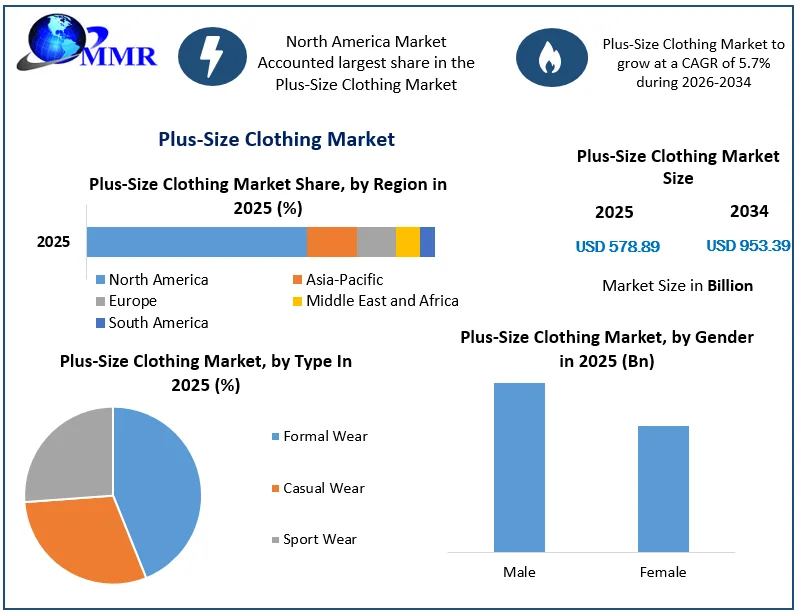
Global Plus-Size Clothing Market size was valued at USD 578.89 Billion in 2025 and the total Global Plus-Size Clothing revenue is expected to grow at 5.7% from 2026 to 2034, reaching nearly USD 953.39 Billion.
Plus-size clothing is extended sizes or full-figure clothing, which refers to clothing specifically designed and tailored for people who wear larger sizes, and its range starts from US size 12 and above. Plus-size clothing includes a wide range of garments, such as tops, dresses, skirts, pants, jeans, jackets, lingerie, swimwear, and activewear.
Plus-Size Clothing Market Growth and Share Analysis
To know about the Research Methodology :- Request Free Sample Report
According to the MMR analysis, it is estimated that more than 3.1 billion people are users of plus-size clothing. The reason for such huge demand are factors such as increasing body positivity, the recognition of diverse body types, and the growing availability of inclusive sizing options. The plus-size clothing market is segmented by type, Age Group, and pricing, with a focus on categories such as casual wear, formal wear, sportswear, and others. Key players in the market such as H&M, Ralph Lauren Corporation, Adidas, Puma, Nike, ASOS, Under Armour, LINING, and ANTA include global and local brands, and the market is witnessing the rising adoption of strategies by these players to cater to the evolving demands of consumers.
The United States leads the global plus-size clothing market with a significant share of 38.9% in 2023. The market is expected to witness substantial growth in regions such as Asia Pacific and North America, with a focus on segments including tops, jeans and trousers, tees and t-shirts, innerwear, dresses and jumpsuits, jackets and outerwear, swimwear, activewear, and loungewear.
Plus-Size Clothing Market Dynamics:
Increasing Body Positivity Movement and Awareness to Drive the Plus-Size Clothing Market Growth
The overweight and obese population is the primary driver for the market growth. There has been a significant shift in societal attitudes toward accepting and celebrating diverse body types. This change has led to a rise in body-positive messaging and advocacy, encouraging individuals to embrace their bodies and demanding inclusive and fashionable clothing options. Strong fashion advertisements and promotional campaigns trend to drive the demand for Plus-Size Clothing.
The visibility and influence of these movements have contributed to increased awareness and demand for plus-size clothing and are expected to boost the Plus-Size Clothing Market. In addition, it has been observed that wearing oversized clothing improves body positivity and confidence among female consumers, due to which the potential sales of plus-size clothing have captured the larger market share during the forecast period.
The Growing Trend of Obesity is A Significant Driver of the Plus-Size Clothing Market
The dominance of obesity and overweight has led to an increased demand for plus-size clothing, as a larger population seeks apparel that fits and flatters their body types. In the United States, 42- 45% of U.S. adults are obese, approximately 20.7% of children ages 6–11 years and 22.2% of adolescents ages 12–19 years have obesity, and approximately 9.2% of adults ages 20 and over severe obesity.
Additionally, the desire for plus-size apparel that represents the most recent fashion trends has contributed to the Plus-Size Clothing market growth. The United States leads the market, with the largest obese population. The rising obesity rates in the Asia-Pacific region are followed by China, which captures a substantial share of 20- 23% in the global plus-size clothing market. Increasing body confidence of plus-size individuals has driven the market and the growing plus-size fashion trend, which has encouraged the growth of the market. The rising overweight and obesity among people is a key factor driving the growth of the plus-size clothing market.
Limited Availability of Fashion-Forward Options to Restrain the Market
Plus-size clothing is associated with basic, shapeless designs, lacking the trendy styles often found in standard sizes. This gap in fashionable plus-size offerings is due to frustration and dissatisfaction among plus-size consumers who desire the same level of variety and style as those available in straight sizes. Brands and retailers need to invest in design innovation and stay updated with the latest fashion trends to bridge this gap. With such a wider range of fashionable options, including on-trend designs, prints, and cuts, brands pose a major challenge for the Plus-Size Clothing Market growth.
Plus-Size Clothing Market Key Growth Trends
1. Body Positivity and Inclusive Marketing
2. Collaboration with Plus-Size Influencers and Celebrities
3. Rise of Size-Inclusive Fashion Brands
4. Online Personal Styling and Subscription Services
5. Sustainable and Ethical Practices
Plus-Size Clothing Market Segment Analysis:
Based on Age Group, the 16 to 59-year segment accounts largest Plus-Size Clothing Market share in 2025 and is expected to grow at a significant CAGR during the forecast period. The plus size segment of the clothing market contains several brands that offer sizes 18 and above, either as part of a core or specialist range. For instance, expenditure on all adult1 clothing, sized 18+ for women and XXL+ for men 42+ inches in the waist, 50+ inches in the chest, or 34 plus inches in the leg length. Includes items sold in a specifically designed range, such as ASOS Curve or F&F True, or as part of a core clothing line at the likes of M&S or River Island. Also, clothing retailers who exclusively serve the plus size customer often start at size 14 and offer up to size 36. Male plus size specialists and female plus size specialist key players such as Evans, Simplybe, Yours Clothing, Curvisa, and Navabi.
By Type, the casual plus-size clothing segment held the approx. 45.5% of Plus-Size Clothing Market share in 2025 and is expected to grow at a significant CAGR during the forecast period. The huge adoption and acceptance of casual wear among consumers due to social occasions is a responsible factor for the casual plus-size clothing growth. Also, with the increase in the plus-size millennial generation, demand for comfort and smart casual clothing is gaining popularity for the plus size clothing. The changes in consumer style and preferences and demand for athleisure sportswear plus size clothing are expected to drive growth.
By Gender, the Female segment dominates the Plus-Size Clothing Market share with 50.1 % in 2025. The segment growth is driven by the highly obese male population globally. Plus size clothing features such as providing comfort and a positive feel due to its various brands and variety of popularity is a key drivers for the segment growth. The growth of the fashion and cosmetics industries is expected to boost market growth.
Plus-Size Clothing Market Regional Insights:
North America Holds a Significant Revenue Share in the Plus-Size Clothing Market
The plus-size clothing market in North America is experiencing significant growth. In 2025, the U.S. women plus-size clothing market was valued at USD 163.03 billion, and the global plus-size women clothing market generated revenue of around USD 182.6 billion, with an expected CAGR of over 4-5%. North America held the largest market share in 2025, and the U.S. leads the market with the largest obese population, in Canada 30% of children and 26.8% of Canadians aged 18 and older were also in this category, and the main factor that drives the plus-size clothing market.
The plus-size clothing market is heavily influenced by the Asia-Pacific region, which is projected to dominate the global plus-size clothing market during the course of the forecast period. Providing chances for businesses to increase their contributions and meet changing customer needs. As of 2025, Japan has a 10% market share in plus-size clothes, while China holds a substantial 18.3% of the plus-size clothing market. Thanks to plus-size people's rising body confidence and the plus-size design trend, which has fueled the plus-size clothing market growth.
In the United Kingdom, the plus-size clothing industry held around 12-14% market share in 2025. The market is also influenced by evolving fashion awareness, an increasing acceptance of diverse body types, and highlighting body positivity. The presence of diverse plus-size brands like ASOS Curve, MANGO, and PUMA SE, having a robust retail infrastructure, and thriving e-commerce platforms strengthened the plus-size clothing market share in the Europe region.
Competitive Landscapes:
The Plus-Size Clothing Market is highly competitive with several key players, each employing distinct strategies to capture a share of the growing demand for inclusive fashion.
1. Lane Bryant stands out for its diverse range of sizes and styles, emphasizing inclusivity and body positivity. Torrid targets a younger demographic with trendy offerings and a strong online presence.
2. ASOS Curve differentiates itself through global reach and collaborations with renowned designers. Eloquii focuses on stylish options for curvy women, emphasizing body positivity and inclusivity. Simply be prioritizes product diversity and community engagement through social media.
These brands navigate a dynamic market driven by shifting attitudes, body positivity movements, and the need for inclusive fashion, leading to intense competition and a constant drive for innovation.
Plus-Size Clothing Market Recent Development
| Date | Company | Development | Impact |
| 14 May 2025 | JCPenney | JCPenney launched an exclusive plus-size collection in collaboration with model Ashley Graham, introducing dedicated apparel sizing across sizes 12–24. | The launch significantly expands inclusive retail fashion access across both physical store channels and digital e-commerce platforms. |
| 18 October 2025 | Parfait Pluss | Parfait Pluss launched a dedicated plus-size lifestyle and fashion marketplace in India. | The platform addresses a major structural void in size-inclusive fashion by delivering curated wellness and apparel options to underserved Asian markets. |
| 12 February 2025 | Lucy and Yak | Lucy and Yak partnered with True Fit to integrate AI-driven sizing data across its e-commerce network. | The integration utilizes data from 82 million shoppers to optimize fit recommendations and lower product return rates for plus-size apparel. |
| 15 March 2025 | Anthropologie | Anthropologie collaborated with size-inclusive brand Universal Standard to introduce an expanded spring apparel collection. | The partnership bridges high-end designer retail with extended size availability across mainstream distribution channels. |
Plus-Size Clothing Market Scope: Inquire before buying
| Plus-Size Clothing Market | |||
|---|---|---|---|
| Report Coverage | Details | ||
| Base Year: | 2025 | Forecast Period: | 2026-2034 |
| Historical Data: | 2020 to 2025 | Market Size in 2025: | USD 578.89 Bn |
| Forecast Period 2026 to 2034 CAGR: | 5.7% | Market Size in 2034: | USD 953.39 Bn |
| Segments Covered: | by Age Group | Below 15 years Age 16 to 59 years Age 60 and Above |
|
| by Type | Formal Wear Casual Wear Sport Wear |
||
| by Price Range | Economy Mid-Range Premium |
||
| by Gender | Male Female |
||
| by Distribution Channel | Offline Sales Online Sales |
||
Plus-Size Clothing Market, by Region
North America (United States, Canada and Mexico)
Europe (UK, France, Germany, Italy, Spain, Sweden, Austria and Rest of Europe)
Asia Pacific (China, South Korea, Japan, India, Australia, Indonesia, Malaysia, Vietnam, Taiwan, Bangladesh, Pakistan and Rest of APAC)
South America (Brazil, Argentina Rest of South America)
Middle East & Africa (South Africa, GCC, Egypt, Nigeria and Rest of ME&A)
Plus-Size Clothing Market Key Players:
Plus-sized Clothing is a segment in the clothing industry whose products are designed and made to cater to people with a larger frame of body, beginning from a US size 12 or 16 up to 3X, 6X, and more.
| Company Name | Headquarters | Core Competencies |
| Torrid Holdings Inc. | City of Industry, California, USA | Women's plus-size apparel, intimates, and accessories |
| Lane Bryant | Mahwah, New Jersey, USA | Women's plus-size apparel, lingerie, and activewear |
| Ashley Stewart, Inc. | Secaucus, New Jersey, USA | Women's plus-size fashion apparel and accessories |
| Old Navy, LLC | San Francisco, California, USA | Inclusive-size casual apparel and family fashion |
| Hanesbrands Inc. | Winston-Salem, North Carolina, USA | Plus-size innerwear, basics, and activewear |
| Nike, Inc. | Beaverton, Oregon, USA | Plus-size sportswear and athletic apparel |
| Under Armour, Inc. | Baltimore, Maryland, USA | Performance apparel and plus-size activewear |
| Ralph Lauren Corporation | New York, New York, USA | Premium fashion and extended-size apparel |
| H & M Hennes & Mauritz AB | Stockholm, Sweden | Plus-size fashion collections and apparel |
| Inditex S.A. | Arteixo, Spain | Zara extended-size apparel and global fashion retail |
| ASOS plc | London, United Kingdom | ASOS Curve plus-size fashion and e-commerce |
| Mango MNG Holding, S.L. | Barcelona, Spain | Plus-size fashion collections and womenswear |
| Adidas AG | Herzogenaurach, Germany | Inclusive-size sportswear and athleisure |
| PUMA SE | Herzogenaurach, Germany | Performance apparel and plus-size activewear |
| Universal Standard Inc. | New York, New York, USA | Inclusive and plus-size apparel across a broad size range |
Frequently Asked Questions:
1. What are the growth drivers for the market?
Ans. The increased size of body moment and plus-size fashion trend are expected to drive market growth are expected to be the major drivers for the Plus-Size Clothing market.
2. Which region is expected to lead the global Market during the forecast period?
Ans. North America is expected to lead the global Market during the forecast period.
3. What is the projected market size and growth rate of the Market?
Ans. The Market size was valued at USD 578.89 Billion in 2025 and the total Plus-Size Clothing revenue is expected to grow at a CAGR of 5.7% from 2026 to 2034, reaching nearly USD 953.39 Billion by 2034.
4. What segments are covered in the Market report?
Ans. The segments covered in the Market report are Type, End-use, and Region.
5. What is the study period of the Plus-Size Clothing Market?
Ans: The Global Market is studied from 2020 to 2034