
Hydrogen Tank Material Market Size – Industry Structure Evaluation, Demand Drivers Analysis, Regional Growth Analysis and Identification, Competitive Positioning Review & Global Market Size Forecast to 2030
Overview
The Hydrogen Tank Material Market Industry size was valued at USD 1013.43 Mn. In 2023, the Hydrogen Tank Material revenue is expected to grow by 22.1 % from 2024 to 2030, reaching nearly USD 4100.18 Mn.
Hydrogen Tank Material Market Overview:
Hydrogen has been recognized as the superior option for the future energy industry because of its unlimited supply, zero-emission of greenhouse gases, and high energy efficiency. The increasing demand for hydrogen fuel is boosting the growth of the hydrogen tank material market. Advancements in materials and technologies are enabling the development of lightweight, high-performance tanks that can store larger amounts of hydrogen. This trend is driving investments and collaborations in the industry, leading to the commercialization of innovative tank materials and the expansion of the hydrogen economy. To support the widespread adoption of hydrogen as an energy carrier, infrastructure development is playing an important part. This includes the establishment of hydrogen refueling stations, distribution networks, and storage facilities. The construction of these infrastructures requires suitable tank materials, stimulating the growth of the hydrogen tank material market.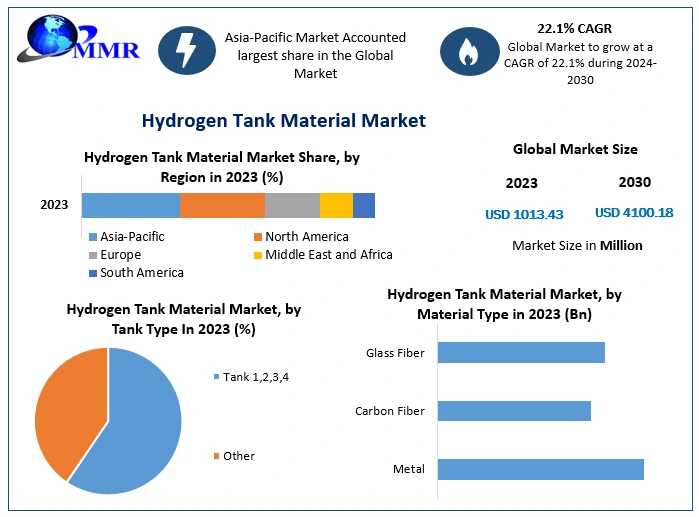 To know about the Research Methodology :- Request Free Sample Report
Hydrogen Tank Material Market Dynamics:
Drivers
Increasing Demand for Hydrogen Fuel Boosts the Market Growth
The demand for Hydrogen fuel is rapidly growing which significantly boosts the Market for Hydrogen Tank Material. Due to being clean and sustainable, with high energy and no carbon emissions Hydrogen fuel is becoming popular nowadays. To focus on building infrastructure for the production, storage, and distribution of the use of hydrogen as a fuel. One important part of this infrastructure is hydrogen storage tanks. These tanks store hydrogen safely and efficiently, ensuring it is available when needed. The materials used in making hydrogen tanks are essential for their performance, and safety. With the increasing demand for hydrogen fuel, there is a need for superior tank materials that can offer improved performance. Advances in material science and engineering technology are driving the development of new materials specifically designed for storing hydrogen.
Growing Automotive Industry Drives Market Growth
The growing automotive industry has a positive impact on the Hydrogen Tank Material Market
Nowadays, the automotive industry expanding rapidly, and more and more high-technology vehicles are being manufactured and purchased by consumers. The automotive industry is developing hydrogen power vehicles such as cars, and trucks. These vehicles use hydrogen as a fuel source instead of diesel. To store hydrogen in these vehicles, specialized tanks are required. With the increasing demand for hydrogen-powered vehicles, the need for hydrogen tanks is also growing. As a result, the hydrogen tank material market is experiencing growth and expansion. The growth in the automotive industry has led to advancements in hydrogen tank materials. This growth in the hydrogen tank material market is crucial for the widespread adoption of hydrogen-powered vehicles.
Restrain
High Cost Associated with the Material Restrains Market Growth
Hydrogen tanks need to meet specific requirements such as high strength, lightweight, and compatibility with hydrogen gas. While materials like carbon fiber composites and advanced metals offer excellent properties for hydrogen storage, they can be expensive to produce, resulting in higher overall costs for hydrogen storage systems.
The hydrogen tank material market is facing a problem because the materials used to make hydrogen tanks are quite expensive. This high cost makes it difficult for the market to grow and expand. Materials of hydrogen tanks are costly, so it increases the overall production cost of hydrogen tanks, which makes them less affordable for customers. As a result, fewer people are investing in the hydrogen tanks industry, which hampers the growth of the market. Lower demand leads to slower progress in developing and improving hydrogen tank technologies. Therefore, the high cost associated with materials is a barrier preventing the hydrogen tank material market from flourishing.
Opportunity
Emergence of Lightweight Composite Material-Based Hydrogen Tanks Create Lucrative Growth Opportunities for the Market Growth.
Hydrogen tanks are made from heavy materials like steel, which can make the tanks bulky and less efficient. However, Due to advancements in technology, the emergence of lightweight composite materials has largely been utilized. This material is strong as well as light. These materials are specially designed to store and transport hydrogen safely.
The use of lightweight composite materials in hydrogen tanks offers several benefits, such as they are lighter in weight compared to traditional materials, which means that vehicles or devices using these tanks can be more fuel-efficient. This is because less energy is required to move a lighter tank, resulting in improved performance and longer driving ranges for vehicles powered by hydrogen. Also, lightweight composite materials provide better safety features. The increasing demand for hydrogen as a clean and renewable energy source creates ample growth opportunities for hydrogen tank materials. For powering vehicles, generating electricity, and storing energy. Hydrogen is considered an important fuel. As the use of hydrogen continues to grow, there will be a greater need for efficient and safe storage solutions, driving the demand for lightweight composite materials for hydrogen tanks.
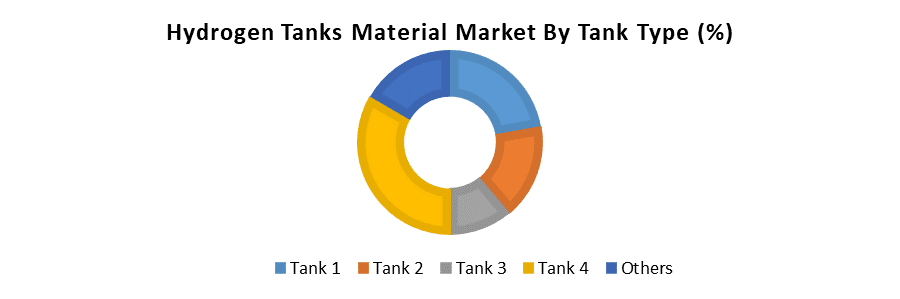
Based on Tank Type, The type 4 hydrogen tank segment dominated the Hydrogen Tank Material Market in the year 2023. Type 4 hydrogen tanks utilize a composite structure consisting of a non-metallic liner and composite materials. They are designed to be lightweight and have a higher hydrogen storage capacity compared to Type 1 tanks. Composite tanks such as carbon fiber with a polymer liner (thermoplastic).Rotational molding and fiber-reinforced plastic. Type 4 hydrogen tanks have an approximate maximum pressure of 700 bars.
Type 4 hydrogen tanks are light and store more volume of gas as compared to other types of tanks therefore demand for type 4 hydrogen tanks is rapidly rising. Due to their lightweight nature, type 4 tanks exhibit high strength because of the composite materials used in their construction. The combination of strength and lightness makes type 4 tanks suitable for various applications, including automotive, aerospace, and portable systems. Therefore it is the fastest-growing segment.
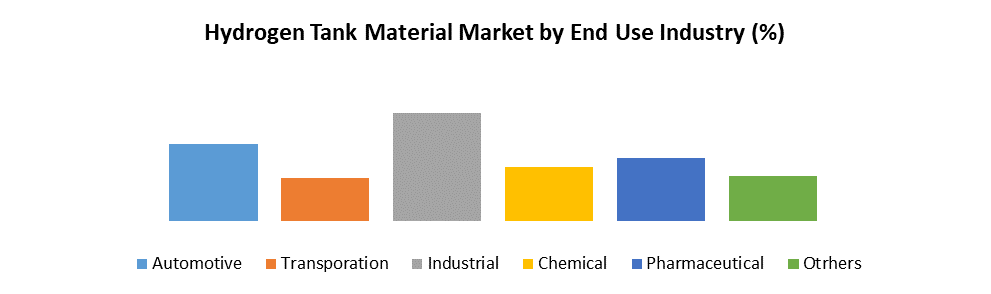
 Based on the End Use, The industrial sector dominates the market in the year 2023. Industries such as petroleum refining, metal production, and chemical manufacturing rely on hydrogen for various processes. Large-scale industrial need strong and dependable storage systems, like tanks, to store hydrogen. Different metal materials such as steel, aluminum, and composites are used to build these tanks. Hydrogen has many uses in industrial manufacturing, including the production of fertilizers, pharmaceuticals, and synthetic materials.
The Hydrogen fuel cells are also becoming popular as a clean and efficient power source for industrial machinery. Hydrogen tanks are essential in these applications as they store and deliver hydrogen for manufacturing processes. They are especially important in refining operations, where hydrogen is used to improve the quality of iron and steel production and enhance the mechanical properties of metals through annealing and heat treatment. Hydrogen tanks ensure the safe storage and delivery of hydrogen in metal production facilities.
 Regional Insights
Asia Pacific dominates the global Hydrogen Tank Material Market in the year 2023. The particularly countries like Japan and South Korea have been at the forefront of fuel cell technology and hydrogen infrastructure development. Japan has a strong focus on hydrogen-powered vehicles and aims to become a leading hydrogen society. South Korea has ambitious hydrogen roadmaps and is actively investing in hydrogen technologies. These countries have been utilizing CFRP and other lightweight materials in their hydrogen tanks. Additionally, China has been increasing its efforts in the hydrogen sector, with significant investments in fuel cell vehicles and infrastructure. The presence of major automotive manufacturers, energy companies, and government initiatives promoting clean energy. Composite materials, such as carbon fiber-reinforced polymer (CFRP) and glass fiber-reinforced polymer (GFRP), are commonly used in hydrogen tanks due to their lightweight and high-strength properties. This factor significantly drives the market growth in the Asia Pacific region
Hydrogen Tank Material Market Scope: Inquire before buying
| Hydrogen Tank Material Market | |||
|---|---|---|---|
| Report Coverage | Details | ||
| Base Year: | 2023 | Forecast Period: | 2024-2030 |
| Historical Data: | 2018 to 2023 | Market Size in 2023: | US$ 1013.43 Mn. |
| Forecast Period 2024 to 2030 CAGR: | 22.1% | Market Size in 2030: | US$ 4100.18 Mn. |
| Segments Covered: | by Material Type | Metal Carbon Fiber Glass Fiber |
|
| by Tank Type | Tank 1,2,3,4 Other |
||
| by End Use Industry | Automotive Transportation Industrial Chemical Pharmaceutical Others |
||
Hydrogen Tank Material Market by Region
North America (United States, Canada, and Mexico)
Europe (UK, France, Germany, Italy, Spain, Sweden, Austria, and the Rest of Europe)
Asia Pacific (China, South Korea, Japan, India, Australia, Indonesia, Malaysia, Vietnam, Taiwan, Bangladesh, Pakistan, and the Rest of APAC)
Middle East and Africa (South Africa, GCC, Egypt, Nigeria, and the Rest of ME&A)
South America (Brazil, Argentina Rest of South America)
Key Players
1. Worthington Industries Inc.
2. Luxfer Gas Cylinders
3. Hexagon Composites ASA
4. Quantum Fuel Systems LLC.
5. Faber Italy
6. Toyota Motor Corporation
7. Mitsubishi Chemical Corporation
8. Everest Kanto Cylinders Ltd.
9. Avanco Group
10. Praxair Technology, Inc.
11. NPROXX
12. Tenaris
13. Pragma Industries
14. Plastic Omnium
15. Umoe Advanced Composites.
Frequently Asked Questions:
1] What segments are covered in the Global Hydrogen Tank Material Market report?
Ans. The segments covered in the Hydrogen Tank Material Market report are based on Material Type, Tank Type, End-use Industry, and Region.
2] Which region is expected to hold the highest share in the Global Hydrogen Tank Material market?
Ans. The Asia Pacific region is expected to hold the highest share of the Hydrogen Tank Material Market.
3] What is the market size of the Global Hydrogen Tank Material Market by 2030?
Ans. The market size of the Hydrogen Tank Material Market by 2030 is expected to reach US$ 4100.18 Mn.
4] What is the forecast period for the Global Hydrogen Tank Material Market?
Ans. The forecast period for the Hydrogen Tank Material Market is 2024-2030.
5] What was the market size of the Global Hydrogen Tank Material Market in 2023?
Ans. The market size of the Hydrogen Tank Material Market in 2023 was valued at US$ 1013.43 Mn.