
Private Cloud Market by Service Model, Deployment Model, Organization Size, Verticals, Region – Global Market Size Estimation, Industry-Wide Analysis, Competitive Landscape Assessment & Long-Term Forecast to 2032
Overview
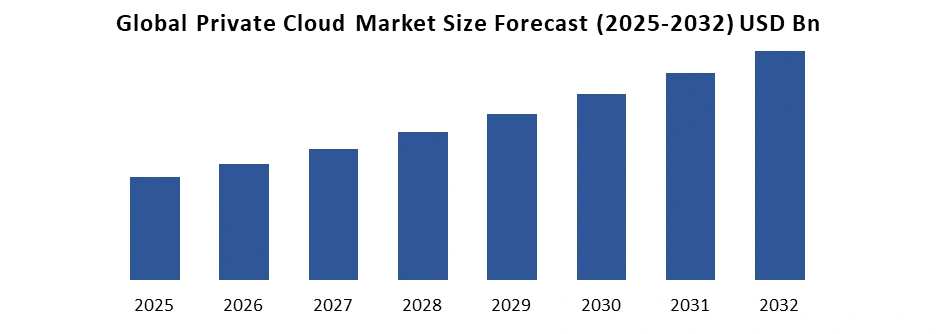
Global Private Cloud Market is valued at USD 186.69 billion in 2025, and is expected to reach USD 345.68 billion by 2032, growing at a strong CAGR of 9.2%, supported by hybrid cloud adoption, enterprise-scale investments, and accelerating digital transformation worldwide.
AI-Driven Workloads Propel Global Private Cloud Market
A Private Cloud is a dedicated cloud computing environment used by a single organization, offering exclusive control over servers, storage, and networking. It is deployed on-premises or hosted by a third-party provider and is designed to deliver higher data security, privacy, regulatory compliance, and performance than public clouds, making it ideal for BFSI, healthcare, government, and AI-driven workloads. Cybersecurity risks, including nearly 10,000 annual EU cyberattacks and 32,211 U.S. federal incidents in FY2023, reinforce demand. North America leads adoption, Europe remains compliance-driven, and Asia Pacific is the fastest-growing region, supported by major government investments. High infrastructure costs continue to limit SME adoption, while large enterprises drive market growth across SaaS, IaaS, and PaaS private cloud solutions.
Key Highlights:
• Cybersecurity and Financial Risk: U.S. federal agencies reported 32,211 security incidents in FY2023, and the EU faced nearly 10,000 annual cyberattacks. Average global breach costs of USD 4.45 million drive private cloud adoption.
• SME Adoption Constraints: High infrastructure costs limit SME adoption, while large enterprises leverage scale to deploy SaaS, IaaS, and PaaS within hybrid frameworks.
• Regional Enterprise Integration: North America leads adoption with mature IT infrastructure & strict regulatory compliance; Europe focuses on compliance; Asia Pacific grows rapidly via digitalisation; MEA & Latin America expand through government initiatives.
• Vendor Backlog and Market Dynamics: AWS holds USD 200 Billion infrastructure backlog, Microsoft Azure nearly 20%, and Google Cloud USD 157.7 Billion, reflecting large-scale AI-enabled hybrid cloud investments shaping the market forecast.
AI-Driven Growth Shapes Global Private Cloud Market
The Global Private Cloud Market is rapidly growing as enterprises shift AI and generative AI workloads to private clouds for secure computing, regulatory compliance, and operational efficiency. BFSI, healthcare, and government sectors prioritize data sovereignty and low-latency analytics. Private clouds reduce public cloud costs and optimize compute for AI workloads, while hybrid architectures allocate tasks based on performance and compliance. Enterprise solutions provide predictable costs, enhanced security, and workload optimization.
To know about the Research Methodology :- Request Free Sample Report
Data Security and Compliance Drive Global Private Cloud Market
Data security, privacy, and regulatory compliance are key drivers of the Global Private Cloud Market. The EU faces nearly 10,000 cyberattacks annually, and U.S. federal agencies reported 32,211 security incidents in FY2023, with global data breach costs averaging USD 4.45 million per incident. BFSI, healthcare, and government sectors deploy private clouds for jurisdictional control, auditability, and security. Adoption is strongest in North America and Europe, with Asia Pacific growing due to regulatory enforcement and digitalization, driving enterprise uptake of SaaS, IaaS, and PaaS private cloud solutions within hybrid frameworks.
Emerging Investments Boost Growth Opportunities in Private Cloud Market
Asia Pacific is a high-growth Private Cloud Market region, driven by government-backed digital transformation and infrastructure investments. Thailand allocated 90.9 billion baht (nearly USD 2.7B) and Malaysia 71.1 billion ringgit (nearly USD 16.06B) for cloud, AI, and ICT projects through 2030. These initiatives support secure, compliance-focused private clouds for BFSI, healthcare, and government sectors, while cloud-first strategies and hybrid deployments accelerate adoption of SaaS, IaaS, and PaaS solutions.
High Infrastructure Costs Shape Global Private Cloud Market
High initial infrastructure costs restrain Global Private Cloud Market growth, particularly for SMEs and emerging markets. On-premises deployments require substantial capital for servers, storage, networking, power, cooling, and secure facilities. Official ICT investment data confirm these costs remain a structural component of enterprise fixed capital. Legacy system integration further increases total ownership costs. Large enterprises can amortize investments across scale, but SMEs face financing and infrastructure constraints.
Segmentation by Service and Deployment Model
Global Private Cloud Market is driven by enterprises prioritizing secure private cloud computing, compliance, and hybrid cloud adoption. According to MMR, 45.2% of EU enterprises purchased cloud services, with 95.8% adopting SaaS Private Cloud, 74.2% IaaS Private Cloud, and 26.1% PaaS Private Cloud. The government-backed digitalisation and infrastructure investments drive the Private Cloud Market Growth.
Segmentation Key Points:
• SaaS-led adoption dominates enterprises.
• Hybrid cloud adoption for workload optimization.
• Asia Pacific fastest-growing region.
• Compliance drives Europe private cloud demand.
• High initial costs constrain SMEs.

Recent Developments
AWS introduced AWS Interconnect - multicloud (preview), enabling secure, high-bandwidth private connections between VPCs and external clouds, supporting hybrid cloud services while maintaining isolation from the public internet. Microsoft expanded Sovereign Private Cloud in Europe, offering region-restricted administrative access, customer-managed encryption keys, and Microsoft 365 Local deployments. These developments emphasize interoperability, sovereignty, and workload control, reflecting Private Cloud Market growth trends and reinforcing adoption of IaaS, PaaS, and SaaS Private Cloud solutions.
Competitive Landscape
As of 2025:
• AWS Private Cloud: Nearly 30% market share, USD 200B infrastructure backlog
• Microsoft Azure: Nearly 20% market share, strong enterprise integration
• Google Cloud: Nearly 13% market share, USD 157.7B backlog, AI/data analytics focus
Other providers (IBM, Oracle, Alibaba) hold <10% each, focusing on region-specific and regulated deployments. Competitive advantage relies on AI integration, hybrid orchestration, and infrastructure scale, shaping Global Private Cloud Market size and forecast.
Regional Insights
• North America Private Cloud Market: Highest enterprise integration, mature IT infrastructure, leading Private Cloud Market share
• Europe: 45.2% of EU enterprises use cloud; adoption highest among large enterprises (77.6%), countries like Finland (78.3%), Sweden (71.6%), Denmark (69.5%), driving Government Private Cloud for compliance
• Asia Pacific: Fastest growth due to digitalization and hybrid cloud adoption
• MEA & Latin America: Emerging markets expanding from a lower base, supported by government initiatives
These dynamics underpin Global Private Cloud Market size and forecast, with adoption strongest where regulatory pressure, enterprise scale, and digital transformation intensity converge.
Private Cloud Market Scope: Inquire before buying
| Private Cloud Market | |||
|---|---|---|---|
| Report Coverage | Details | ||
| Base Year: | 2025 | Forecast Period: | 2026-2032 |
| Historical Data: | 2020 to 2025 | Market Size in 2025: | USD 186.69 Bn. |
| Forecast Period 2026 to 2032 CAGR: | 9.2% | Market Size in 2032: | USD 345.68 Bn. |
| Segments Covered: | by Service Model | Infrastructure as a Service (IaaS) Platform as a Service (PaaS) Software as a service (SaaS) |
|
| by Deployment Model | Virtual Private Cloud Hosted private cloud Managed private cloud |
||
| by Organization Size | Small and Medium-sized Enterprises (SMEs) Large Enterprises |
||
| by Verticals | Banking, Financial Services, and Insurance (BFSI) Telecommunications IT and ITeS Government and Public Sector Retail and Consumer Goods Manufacturing Energy and Utilities Media and Entertainment Healthcare and Life Sciences Others (education, travel and hospitality, and transportation and logistics) |
||
Private Cloud Market, by Region
North America (United States, Canada and Mexico)
Europe (UK, France, Germany, Italy, Spain, Sweden, Austria and Rest of Europe)
Asia Pacific (China, South Korea, Japan, India, Australia, Indonesia, Malaysia, Vietnam, Taiwan, Bangladesh, Pakistan and Rest of APAC)
Middle East and Africa (South Africa, GCC, Egypt, Nigeria and Rest of ME&A)
South America (Brazil, Argentina Rest of South America)
Private Cloud Market, Key Players
1. Cisco Systems, Inc
2. AWS
3. Google
4. Dell
5. HPE
6. IBM
7. OpenStack
8. Microsoft
9. VMware (Broadcom)
10. Oracle
11. Rackspace
12. Alibaba Cloud
13. Lumen Technologies, Inc.
14. Fujitsu Cloud
15. Tata Communications
16. OVHcloud
17. Red Hat (IBM subsidiary)
18. Nutanix
19. SAP Cloud Infrastructure
20. Akamai
21. Others
FAQs
Q1. What are the primary growth drivers of the Global Private Cloud Market?
A: The Global Private Cloud Market is driven by AI and generative AI workloads, increasing cybersecurity incidents, stringent regulatory compliance requirements, and accelerating hybrid cloud adoption across regulated industries.
Q2. Why are BFSI, healthcare, and government sectors leading private cloud adoption?
A: These sectors prioritize private cloud deployments to maintain data sovereignty, ensure auditability, meet regulatory mandates, and securely process sensitive and AI-intensive workloads.
Q3. Which region is expected to grow fastest in the Private Cloud Market?
A: Asia Pacific is the fastest-growing region due to government-funded digital transformation programs, large-scale cloud and AI investments, and expanding hybrid cloud infrastructure.
Q4. What is the key restraint impacting Private Cloud Market adoption?
A: High initial infrastructure costs related to servers, storage, networking, power, cooling, and legacy system integration remain a significant barrier, particularly for SMEs.
Q5. How does the competitive landscape influence Market expansion?
A: Market expansion is shaped by large vendor infrastructure backlogs, AI-enabled hybrid cloud capabilities, and sovereign cloud offerings led by AWS, Microsoft, and Google.