
Power Electronics Market by Device Type, Material, Voltage, End-User and Region – Global Market Size Estimation, Industry-Wide Analysis, Competitive Landscape Assessment & Long-Term Forecast to 2032
Overview
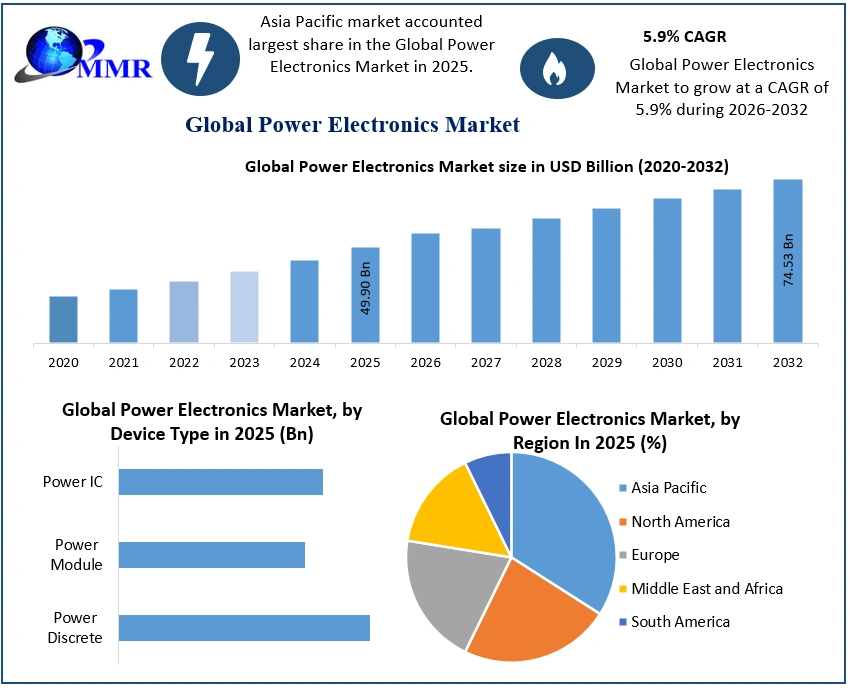
The Power Electronics Market size was valued at USD 49.90 Billion in 2025 and the total Power Electronics revenue is expected to grow at a CAGR of 5.9% from 2026 to 2032, reaching nearly USD 74.53 Billion by 2032.
Power Electronics Market Overview
Power electronics is a branch of electrical engineering that deals with the conversion, control, and management of electrical power. It involves the study and application of solid-state electronics to control the flow of electrical energy for various purposes, including conversion between different voltage and current levels, frequency conversion, and power conditioning. Key components of power electronics systems include power semiconductor devices such as diodes, transistors, thyristors, and integrated circuits, as well as passive components like capacitors and inductors. These components are used to design circuits and systems for applications such as power supplies, motor drives, renewable energy systems (such as solar inverters and wind turbine converters), electric vehicles, and many others.
The increasing adoption of renewable energy sources such as solar and wind power has boosted the demand for power electronics systems for inverters, converters, and energy storage systems, which is expected to boost the Power Electronics Market growth. Power electronics facilitate the efficient conversion of DC power generated by renewables into AC power suitable for grid integration. The consumer electronics market continues to drive demand for power electronics components such as voltage regulators, DC-DC converters, and battery charging solutions. The proliferation of smartphones, tablets, laptops, and wearable devices requires efficient power management to extend battery life and improve performance. Power electronics technologies are essential for the development of smart grids, which enable bidirectional power flow, demand response, and integration of distributed energy resources. Energy storage systems, including batteries and supercapacitors, rely on power electronics for efficient energy conversion and management.
To know about the Research Methodology :- Request Free Sample Report
Power Electronics Market Dynamics
Renewable Energy Integration to boost Power Electronics Market growth
The increasing integration of renewable energy sources such as solar and wind power into the grid significantly drives the Power Electronics Market growth. Power electronics play a crucial role in converting the variable DC output of renewable energy sources into the stable AC power required for grid compatibility. The global shift towards cleaner and more sustainable energy sources drives demand for inverters, converters, and energy storage systems, spurring growth in the power electronics sector. The rapid electrification of transportation, driven by concerns over environmental pollution and energy security, is another significant driver of the power electronics market. Electric vehicles (EVs) rely on power electronics systems for motor drives, battery management, and on-board chargers. As governments worldwide implement stringent emission regulations and offer incentives for electric vehicle adoption, the demand for power electronics components and systems in the automotive sector continues to surge.
The ongoing trend towards industrial automation and the implementation of Industry 4.0 principles propel demand for power electronics solutions in manufacturing and process industries. Power electronics devices such as motor drives, variable frequency drives (VFDs), and power supplies enable energy-efficient operation, precise control, and automation of industrial processes. The pursuit of increased productivity, energy efficiency, and cost savings drives investment in power electronics technologies across industrial sectors. The development of smart grids and the integration of energy storage systems represent significant opportunities for the power electronics market. Smart grid technologies leverage power electronics for bidirectional power flow, demand response, and integration of renewable energy sources and distributed energy resources. Energy storage systems, including batteries and supercapacitors, rely on power electronics for efficient energy conversion, storage, and management. As governments and utilities worldwide invest in grid modernization and energy storage deployment, the demand for power electronics solutions in this segment is expected to grow rapidly.
Complexity and Integration Challenges to limit Power electronics Market growth
Power electronics systems are inherently complex, involving various components, control algorithms, and integration requirements. Designing, installing, and maintaining these systems is challenging, requiring specialized expertise and engineering resources. Integration challenges arise when combining power electronics with existing infrastructure or other technologies, leading to compatibility issues and performance limitations, which significantly restraints the Power Electronics Market growth. The deployment of power electronics solutions often requires significant upfront investment, especially for large-scale applications such as renewable energy projects, electric vehicle charging infrastructure, and industrial automation systems. High initial capital costs deter potential adopters, particularly in markets with limited financial resources or uncertain returns on investment.
Power electronics components and systems operate reliably under a wide range of operating conditions, including temperature fluctuations, voltage transients, and mechanical stresses. Reliability and durability concerns, such as component failure, thermal management issues, and degradation over time undermine confidence in power electronics solutions, especially in safety-critical applications like automotive and aerospace. Interoperability and standardization play a crucial role in ensuring compatibility and seamless integration of power electronics systems with existing infrastructure and devices. Interoperability issues and lack of standardization across different manufacturers or technologies hinder interoperability, limit product interchangeability, and fragment the Power Electronics market. Standardization efforts and industry collaboration are needed to address these challenges and foster interoperability.
Power Electronics Market Segment Analysis
Based on Material, the market is segmented into Silicon, Silicon Carbide, Gallium Nitride, and Others. Silicon segment dominated the market in 2025 and is expected to hold the largest Power Electronics Market share over the forecast period. Silicon has been the dominant material used in power electronics for several decades due to its well-established manufacturing processes, reliability, and relatively low cost compared to other semiconductor materials. Silicon-based semiconductor devices are the building blocks of power electronics circuits. These devices include diodes, transistors (bipolar junction transistors - BJTs, metal-oxide-semiconductor field-effect transistors - MOSFETs, insulated gate bipolar transistors - IGBTs), thyristors, and integrated circuits (ICs) used for control and protection functions. These devices are used in various power conversion and control applications across industries.
Despite the emergence of SiC and GaN technologies, silicon-based power devices continue to dominate the market due to their cost-effectiveness and reliability. However, the adoption of SiC and GaN devices is growing, particularly in applications where their performance benefits justify the higher cost. The silicon segment remains significant in the power electronics market and is expected to coexist with SiC and GaN technologies for the foreseeable future, catering to a wide range of applications and market segments.
Based on Device Type, the market is segmented into Power Discrete, Power Modules, and Power ICs. The Power ICs segment dominated the market in 2025 and is expected to hold the largest Power Electronics Market share over the forecast period. The "Power ICs" segment in the power electronics industry are integrated circuits (ICs) specifically designed to control, manage, and regulate power within electronic systems. These ICs are compact, highly efficient, and offer advanced functionality for various power management applications. Power ICs play a crucial role in optimizing energy efficiency, improving system reliability, and reducing overall system size and cost. Power ICs integrate multiple power semiconductor devices, control circuits, and protection features into a single chip. They perform a wide range of functions, including voltage regulation, current sensing, switching, protection against overvoltage, overcurrent, and overtemperature conditions, and power factor correction (PFC). Power ICs are designed to meet specific power management requirements in different applications, from low-power consumer electronics to high-power industrial systems, which is expected to boost the Power Electronics Industry growth.
Based on End-user, the market is segmented into ICT, Consumer Electronics, Energy & Power, Industrial, Automotive, Aerospace & Defense, and Others. The consumer Electronics segment dominated the market in 2025 and is expected to hold the largest Power Electronics Market share over the forecast period. Consumer electronics are the application of power electronics technologies in devices and products used by consumers for personal, entertainment, and communication purposes. This segment encompasses a wide range of electronic devices commonly found in households, offices, and recreational settings. Consumer demand for smaller, lighter, and more portable devices drives the miniaturization of power electronics components and the integration of power management functions into compact chips. The adoption of wireless charging technology eliminates the need for wired connections and enhances convenience for consumers, driving the integration of wireless charging circuits in smartphones, wearables, and other portable devices.
Power Electronics Industry Ecosystem Power Electronics Market Regional Analysis
Expanding Renewable Energy Sector to boost Asia Pacific Power Electronics Market growth
The APAC region is witnessing rapid growth in the renewable energy sector, particularly in countries with abundant solar and wind resources such as China, India, Japan, and Australia. Power electronics solutions are essential for integrating renewable energy sources into the grid, managing fluctuations in power output, and ensuring grid stability. In India, for instance, the government's ambitious renewable energy targets are driving investments in solar inverters, wind turbine converters, and energy storage systems. The electrification of transportation is a significant driver of the power electronics market in APAC, driven by concerns over air pollution, energy security, and the need to reduce greenhouse gas emissions. Countries like China and Japan are leading the way in electric vehicle (EV) adoption, with supportive policies, incentives, and infrastructure development. This trend fuels demand for power electronics components such as motor drives, battery management systems, and charging infrastructure.
The APAC region is a major consumer electronics market, with countries like China, South Korea, and Japan being key manufacturing hubs and consumer markets. The growing demand for smartphones, tablets, laptops, and other consumer electronics devices drives the need for power electronics components such as voltage regulators, DC-DC converters, and battery management systems, which significantly boost the Asia Pacific Power Electronics Market growth. China, in particular, has a vast consumer electronics market driven by its large population and rising disposable income levels. Governments and utilities in APAC countries are investing in smart grid infrastructure to improve energy efficiency, enhance grid reliability, and integrate renewable energy sources. Power electronics technologies play a crucial role in smart grid applications such as advanced metering infrastructure (AMI), distribution automation, and grid-scale energy storage. Countries like Japan and South Korea are pioneers in smart grid deployment, driving demand for power electronics solutions in these markets.
Power Electronics Market Scope: Inquiry Before Buying
| Global Power Electronics Market | |||
|---|---|---|---|
| Report Coverage | Details | ||
| Base Year: | 2025 | Forecast Period: | 2026-2032 |
| Historical Data: | 2020 to 2025 | Market Size in 2025: | USD 49.90 Bn. |
| Forecast Period 2026 to 2032 CAGR: | 5.9% | Market Size in 2032: | USD 74.53 Bn. |
| Segments Covered: | by Device Type | Power Discrete Power Module Power IC |
|
| by Material | Silicon (Si) Silicon Carbide (SiC) Gallium Nitride (GaN) Others |
||
| by Voltage | Low Voltage Medium Voltage High Voltage |
||
| by End-User | Automotive ICT Industrial Energy & Power Consumer Electronics Aerospace & Defense |
||
Power Electronics Market, by Region
North America (United States, Canada and Mexico)
Europe (UK, France, Germany, Italy, Spain, Sweden, Austria and Rest of Europe)
Asia Pacific (China, South Korea, Japan, India, Australia, Indonesia, Malaysia, Vietnam, Taiwan, and Rest of APAC)
Middle East and Africa (South Africa, GCC, Egypt, Nigeria and Rest of ME&A)
South America (Brazil, Argentina Rest of South America)
Power Electronics Market, Key Players
North America:
1. Infineon Technologies AG
2. Semiconductor Components Industries, LLC
3. STMicroelectronics
4. Mitsubishi Electric Corporation
5. Vishay Intertechnology, Inc.
6. Fuji ElectricCo., Ltd.
7. NXP Semiconductors
8. Renesas Electronics Corporation
9. Texas Instruments Incorporated
10. TOSHIBA CORPORATION
11. ABB
12. Littelfuse, Inc.
13. Analog Devices, Inc.
14. Microchip Technology Inc.
15. ROHM CO., LTD.
16. Semikron
17. Transphorm Inc.
18. Qorvo, Inc
19. Wolfspeed, Inc.
20. Euclid Techlabs
21. Navitas Semiconductor
22. Efficient Power Conversion Corporation.
23. Lubi Electronics.
24. Elcom International Pvt. Ltd.
25. TMEIC.
26. Electronicon System Electric Pvt. Ltd.
27. Hitachi Industrial Products
28. Huawei Digital Power Technologies Co., Ltd.
29. CRRC
30. Samsung Electronics
Frequently asked Questions:
1. What is power electronics?
Ans: Power electronics is a branch of electrical engineering focusing on the conversion, control, and management of electrical power using solid-state electronics components.
2. What are the main applications of power electronics?
Ans: Power electronics finds applications in power supplies, motor drives, renewable energy systems (such as solar inverters and wind turbine converters), electric vehicles, and consumer electronics.
3. What drives the demand for power electronics in the automotive sector?
Ans: The rapid electrification of transportation, driven by environmental concerns and government regulations, leads to increased demand for power electronics systems in electric vehicles for motor drives, battery management, and charging.
4. Which regions are driving the growth of the power electronics market?
Ans: Regions like Asia Pacific witness significant growth due to expanding renewable energy sectors, electrification of transportation, and consumer electronics demand, particularly in countries like China, India, and Japan.
5. What challenges does the power electronics market face?
Ans: Challenges include complexity in system design, integration issues, reliability concerns, and interoperability issues, which require specialized expertise, upfront investment, and industry collaboration to address effectively.