Personal Service Robotics Market Size by Type, Region – Revenue Pool Analysis, Margin Structure Assessment, Capital Flow Trends, Competitive Benchmarking & Forecast to 2032

15.14%
CAGR (2026-2032)
75.39 USD Bn.
Market Size
308
Report Pages
153
Market Tables

Overview

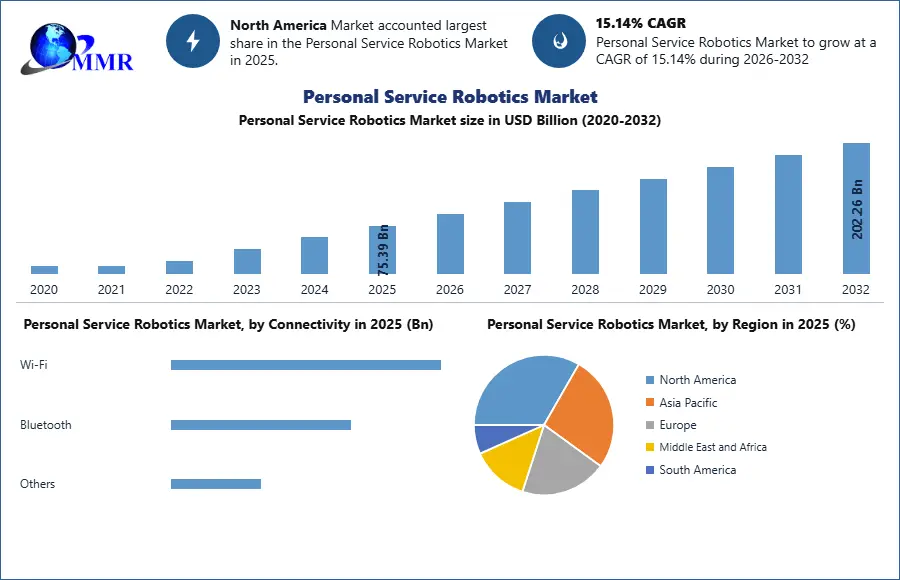
The Personal Service Robotics Market size was valued at USD 75.39 Billion in 2025 and the total Personal Service Robotics revenue is expected to grow at a CAGR of 15.14% from 2025 to 2032, reaching nearly USD 202.26 Billion.

Personal Service Robotics Market Overview:

The Personal Service Robotics Market is witnessing strong growth driven by increasing adoption of smart home technologies, AI-enabled automation, and rising consumer demand for convenience-oriented robotic solutions. Personal service robots are widely used for domestic cleaning, entertainment, elderly assistance, education, and lawn maintenance applications. The growing aging population, rising labor shortages for household services, and increasing awareness regarding smart living solutions are accelerating market expansion globally. Advancements in artificial intelligence, voice recognition, computer vision, and IoT connectivity are improving robot functionality, autonomy, and user interaction capabilities. North America dominates the market due to high smart home penetration and strong consumer spending on intelligent home automation devices. Continuous innovation in autonomous navigation, cloud connectivity, and human-robot interaction technologies is expected to create significant growth opportunities for the Personal Service Robotics Market during the forecast period.
To know about the Research Methodology :- Request Free Sample Report

Personal Service Robotics Market Dynamics

Market Trend – Rising Integration of AI and Smart Home Ecosystems

One of the major trends shaping the Personal Service Robotics Market is the increasing integration of artificial intelligence (AI), IoT connectivity, and smart home ecosystems into personal robotic devices. Consumers are increasingly adopting intelligent robots capable of autonomous navigation, voice interaction, object recognition, and adaptive learning to improve convenience and home automation. Robotic vacuum cleaners, lawn-mowing robots, and companion robots are now integrated with smart assistants such as Amazon Alexa, Google Assistant, and Apple HomeKit for seamless control and automation. Companies are also introducing AI-powered robots capable of understanding user behavior, optimizing cleaning patterns, and delivering personalized interaction experiences. The growing popularity of connected homes and smart appliances is accelerating demand for multifunctional service robots across residential environments. Additionally, advancements in cloud computing, edge AI, and sensor technologies are improving robot efficiency and decision-making capabilities. The increasing focus on contactless services, convenience, and autonomous household management continues to drive innovation within the personal service robotics industry globally.

Growing Aging Population and Demand for Home Assistance

The growing aging population and increasing demand for home assistance solutions are major drivers fueling the growth of the Personal Service Robotics Market. Elderly individuals increasingly require robotic assistance for daily activities, healthcare monitoring, mobility support, and companionship, particularly in developed economies facing labor shortages in caregiving services. Personal service robots help improve quality of life by supporting independent living and reducing dependence on human caregivers. In addition, rising consumer preference for automated household management is increasing adoption of robotic vacuum cleaners, lawn-mowing robots, and smart companion robots. Busy lifestyles, urbanization, and increasing disposable income are encouraging households to invest in intelligent robotic systems that improve convenience and operational efficiency. Healthcare institutions are also deploying assistive robots for rehabilitation and patient support applications. Furthermore, technological advancements in AI, speech recognition, machine vision, and autonomous navigation are significantly improving robotic capabilities, making personal service robots more efficient, affordable, and user-friendly across residential and healthcare environments.

Market Restraint – High Product Costs and Data Privacy Concerns

High product costs and growing concerns regarding data privacy and cybersecurity remain major restraints affecting the growth of the Personal Service Robotics Market. Advanced personal service robots equipped with AI processors, sensors, cameras, voice recognition systems, and cloud connectivity often involve high manufacturing and retail costs, limiting adoption among price-sensitive consumers. In addition, maintenance expenses and software update requirements can increase long-term ownership costs. Consumers are also increasingly concerned about privacy risks associated with robots that continuously collect household data, audio recordings, and visual information through connected sensors and cameras. Potential cybersecurity vulnerabilities and unauthorized data access create trust-related challenges, particularly for AI-powered home assistant robots connected to cloud networks. Furthermore, limited technical awareness and reluctance among elderly users to adopt advanced robotic systems may slow market penetration in certain regions. Regulatory uncertainties regarding AI ethics, data handling, and autonomous decision-making also create operational challenges for manufacturers within the personal robotics industry.

Personal Service Robotics Market Segment Analysis

By Type,  the Domestic Cleaning Robots segment dominates the Personal Service Robotics Market due to increasing consumer demand for automated household cleaning solutions that improve convenience, efficiency, and time management. Robotic vacuum cleaners and floor-cleaning robots are widely adopted across residential households because they provide autonomous cleaning, smart navigation, scheduling capabilities, and app-based remote control functions. Busy lifestyles, urbanization, and growing smart home adoption are significantly accelerating demand for AI-powered cleaning robots globally. Manufacturers are continuously enhancing product performance through machine vision, LiDAR mapping, obstacle detection, and voice assistant integration technologies. In addition, rising consumer awareness regarding hygiene and automated home management is strengthening market growth. The affordability of robotic cleaning systems compared to other personal robots also supports wider adoption across middle-income households. Continuous advancements in battery efficiency, self-charging systems, and AI-based cleaning optimization continue to reinforce the dominance of domestic cleaning robots within the global personal service robotics market.

By Technology, The AI-Powered segment held the largest the Personal Service Robotics Market share due to the increasing integration of artificial intelligence technologies that enable robots to perform autonomous decision-making, adaptive learning, and intelligent human interaction. AI-powered personal robots utilize machine learning, computer vision, speech recognition, and sensor fusion technologies to improve navigation accuracy, task automation, and personalized user experiences. Consumers increasingly prefer intelligent robots capable of understanding voice commands, learning household patterns, and optimizing operational efficiency without constant human intervention. AI technologies also enhance robotic functionality in domestic cleaning, elderly assistance, entertainment, and educational applications. The rapid growth of smart homes and connected devices is significantly accelerating demand for AI-enabled robotic systems integrated with cloud computing and IoT platforms. Additionally, continuous advancements in neural networks, natural language processing, and real-time data analytics are improving robot adaptability and performance. The ability to deliver intelligent automation and enhanced user convenience continues to strengthen the dominance of AI-powered personal service robots globally.

Personal Service Robotics Market Regional Insights

North America dominates the Personal Service Robotics Market due to high smart home adoption, strong consumer spending power, and rapid technological innovation across the United States and Canada. The region has witnessed substantial demand for robotic vacuum cleaners, AI-powered home assistants, lawn-mowing robots, and elderly care robots driven by increasing consumer preference for convenience and home automation solutions. Major robotics and technology companies are actively investing in AI-enabled personal service robots integrated with cloud computing, voice recognition, and IoT connectivity. The growing aging population and rising demand for independent living solutions are also accelerating adoption of assistive robotics in healthcare and residential applications. In addition, North America benefits from strong digital infrastructure, widespread internet penetration, and advanced smart home ecosystems that support seamless robotic integration. Increasing awareness regarding contactless home services and autonomous household management further strengthens market growth. Continuous innovation in machine learning, autonomous navigation, and human-robot interaction technologies continues to position North America as the dominant regional market globally.

Recent Developments

March 2025: iRobot Corporation expanded its AI-enabled Roomba robotic vacuum portfolio with enhanced machine vision, real-time room mapping, and predictive cleaning technologies designed for smart home ecosystems. The company introduced upgraded autonomous navigation systems and personalized cleaning intelligence capable of learning user behavior and optimizing cleaning schedules automatically. iRobot also strengthened integration with voice assistants and connected home platforms to improve user convenience and automation efficiency. The development focused on improving battery performance, obstacle detection, and self-maintenance capabilities, supporting growing consumer demand for intelligent domestic service robots and strengthening iRobot’s leadership within the personal service robotics market.

February 2025: KUKA AG expanded its cognitive and collaborative robotics portfolio for personal assistance and smart service applications through advanced AI-enabled robotic systems. The company introduced enhanced human-robot interaction technologies, adaptive learning systems, and autonomous motion control capabilities to improve robotic performance in healthcare, domestic assistance, and smart living environments. KUKA also focused on integrating machine vision and cloud-connected robotics platforms to support real-time decision-making and intelligent automation. These developments aligned with increasing global demand for personal service robots capable of autonomous operation, interactive communication, and adaptive assistance across residential and commercial applications.

Personal Service Robotics Market Scope: Inquire before buying

Personal Service Robotics Market
Report Coverage Details
Base Year: 2025 Forecast Period: 2026-2032
Historical Data: 2020 to 2025 Market Size in 2025: 75.39 USD Billion
Forecast Period 2026-2032 CAGR: 15.14% Market Size in 2032: 202.26 USD Billion
Segments Covered: by Type Domestic Cleaning Robots
Entertainment & Toy Robot
Education Robot
Handicap Assistance Robot
Lawn-Mowing Robots
Others
by Technology AI-Powered
Voice-Recognition Enabled
Others
by Connectivity Wi-Fi
Bluetooth
Others
by Sales Channel Online Retail
Specialty Electronics Stores
Others

Personal Service Robotics Market, by Region

North America (United States, Canada and Mexico)
Europe (UK, France, Germany, Italy, Spain, Sweden, Austria and Rest of Europe)
Asia Pacific (China, South Korea, Japan, India, Australia, Indonesia, Malaysia, Vietnam, Taiwan, Bangladesh, Pakistan and Rest of APAC)
Middle East and Africa (South Africa, GCC, Egypt, Nigeria and Rest of ME&A)
South America (Brazil, Argentina Rest of South America)

Key players/Competitors profiles covered in the Personal Service Robotics Market report in strategic perspective

  1. iRobot Corporation (U.S.)
  2. KUKA AG (Germany)
  3. Adept Technology, Inc. (U.S.)
  4. Intuitive Surgical, Inc. (U.S.)
  5. Nachi-Fujikoshi Corp. (Japan)
  6. Yaskawa Electric Corporation (Japan)
  7. General Electric Company (U.S.)
  8. Amazon Robotics (U.S.)
  9. Samsung Electronics Co., Ltd. (South Korea)
  10. Hasbro, Inc. (U.S.)
  11. Ecovacs Robotics, Inc. (China)
  12. ZMP Inc. (Japan)
  13. Hansol Robotics Corp. (South Korea)
  14. Neato Robotics, Inc. (U.S.)
  15. F&P Robotics AG (Switzerland)
  16. Segway Inc. (U.S.)
  17. Honda Motor Co., Ltd. (Japan)
  18. SoftBank Robotics Group (Japan)
  19. ABB Ltd. (Switzerland)
  20. Blue Frog Robotics SAS (France)
  21. UBTECH Robotics Corp. Ltd. (China)
  22. Robosen Robotics Inc. (China)
  23. Sony Group Corporation (Japan)
  24. LG Electronics Inc. (South Korea)
  25. WowWee Group Limited (Hong Kong)
  26. Parrot Drones SAS (France)
  27. Dyson Ltd. (United Kingdom)

Table of Contents

1. Personal Service Robotics Market Introduction 1.1. Study Assumption and Market Definition 1.2. Scope of the Study 1.3. Executive Summary 2. Global Personal Service Robotics Market: Competitive Landscape 2.1. MMR Competition Matrix 2.2. Competitive Landscape 2.3. Key Players Benchmarking 2.3.1. Company Name 2.3.2. Business Segment 2.3.3. End-user Segment 2.3.4. Revenue (2025) 2.3.5. Company Locations 2.4. Leading Personal Service Robotics Market Companies, by market capitalization 2.5. Market Structure 2.5.1. Market Leaders 2.5.2. Market Followers 2.5.3. Emerging Players 2.6. Mergers and Acquisitions Details 3. Personal Service Robotics Market: Dynamics 3.1. Personal Service Robotics Market Trends by Region 3.1.1. North America Personal Service Robotics Market Trends 3.1.2. Europe Personal Service Robotics Market Trends 3.1.3. Asia Pacific Personal Service Robotics Market Trends 3.1.4. Middle East and Africa Personal Service Robotics Market Trends 3.1.5. South America Personal Service Robotics Market Trends 3.2. Personal Service Robotics Market Dynamics by Region 3.2.1. North America 3.2.1.1. North America Personal Service Robotics Market Drivers 3.2.1.2. North America Personal Service Robotics Market Restraints 3.2.1.3. North America Personal Service Robotics Market Opportunities 3.2.1.4. North America Personal Service Robotics Market Challenges 3.2.2. Europe 3.2.2.1. Europe Personal Service Robotics Market Drivers 3.2.2.2. Europe Personal Service Robotics Market Restraints 3.2.2.3. Europe Personal Service Robotics Market Opportunities 3.2.2.4. Europe Personal Service Robotics Market Challenges 3.2.3. Asia Pacific 3.2.3.1. Asia Pacific Personal Service Robotics Market Drivers 3.2.3.2. Asia Pacific Personal Service Robotics Market Restraints 3.2.3.3. Asia Pacific Personal Service Robotics Market Opportunities 3.2.3.4. Asia Pacific Personal Service Robotics Market Challenges 3.2.4. Middle East and Africa 3.2.4.1. Middle East and Africa Personal Service Robotics Market Drivers 3.2.4.2. Middle East and Africa Personal Service Robotics Market Restraints 3.2.4.3. Middle East and Africa Personal Service Robotics Market Opportunities 3.2.4.4. Middle East and Africa Personal Service Robotics Market Challenges 3.2.5. South America 3.2.5.1. South America Personal Service Robotics Market Drivers 3.2.5.2. South America Personal Service Robotics Market Restraints 3.2.5.3. South America Personal Service Robotics Market Opportunities 3.2.5.4. South America Personal Service Robotics Market Challenges 3.3. PORTER's Five Forces Analysis 3.4. PESTLE Analysis 3.5. Technology Roadmap 3.6. Regulatory Landscape by Region 3.6.1. North America 3.6.2. Europe 3.6.3. Asia Pacific 3.6.4. Middle East and Africa 3.6.5. South America 3.7. Key Opinion Leader Analysis For Personal Service Robotics Industry 3.8. Analysis of Government Schemes and Initiatives For Personal Service Robotics Industry 3.9. Personal Service Robotics Market Trade Analysis 3.10. The Global Pandemic Impact on Personal Service Robotics Market 4. Personal Service Robotics Market: Global Market Size and Forecast by Segmentation (in USD Billion) 2025-2032 4.1. Personal Service Robotics Market Size and Forecast, by Type (2025-2032) 4.1.1. Domestic Cleaning Robots 4.1.2. Entertainment & Toy Robot 4.1.3. Education Robot 4.1.4. Handicap Assistance Robot 4.1.5. Lawn-Mowing Robots 4.1.6. Others 4.2. Personal Service Robotics Market Size and Forecast, by Technology (2025-2032) 4.2.1. AI-Powered 4.2.2. Voice-Recognition Enabled 4.2.3. Others 4.3. Personal Service Robotics Market Size and Forecast, by Connectivity (2025-2032) 4.3.1. Wi-Fi 4.3.2. Bluetooth 4.3.3. Others 4.4. Personal Service Robotics Market Size and Forecast, by Sales Channel (2025-2032) 4.4.1. Online Retail 4.4.2. Specialty Electronics Stores 4.4.3. Others 4.5. Personal Service Robotics Market Size and Forecast, by Region (2025-2032) 4.5.1. North America 4.5.2. Europe 4.5.3. Asia Pacific 4.5.4. Middle East and Africa 4.5.5. South America 5. North America Personal Service Robotics Market Size and Forecast by Segmentation (in USD Billion) 2025-2032 5.1. North America Personal Service Robotics Market Size and Forecast, by Type (2025-2032) 5.1.1. Domestic Cleaning Robots 5.1.2. Entertainment & Toy Robot 5.1.3. Education Robot 5.1.4. Handicap Assistance Robot 5.1.5. Lawn-Mowing Robots 5.1.6. Others 5.2. North America Personal Service Robotics Market Size and Forecast, by Technology (2025-2032) 5.2.1. AI-Powered 5.2.2. Voice-Recognition Enabled 5.2.3. Others 5.3. North America Personal Service Robotics Market Size and Forecast, by Connectivity (2025-2032) 5.3.1. Wi-Fi 5.3.2. Bluetooth 5.3.3. Others 5.4. North America Personal Service Robotics Market Size and Forecast, by Sales Channel (2025-2032) 5.4.1. Online Retail 5.4.2. Specialty Electronics Stores 5.4.3. Others 5.5. North America Personal Service Robotics Market Size and Forecast, by Country (2025-2032) 5.5.1. United States 5.5.1.1. United States Personal Service Robotics Market Size and Forecast, by Type (2025-2032) 5.5.1.1.1. Domestic Cleaning Robots 5.5.1.1.2. Entertainment & Toy Robot 5.5.1.1.3. Education Robot 5.5.1.1.4. Handicap Assistance Robot 5.5.1.1.5. Lawn-Mowing Robots 5.5.1.1.6. Others 5.5.1.2. United States Personal Service Robotics Market Size and Forecast, by Technology (2025-2032) 5.5.1.2.1. AI-Powered 5.5.1.2.2. Voice-Recognition Enabled 5.5.1.2.3. Others 5.5.1.3. United States Personal Service Robotics Market Size and Forecast, by Connectivity (2025-2032) 5.5.1.3.1. Wi-Fi 5.5.1.3.2. Bluetooth 5.5.1.3.3. Others 5.5.1.4. United States Personal Service Robotics Market Size and Forecast, by Sales Channel (2025-2032) 5.5.1.4.1. Online Retail 5.5.1.4.2. Specialty Electronics Stores 5.5.1.4.3. Others 5.5.2. Canada 5.5.2.1. Canada Personal Service Robotics Market Size and Forecast, by Type (2025-2032) 5.5.2.1.1. Domestic Cleaning Robots 5.5.2.1.2. Entertainment & Toy Robot 5.5.2.1.3. Education Robot 5.5.2.1.4. Handicap Assistance Robot 5.5.2.1.5. Lawn-Mowing Robots 5.5.2.1.6. Others 5.5.2.2. Canada Personal Service Robotics Market Size and Forecast, by Technology (2025-2032) 5.5.2.2.1. AI-Powered 5.5.2.2.2. Voice-Recognition Enabled 5.5.2.2.3. Others 5.5.2.3. Canada Personal Service Robotics Market Size and Forecast, by Connectivity (2025-2032) 5.5.2.3.1. Wi-Fi 5.5.2.3.2. Bluetooth 5.5.2.3.3. Others 5.5.2.4. Canada Personal Service Robotics Market Size and Forecast, by Sales Channel (2025-2032) 5.5.2.4.1. Online Retail 5.5.2.4.2. Specialty Electronics Stores 5.5.2.4.3. Others 5.5.3. Mexico 5.5.3.1. Mexico Personal Service Robotics Market Size and Forecast, by Type (2025-2032) 5.5.3.1.1. Domestic Cleaning Robots 5.5.3.1.2. Entertainment & Toy Robot 5.5.3.1.3. Education Robot 5.5.3.1.4. Handicap Assistance Robot 5.5.3.1.5. Lawn-Mowing Robots 5.5.3.1.6. Others 5.5.3.2. Mexico Personal Service Robotics Market Size and Forecast, by Technology (2025-2032) 5.5.3.2.1. AI-Powered 5.5.3.2.2. Voice-Recognition Enabled 5.5.3.2.3. Others 5.5.3.3. Mexico Personal Service Robotics Market Size and Forecast, by Connectivity (2025-2032) 5.5.3.3.1. Wi-Fi 5.5.3.3.2. Bluetooth 5.5.3.3.3. Others 5.5.3.4. Mexico Personal Service Robotics Market Size and Forecast, by Sales Channel (2025-2032) 5.5.3.4.1. Online Retail 5.5.3.4.2. Specialty Electronics Stores 5.5.3.4.3. Others 6. Europe Personal Service Robotics Market Size and Forecast by Segmentation (in USD Billion) 2025-2032 6.1. Europe Personal Service Robotics Market Size and Forecast, by Type (2025-2032) 6.2. Europe Personal Service Robotics Market Size and Forecast, by Technology (2025-2032) 6.3. Europe Personal Service Robotics Market Size and Forecast, by Connectivity (2025-2032) 6.4. Europe Personal Service Robotics Market Size and Forecast, by Sales Channel (2025-2032) 6.5. Europe Personal Service Robotics Market Size and Forecast, by Country (2025-2032) 6.5.1. United Kingdom 6.5.1.1. United Kingdom Personal Service Robotics Market Size and Forecast, by Type (2025-2032) 6.5.1.2. United Kingdom Personal Service Robotics Market Size and Forecast, by Technology (2025-2032) 6.5.1.3. United Kingdom Personal Service Robotics Market Size and Forecast, by Connectivity (2025-2032) 6.5.1.4. United Kingdom Personal Service Robotics Market Size and Forecast, by Sales Channel (2025-2032) 6.5.2. France 6.5.2.1. France Personal Service Robotics Market Size and Forecast, by Type (2025-2032) 6.5.2.2. France Personal Service Robotics Market Size and Forecast, by Technology (2025-2032) 6.5.2.3. France Personal Service Robotics Market Size and Forecast, by Connectivity (2025-2032) 6.5.2.4. France Personal Service Robotics Market Size and Forecast, by Sales Channel (2025-2032) 6.5.3. Germany 6.5.3.1. Germany Personal Service Robotics Market Size and Forecast, by Type (2025-2032) 6.5.3.2. Germany Personal Service Robotics Market Size and Forecast, by Technology (2025-2032) 6.5.3.3. Germany Personal Service Robotics Market Size and Forecast, by Connectivity (2025-2032) 6.5.3.4. Germany Personal Service Robotics Market Size and Forecast, by Sales Channel (2025-2032) 6.5.4. Italy 6.5.4.1. Italy Personal Service Robotics Market Size and Forecast, by Type (2025-2032) 6.5.4.2. Italy Personal Service Robotics Market Size and Forecast, by Technology (2025-2032) 6.5.4.3. Italy Personal Service Robotics Market Size and Forecast, by Connectivity (2025-2032) 6.5.4.4. Italy Personal Service Robotics Market Size and Forecast, by Sales Channel (2025-2032) 6.5.5. Spain 6.5.5.1. Spain Personal Service Robotics Market Size and Forecast, by Type (2025-2032) 6.5.5.2. Spain Personal Service Robotics Market Size and Forecast, by Technology (2025-2032) 6.5.5.3. Spain Personal Service Robotics Market Size and Forecast, by Connectivity (2025-2032) 6.5.5.4. Spain Personal Service Robotics Market Size and Forecast, by Sales Channel (2025-2032) 6.5.6. Sweden 6.5.6.1. Sweden Personal Service Robotics Market Size and Forecast, by Type (2025-2032) 6.5.6.2. Sweden Personal Service Robotics Market Size and Forecast, by Technology (2025-2032) 6.5.6.3. Sweden Personal Service Robotics Market Size and Forecast, by Connectivity (2025-2032) 6.5.6.4. Sweden Personal Service Robotics Market Size and Forecast, by Sales Channel (2025-2032) 6.5.7. Austria 6.5.7.1. Austria Personal Service Robotics Market Size and Forecast, by Type (2025-2032) 6.5.7.2. Austria Personal Service Robotics Market Size and Forecast, by Technology (2025-2032) 6.5.7.3. Austria Personal Service Robotics Market Size and Forecast, by Connectivity (2025-2032) 6.5.7.4. Austria Personal Service Robotics Market Size and Forecast, by Sales Channel (2025-2032) 6.5.8. Rest of Europe 6.5.8.1. Rest of Europe Personal Service Robotics Market Size and Forecast, by Type (2025-2032) 6.5.8.2. Rest of Europe Personal Service Robotics Market Size and Forecast, by Technology (2025-2032) 6.5.8.3. Rest of Europe Personal Service Robotics Market Size and Forecast, by Connectivity (2025-2032) 6.5.8.4. Rest of Europe Personal Service Robotics Market Size and Forecast, by Sales Channel (2025-2032) 7. Asia Pacific Personal Service Robotics Market Size and Forecast by Segmentation (in USD Billion) 2025-2032 7.1. Asia Pacific Personal Service Robotics Market Size and Forecast, by Type (2025-2032) 7.2. Asia Pacific Personal Service Robotics Market Size and Forecast, by Technology (2025-2032) 7.3. Asia Pacific Personal Service Robotics Market Size and Forecast, by Connectivity (2025-2032) 7.4. Asia Pacific Personal Service Robotics Market Size and Forecast, by Sales Channel (2025-2032) 7.5. Asia Pacific Personal Service Robotics Market Size and Forecast, by Country (2025-2032) 7.5.1. China 7.5.1.1. China Personal Service Robotics Market Size and Forecast, by Type (2025-2032) 7.5.1.2. China Personal Service Robotics Market Size and Forecast, by Technology (2025-2032) 7.5.1.3. China Personal Service Robotics Market Size and Forecast, by Connectivity (2025-2032) 7.5.1.4. China Personal Service Robotics Market Size and Forecast, by Sales Channel (2025-2032) 7.5.2. S Korea 7.5.2.1. S Korea Personal Service Robotics Market Size and Forecast, by Type (2025-2032) 7.5.2.2. S Korea Personal Service Robotics Market Size and Forecast, by Technology (2025-2032) 7.5.2.3. S Korea Personal Service Robotics Market Size and Forecast, by Connectivity (2025-2032) 7.5.2.4. S Korea Personal Service Robotics Market Size and Forecast, by Sales Channel (2025-2032) 7.5.3. Japan 7.5.3.1. Japan Personal Service Robotics Market Size and Forecast, by Type (2025-2032) 7.5.3.2. Japan Personal Service Robotics Market Size and Forecast, by Technology (2025-2032) 7.5.3.3. Japan Personal Service Robotics Market Size and Forecast, by Connectivity (2025-2032) 7.5.3.4. Japan Personal Service Robotics Market Size and Forecast, by Sales Channel (2025-2032) 7.5.4. India 7.5.4.1. India Personal Service Robotics Market Size and Forecast, by Type (2025-2032) 7.5.4.2. India Personal Service Robotics Market Size and Forecast, by Technology (2025-2032) 7.5.4.3. India Personal Service Robotics Market Size and Forecast, by Connectivity (2025-2032) 7.5.4.4. India Personal Service Robotics Market Size and Forecast, by Sales Channel (2025-2032) 7.5.5. Australia 7.5.5.1. Australia Personal Service Robotics Market Size and Forecast, by Type (2025-2032) 7.5.5.2. Australia Personal Service Robotics Market Size and Forecast, by Technology (2025-2032) 7.5.5.3. Australia Personal Service Robotics Market Size and Forecast, by Connectivity (2025-2032) 7.5.5.4. Australia Personal Service Robotics Market Size and Forecast, by Sales Channel (2025-2032) 7.5.6. Indonesia 7.5.6.1. Indonesia Personal Service Robotics Market Size and Forecast, by Type (2025-2032) 7.5.6.2. Indonesia Personal Service Robotics Market Size and Forecast, by Technology (2025-2032) 7.5.6.3. Indonesia Personal Service Robotics Market Size and Forecast, by Connectivity (2025-2032) 7.5.6.4. Indonesia Personal Service Robotics Market Size and Forecast, by Sales Channel (2025-2032) 7.5.7. Malaysia 7.5.7.1. Malaysia Personal Service Robotics Market Size and Forecast, by Type (2025-2032) 7.5.7.2. Malaysia Personal Service Robotics Market Size and Forecast, by Technology (2025-2032) 7.5.7.3. Malaysia Personal Service Robotics Market Size and Forecast, by Connectivity (2025-2032) 7.5.7.4. Malaysia Personal Service Robotics Market Size and Forecast, by Sales Channel (2025-2032) 7.5.8. Vietnam 7.5.8.1. Vietnam Personal Service Robotics Market Size and Forecast, by Type (2025-2032) 7.5.8.2. Vietnam Personal Service Robotics Market Size and Forecast, by Technology (2025-2032) 7.5.8.3. Vietnam Personal Service Robotics Market Size and Forecast, by Connectivity (2025-2032) 7.5.8.4. Vietnam Personal Service Robotics Market Size and Forecast, by Sales Channel (2025-2032) 7.5.9. Taiwan 7.5.9.1. Taiwan Personal Service Robotics Market Size and Forecast, by Type (2025-2032) 7.5.9.2. Taiwan Personal Service Robotics Market Size and Forecast, by Technology (2025-2032) 7.5.9.3. Taiwan Personal Service Robotics Market Size and Forecast, by Connectivity (2025-2032) 7.5.9.4. Taiwan Personal Service Robotics Market Size and Forecast, by Sales Channel (2025-2032) 7.5.10. Rest of Asia Pacific 7.5.10.1. Rest of Asia Pacific Personal Service Robotics Market Size and Forecast, by Type (2025-2032) 7.5.10.2. Rest of Asia Pacific Personal Service Robotics Market Size and Forecast, by Technology (2025-2032) 7.5.10.3. Rest of Asia Pacific Personal Service Robotics Market Size and Forecast, by Connectivity (2025-2032) 7.5.10.4. Rest of Asia Pacific Personal Service Robotics Market Size and Forecast, by Sales Channel (2025-2032) 8. Middle East and Africa Personal Service Robotics Market Size and Forecast by Segmentation (in USD Billion) 2025-2032 8.1. Middle East and Africa Personal Service Robotics Market Size and Forecast, by Type (2025-2032) 8.2. Middle East and Africa Personal Service Robotics Market Size and Forecast, by Technology (2025-2032) 8.3. Middle East and Africa Personal Service Robotics Market Size and Forecast, by Connectivity (2025-2032) 8.4. Middle East and Africa Personal Service Robotics Market Size and Forecast, by Sales Channel (2025-2032) 8.5. Middle East and Africa Personal Service Robotics Market Size and Forecast, by Country (2025-2032) 8.5.1. South Africa 8.5.1.1. South Africa Personal Service Robotics Market Size and Forecast, by Type (2025-2032) 8.5.1.2. South Africa Personal Service Robotics Market Size and Forecast, by Technology (2025-2032) 8.5.1.3. South Africa Personal Service Robotics Market Size and Forecast, by Connectivity (2025-2032) 8.5.1.4. South Africa Personal Service Robotics Market Size and Forecast, by Sales Channel (2025-2032) 8.5.2. GCC 8.5.2.1. GCC Personal Service Robotics Market Size and Forecast, by Type (2025-2032) 8.5.2.2. GCC Personal Service Robotics Market Size and Forecast, by Technology (2025-2032) 8.5.2.3. GCC Personal Service Robotics Market Size and Forecast, by Connectivity (2025-2032) 8.5.2.4. GCC Personal Service Robotics Market Size and Forecast, by Sales Channel (2025-2032) 8.5.3. Nigeria 8.5.3.1. Nigeria Personal Service Robotics Market Size and Forecast, by Type (2025-2032) 8.5.3.2. Nigeria Personal Service Robotics Market Size and Forecast, by Technology (2025-2032) 8.5.3.3. Nigeria Personal Service Robotics Market Size and Forecast, by Connectivity (2025-2032) 8.5.3.4. Nigeria Personal Service Robotics Market Size and Forecast, by Sales Channel (2025-2032) 8.5.4. Rest of ME&A 8.5.4.1. Rest of ME&A Personal Service Robotics Market Size and Forecast, by Type (2025-2032) 8.5.4.2. Rest of ME&A Personal Service Robotics Market Size and Forecast, by Technology (2025-2032) 8.5.4.3. Rest of ME&A Personal Service Robotics Market Size and Forecast, by Connectivity (2025-2032) 8.5.4.4. Rest of ME&A Personal Service Robotics Market Size and Forecast, by Sales Channel (2025-2032) 9. South America Personal Service Robotics Market Size and Forecast by Segmentation (in USD Billion) 2025-2032 9.1. South America Personal Service Robotics Market Size and Forecast, by Type (2025-2032) 9.2. South America Personal Service Robotics Market Size and Forecast, by Technology (2025-2032) 9.3. South America Personal Service Robotics Market Size and Forecast, by Connectivity (2025-2032) 9.4. South America Personal Service Robotics Market Size and Forecast, by Sales Channel (2025-2032) 9.5. South America Personal Service Robotics Market Size and Forecast, by Country (2025-2032) 9.5.1. Brazil 9.5.1.1. Brazil Personal Service Robotics Market Size and Forecast, by Type (2025-2032) 9.5.1.2. Brazil Personal Service Robotics Market Size and Forecast, by Technology (2025-2032) 9.5.1.3. Brazil Personal Service Robotics Market Size and Forecast, by Connectivity (2025-2032) 9.5.1.4. Brazil Personal Service Robotics Market Size and Forecast, by Sales Channel (2025-2032) 9.5.2. Argentina 9.5.2.1. Argentina Personal Service Robotics Market Size and Forecast, by Type (2025-2032) 9.5.2.2. Argentina Personal Service Robotics Market Size and Forecast, by Technology (2025-2032) 9.5.2.3. Argentina Personal Service Robotics Market Size and Forecast, by Connectivity (2025-2032) 9.5.2.4. Argentina Personal Service Robotics Market Size and Forecast, by Sales Channel (2025-2032) 9.5.3. Rest Of South America 9.5.3.1. Rest Of South America Personal Service Robotics Market Size and Forecast, by Type (2025-2032) 9.5.3.2. Rest Of South America Personal Service Robotics Market Size and Forecast, by Technology (2025-2032) 9.5.3.3. Rest Of South America Personal Service Robotics Market Size and Forecast, by Connectivity (2025-2032) 9.5.3.4. Rest Of South America Personal Service Robotics Market Size and Forecast, by Sales Channel (2025-2032) 10. Company Profile: Key Players 10.1. iRobot Corporation (U.S.) 10.1.1. Company Overview 10.1.2. Business Portfolio 10.1.3. Financial Overview 10.1.4. SWOT Analysis 10.1.5. Strategic Analysis 10.1.6. Scale of Operation (small, medium, and large) 10.1.7. Details on Partnership 10.1.8. Regulatory Accreditations and Certifications Received by Them 10.1.9. Awards Received by the Firm 10.1.10. Recent Developments 10.2. KUKA AG (Germany) 10.3. Adept Technology 10.4. Inc. (U.S.) 10.5. Intuitive Surgical 10.6. Nachi-Fujikoshi Corp. (Japan) 10.7. Yaskawa Electric Corporation (Japan) 10.8. General Electric Company (U.S.) 10.9. Amazon Robotics (U.S.) 10.10. Samsung Electronics Co. 10.11. Ltd. (South Korea) 10.12. Hasbro 10.13. Ecovacs Robotics 10.14. Inc. (China) 10.15. ZMP Inc. (Japan) 10.16. Hansol Robotics Corp. (South Korea) 10.17. Neato Robotics 10.18. F&P Robotics AG (Switzerland) 10.19. Segway Inc. (U.S.) 10.20. Honda Motor Co. 10.21. Ltd. (Japan) 10.22. SoftBank Robotics Group (Japan) 10.23. ABB Ltd. (Switzerland) 10.24. Blue Frog Robotics SAS (France) 10.25. UBTECH Robotics Corp. Ltd. (China) 10.26. Robosen Robotics Inc. (China) 10.27. Sony Group Corporation (Japan) 10.28. LG Electronics Inc. (South Korea) 10.29. WowWee Group Limited (Hong Kong) 10.30. Parrot Drones SAS (France) 10.31. Dyson Ltd. (United Kingdom) 11. Key Findings 12. Industry Recommendations 13. Personal Service Robotics Market: Research Methodology 14. Terms and Glossary

Custom Market Research Services

We Will Customise The Research For You, In Case The Report Listed Above Does Not Meet With Your Requirements