
Essential Oils Market by Servo Product, Source , Mode of Extraction, Application, Distribution Channel and Region – Global Market Size Estimation, Industry-Wide Analysis, Competitive Landscape Assessment & Long-Term Forecast to 2032
Overview
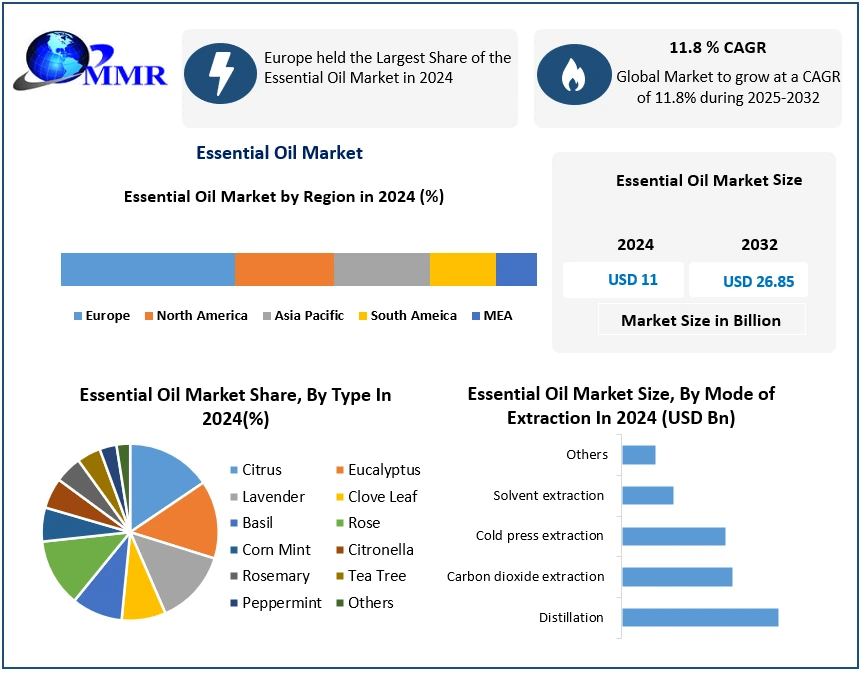
The Essential Oil Market was valued at USD 11 billion in 2024, and total global Essential Oil Market revenue is expected to grow at a CAGR of 11.8% from 2025 to 2032, reaching nearly USD 26.85 billion.
Essential Oil Market Overview
Essential oils are concentrated, volatile, aromatic compounds extracted from plants using methods such as steam distillation or CO₂ extraction. They are widely used in aromatherapy, cosmetics, food, and cleaning products. The MMR report on the essential oils market highlights key industry trends, including pricing dynamics, patent activity, conference and webinar insights, major stakeholders, and evolving consumer buying behavior. Market growth is being driven by strong demand from end-use sectors such as food & beverages, beauty & personal care, and aromatherapy. The adoption of essential oils is rising across industries due to their proven health benefits, natural origin, and minimal side effects. In North America, demand is boosted by a growing consumer preference for healthy lifestyles and transparent ingredient sourcing. Additionally, applications of essential oils in research & development (R&D) and innovative product formulations are expanding at a rapid pace.
 To know about the Research Methodology :- Request Free Sample Report
Top players such as TERRA and Young Living dominate due to strong supply chain control, organic product expansion, and traceability. Givaudan and Firmenich lead via innovation and global sourcing strategies. The food & beverage segment dominated in 2024, contributing over 40% of market revenue due to its growing use of essential oils as natural preservatives and flavoring agents.
Essential Oil Market Dynamics
Increased trend of aromatherapy to boost the Essential Oil Market growth
The utilization of essential oil has surged in popularity, with many individuals turning to them for relaxation and immune support. Eucalyptus, tea tree, peppermint, apricot kernel, and other fragrance-based oil like rosehip and lemon are among the most commonly used oil in aromatherapy. Additionally, orange and lavender oils, frequently incorporated into oral products, stand as top-selling variants. Citrus oil, Essential Oil largest market share as of 2024, are extensively marketed as an aromatherapy essential.
The global trend of aromatherapy is witnessing an upswing, fueled by the growing demand for products promoting self-awareness and self-care, which is expected to boost the Essential Oil Market growth. Essential oil, when blended in specific compositions, have been clinically proven to uplift moods and enhance cognitive functions. This trend indicates a transition in demand from the fragrance and cosmetics industry towards the wellness and natural health sectors. Despite their concentrated natural essence, essential oils present challenges regarding stability during usage and manufacturing processes. The heightened demand has posed difficulties for producers in meeting production quotas and maintaining a consistent supply.
The production of essential oil is a costly endeavor, with approximately 250 pounds of lavender flowers required to yield a single pound of lavender oil. Major buyers of essential oil span various sectors, including food and beverages, personal care and cosmetics, relaxation and self-care, pharmaceuticals, medical formulations, and more. The food and beverage sector, in particular, is anticipated to retain its leading position owing to the escalating utilization of essential oils as additives and flavoring agents for naturally preserving a diverse range of food items such as candies, confectionery, meats, pickles, and beverages.
Limited Supply and Production Challenges to restrain the Essential Oil Market growth
The limited supply of certain essential oils is due to factors such as climate change, environmental degradation, and geopolitical instability in regions where these oils are sourced. Many essential oils are extracted from specific plant species that are cultivated in specific regions, making them vulnerable to disruptions in supply caused by natural disasters, diseases, or political conflicts. Additionally, the production of essential oil is labor-intensive and requires specialized knowledge and equipment, leading to challenges in meeting growing demand. The essential oil market is subject to regulations and standards governing the production, labeling, and marketing of natural health products. These regulations vary significantly between countries and regions, leading to compliance challenges for manufacturers and distributors operating in multiple markets.
The lack of standardized testing methods and quality standards for essential oils creates confusion and inconsistency in the marketplace, making it difficult for consumers to make informed purchasing decisions. Despite the growing popularity of essential oils, there is still a lack of widespread awareness and education regarding their proper use, benefits, and potential risks. Many consumers be unaware of the differences between pure essential oil and synthetic fragrance oil, as well as the importance of dilution and proper application methods. Misinformation and misconceptions about essential oils abound, leading to confusion and skepticism among some consumers.
Essential Oil Market Segment Analysis
Based on Type, in 2024, citrus oils, including orange, lemon, grapefruit, lime, and others, dominate the essential oils market as consumers increasingly use them in beverages, flavorings, cleaning products, and aromatherapy for their refreshing aroma and antimicrobial properties. Eucalyptus oil continues to see strong demand for its respiratory health benefits and use in pharmaceuticals, personal care, and cleaning products. Lavender oil remains a cornerstone segment, valued for its calming effects, skincare benefits, and versatility in aromatherapy. Clove leaf oil is gaining traction in dental care and natural pain relief applications, while basil oil is sought after in the food and fragrance industries for its sweet, herbal aroma. Rose oil, a high-value type, is favored in premium perfumes, cosmetics, and therapeutic blends. Corn mint oil holds significance in the menthol industry for pharmaceuticals, confectionery, and cosmetics. Citronella oil benefits from growing natural insect-repellent demand. Rosemary oil is increasingly used in hair care, memory-enhancing formulations, and food preservation. Tea tree oil is in high demand for its potent antimicrobial properties, especially in skincare and personal hygiene products. Peppermint oil enjoys robust growth across food, beverages, oral care, and aromatherapy segments. The other category, comprising niche essential oils, is also expanding as consumer interest in diverse botanical extracts grows across wellness, cosmetics, and household applications.
Based on the Method of extraction, the market is segmented into Distillation, Carbon dioxide extraction, Cold press extraction, Solvent extraction, and other. The distillation segment dominated the market in 2024 and is expected to hold the largest Essential Oil Market share over the forecast period. The distillation segment is a crucial component of the essential oil market, responsible for the extraction of aromatic compounds from botanical materials to produce pure essential oils. Distillation is the primary method used to extract essential oils from various plant sources, including flowers, leaves, stems, roots, and seeds. It involves the process of heating the botanical material to release its volatile compounds, which are then collected and condensed into a liquid form. Steam distillation is the most common method of essential oil extraction and is suitable for a wide range of plant materials. In this process, steam is passed through the botanical material, causing the volatile compounds to evaporate. The steam and volatile compounds are then cooled and condensed, resulting in a mixture of essential oil and water, which is then separated.
Essential Oil Market Regional Analysis
In 2024, Europe emerged as the global leader in the essential oils market, maintaining its dominant share through a blend of heritage craftsmanship, advanced production capabilities, and a robust export network. This leadership is anchored in the region’s deep-rooted perfume manufacturing tradition, exemplified by France’s position as the world’s top exporter and reinforced by strong intra-European trade flows. The Asia-Pacific region and North America follow closely, with North America’s momentum fueled by wellness trends and the surging demand for clean-label, plant-based products.
In North America, the essential oils market benefits from a strong consumer shift toward natural, organic, and functional products, with significant adoption in aromatherapy, skincare, dietary supplements, and eco-friendly household cleaners. The U.S. remains the dominant market within the region, with orange oil, corn mint oil, and eucalyptus oil accounting for the largest market shares. Demand for citric oils is particularly robust lemon oil and orange oil consumption reaching around 11 kilotons and 7 kilotons, respectively, driven by their perceived antiseptic and anti-inflammatory benefits. Tea tree oil, widely recognized for its antibacterial and antifungal properties, is projected to reach about 8 kilotons in demand by 2024. The market’s expansion is further fueled by increased consumer awareness of therapeutic benefits, growth in e-commerce distribution, and the integration of essential oils into premium product lines across personal care and wellness categories, solidifying North America’s position as one of the fastest-growing regional markets globally.
Essential Oil Market Competitive Landscape
he essential oil market is rapidly expanding, driven by rising demand for natural wellness products. According to the USDA, organic essential oil crop demand is growing steadily, while India’s Ministry of AYUSH reports a 15% annual rise in herbal product use. This growth fuels intense competition as global players focus on innovation, ethical sourcing, and strategy.
doTERRA leads the essential oil market by its Co-Impact Sourcing model, ensuring ethical and sustainable supply chains. Its vertically integrated operations and CPTG-certified quality give it a competitive edge. A strong direct selling network fuels global brand loyalty.
Young Living excels with its Seed to Seal process, maintaining strict control from cultivation to bottling. The company owns global farms and offers a wide product range, helping it dominate in wellness, personal care, and household segments.
Givaudan holds a leading position through its strategic acquisitions, like Naturex, expanding its natural ingredient offerings. Its commitment to traceability and clean label solutions attracts top cosmetic, food, and nutraceutical brands seeking essential oil-based formulations. Expansion to capture market share.
Essential Oil Market Key Trends
| Key Trend | Description | Market Implication |
| Sustainable Packaging Shift | Brands are adopting UV-protective amber glass and eco-friendly materials to reduce environmental impact | Increased consumer trust and loyalty; premium pricing opportunities for eco-conscious products |
| Sleep & Relaxation Focus | New essential oil blends specifically targeting stress relief and improved sleep quality | Tapping into the $100B+ global sleep aid market, partnerships with wellness brands |
| Organic Certification Demand | USDA and other organic certifications are becoming standard for transparency and quality assurance | Ability to command 20-30% price premiums; access to health-focused retail channels |
| Science-Backed Formulations | Combining traditional oils with clinically studied ingredients for measurable effects | Justification for premium pricing; appeal to medical and professional wellness markets |
Essential Oil Market Recent Developments
• On Jan 18, 2024, NOW Foods launched amber glass bottles for essential oils to enhance shelf life and protect against UV degradation.
• On Nov 7, 2023, Falcon introduced Dead Sea Mineral-Infused Essential Oils, combining therapeutic benefits with mineral-rich Dead Sea extracts.
• On Dec 5, 2023, Young Living debuted Starlight™ Essential Oil Blend, promoting relaxation and sleep through a calming aromatic experience.
• On June 7, 2022, Plant Therapy earned USDA Organic Certification for select oils, ensuring pesticide-free, high-quality essential oils.
Global Essential Oil Market Scope: Inquire before buying
| Global Essential Oil Market | |||
|---|---|---|---|
| Report Coverage | Details | ||
| Base Year: | 2024 | Forecast Period: | 2025-2032 |
| Historical Data: | 2019 to 2024 | Market Size in 2024: | USD 11 Bn. |
| Forecast Period 2025 to 2032 CAGR: | 11.8% | Market Size in 2032: | USD 26.85 Bn. |
| Segments Covered: | by Product | Citrus Orange Lemon Grapefruit Lime Others Eucalyptus Lavender Clove Leaf Basil Rose Corn Mint Citronella Rosemary Tea Tree Peppermint Others |
|
| by Source | Fruits & vegetables Herbs & spices Flowers Leaves Others |
||
| by Mode of Extraction | Distillation Carbon dioxide extraction Cold press extraction Solvent extraction Others |
||
| by Application | Medical Food & Beverages Bakery Confectionery Dairy Meat, Poultry & Seafood Snacks & Nutritional Bars Others Spa & Relaxation Aromatherapy Massage Oil Personal Care Cosmetics Hair Care Skin Care Sun Care Makeup & Colour Cosmetics Toiletries Soaps Shampoos Men's Grooming Oral Care Baby Care Fragrances Perfumes Body Sprays Air fresheners Cleaning & Home Kitchen Cleaners Floor Cleaners Bathroom Cleaner Fabric Care |
||
| by Distribution Channel | Direct Distribution Retail Distribution E-Commerce / Online Platforms Others |
||
Essential Oil Market, by Region
• North America (United States, Canada, Mexico)
• Europe (United Kingdom, France, Germany, Italy, Spain, Sweden, Russia, the Rest of Europe)
• Asia Pacific (China, South Korea, Japan, India, Australia, Indonesia, Malaysia, Philippines, Thailand, Vietnam, Rest of Asia Pacific)
• Middle East and Africa (MEA) (South Africa, GCC, Nigeria, Rest of MEA)
• South America (Brazil, Argentina, Colombia, Chile, Rest of South America)
Essential Oil Market, key players
North America
1. Young Living (USA)
2. doTERRA (USA)
3. Plant Therapy (USA)
4. Rocky Mountain Oils (USA)
5. Lebermuth, Inc. (USA)
6. Mountain Rose Herbs (USA)
7. Aura Cacia (USA)
8. Nature’s Truth (USA)
9. Nature’s Bounty (USA)
10. NOW Foods (USA)
11. Revive Essential Oils (USA)
12. Simply Earth (USA)
Europe
13. Givaudan (Switzerland)
14. Robertet Group (France)
15. Symrise (Germany)
16. Firmenich (Switzerland)
17. Biolandes SAS (France)
18. Florihana (France)
Asia Pacific
19. Synthite Industries Ltd. (India)
20. NR Group / Nesso (India)
21. Aromaaz International (India)
22. Aarnav Global Exports (India)
23. Natures Natural India (India)
24. Takasago International Corporation (Japan)
Middle East & Africa
25. Falcon Essential Oils (Israel)
Frequently Asked Questions:
1] What segments are covered in the Essential Oils Market report?
Ans. The segments covered in the Essential Oils Market report are based on Type, Source, Mode of Extraction, Application, Distribution Channel, and region
2] Which region is expected to hold the highest share of the Essential Oils Market?
Ans. The Europe region is expected to hold the highest share of the Essential Oils Market.
3] What is the market size of the Essential Oils Market by 2032?
Ans. The market size of the Essential Oils Market by 2032 is USD 26.85 Bn.
4] What is the growth rate of the Essential Oils Market?
Ans. The Global Essential Oils Market is growing at a CAGR of 11.8 % during the forecasting period 2025-2032.
5] What was the market size of the Essential Oils Market in 2024?
Ans. The market size of the Essential Oils Market in 2024 was USD 11 Bn.
6] What are the challenges faced by the essential oil market?
Ans: Challenges in the essential oil market include limited supply and production challenges due to factors like climate change and geopolitical instability, compliance with regulations and standards, and misinformation/misconceptions about essential oils among consumers.