
Distributed Antenna Systems (DAS) Market Size by Product, Signal Source, Ownership, Application, End Use Industry, Region – Segment-Level Market Assessment, Growth Opportunity Analysis, Competitive Mapping & Forecast to 2034
Overview
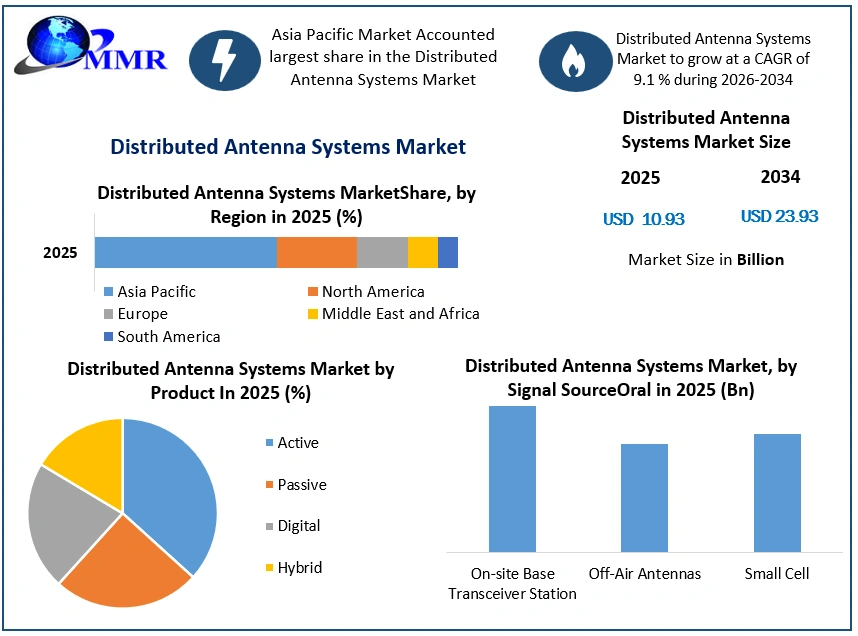
Global Distributed Antenna Systems Market size was valued at USD 10.93 Bn. in 2025 and the total Global Distributed Antenna Systems Market revenue is expected to grow at a CAGR of 9.1% from 2026 to 2034, reaching nearly USD 23.93 Bn. by 2034.
Distributed Antenna Systems (DAS) are networks of antennas spread throughout an area to enhance wireless coverage and capacity, often used in large buildings or venues. They improve signal strength and reliability by distributing antenna nodes and connecting them to a central hub or base station. Increasing demand for improved wireless coverage and capacity in densely populated areas such as urban environments, stadiums, airports, and commercial buildings driving the growth of Distributed Antenna Systems Market.
With the rising adoption of smartphones, IoT devices, and the deployment of 5G networks, there's a pressing need for reliable connectivity, which DAS addresses effectively. The current scenario reflects a surge in DAS installations globally, with key players focusing on expanding their product portfolios to cater to diverse market requirements. Growth factors include the rising adoption of mobile devices, the need for seamless connectivity in smart buildings, and stringent regulations mandating reliable wireless coverage in public safety applications.
Distributed Antenna Systems Market Size, Growth & Share Analysis
To know about the Research Methodology :- Request Free Sample Report
The evolution of technologies like cloud computing, edge computing, and the Internet of Things (IoT) is driving the demand for robust and scalable DAS solutions to support the increasing data traffic and connectivity demands. Recent developments by Distributed Antenna Systems Market key players include strategic partnerships, acquisitions, and product innovations aimed at enhancing DAS performance, efficiency, and flexibility.
For instance, major players like CommScope, Corning Incorporated, and Cobham Wireless have been actively investing in R&D to introduce advanced DAS solutions capable of supporting multiple frequency bands, higher data rates, and seamless integration with emerging technologies like 5G and Wi-Fi 6. Partnerships between DAS providers and telecom operators are on the rise to leverage synergies and offer comprehensive wireless solutions to end-users. These developments underscore the dynamic nature of the Distributed Antenna Systems Market and highlight the industry's commitment to meeting evolving connectivity needs in an increasingly digital world.
Distributed Antenna Systems Market Dynamics:
Increasing deployment of DAS to ensure comprehensive wireless coverage in smart buildings equipped with IoT devices
Rising demand for enhanced cellular coverage, particularly in high-density venues such as stadiums and commercial buildings driving the growth of Distributed Antenna Systems Market. For example, AT&T's deployment of DAS solutions at the Mercedes-Benz Stadium during major events highlights the necessity for reliable coverage in crowded areas. Additionally, the rollout of 5G networks worldwide is accelerating the adoption of DAS, as providers offer solutions optimized for 5G connectivity. Ericsson's Radio Dot System, designed to seamlessly integrate with 5G networks, exemplifies this trend, ensuring efficient deployment and enhanced network performance in indoor environments.
The trend towards smart buildings equipped with IoT devices is boosting the adoption of DAS to ensure comprehensive wireless coverage throughout these facilities. Corning Incorporated's deployment of DAS solutions in the Hudson Yards development illustrates this, supporting smart building applications such as energy management and indoor navigation. Moreover, the exponential growth of data traffic, driven by video streaming and cloud services, necessitates scalable DAS solutions capable of meeting the rising demand for bandwidth.
Distributed Antenna Systems Market players such as CommScope offer advanced DAS platforms to accommodate increasing data volumes in high-traffic environments like airports and shopping malls. Additionally, the proliferation of IoT devices across industries further drives the need for robust connectivity solutions like DAS, enhancing overall operational efficiency and productivity.
Compatibility issues with legacy systems hinder seamless integration of DAS infrastructure
The Distributed Antenna Systems market faces several challenges, foremost among them being cost and time pressures. The design costs of DAS systems are influenced by factors such as the frequency range they need to cover, with systems integrating Very High Frequency (VHF) or Ultra High Frequency (UHF) being more complex and therefore more expensive.
Additionally, the majority of DAS systems rely on fiber optics for signal transmission, necessitating custom cabling, installation, and equipment, which contribute to increased material costs and deployment time. Moreover, the process from obtaining carrier permission to final installation typically spans a minimum of six months. Although new trends such as converged infrastructure and centralized headends are beginning to mitigate these challenges by lowering overall system costs, addressing cost and time pressures remains a significant hurdle for the DAS market.
Wireless service providers (WSPs) must share their growth roadmap with DAS designers to ensure that systems can support future traffic and frequency requirements. This involves anticipating increased traffic demand driven by the widespread adoption of smartphones and tablets and designing DAS with a flexible architecture that can easily accommodate additional channels and frequencies.
Implementing features like Multiple Input Multiple Output (MIMO) transmission and multi-band equipment, along with providing expandable core architectures, are essential strategies to meet evolving coverage demands. However, designing DAS for specific venues presents additional challenges, as considerations such as the venue's construction materials, layout, and aesthetic constraints must be carefully accounted for.
Distributed Antenna Systems Market Segment Analysis:
Based on Type, Active DAS dominated the Distributed Antenna Systems Market in 2025, it utilizes fiber optic cables and signal boosters to amplify wireless signals, making it suitable for large venues like stadiums and airports where high capacity and coverage are critical. Passive DAS, on the other hand, relies on coaxial cables to distribute signals without amplification, making it more cost-effective for smaller indoor environments such as office buildings and hotels.
Digital DAS employs advanced signal processing techniques to enhance signal quality and capacity, making it ideal for complex indoor environments with high-density user requirements such as shopping malls and convention centers. Hybrid DAS combines elements of both active and passive systems, offering flexibility and scalability for diverse applications ranging from healthcare facilities to university campuses. Adoption varies based on factors such as budget, coverage requirements, and technological capabilities, with active and digital DAS often favored for large-scale deployments demanding high performance, while passive and hybrid systems are preferred for smaller-scale applications with cost considerations.
Based on Application, Enterprise DAS Segment Dominated the Global distributed antenna systems Market in 2025. This segment encompasses office buildings, shopping malls, educational campuses, corporate parks, hotels and mixed use facilities spaces where reliable and seamless indoor cellular coverage is critical. With increasing mobile data consumption, widespread adoption of 4G/5G-enabled smart devices, and the growing demand for uninterrupted voice and data connectivity, enterprises are heavily investing in DAS infrastructure to eliminate signal dead zones and ensure superior user experience.
Distributed Antenna Systems Market Regional Insights:
Asia Pacific Dominated the Distributed Antenna Systems Market
China stands as the dominant country in the Asia Pacific region's Distributed Antenna Systems market, boasting the largest market share for both services and components. The country's thriving telecom sector, led by giants like Tencent, Baidu, and Alibaba, continues to push the boundaries of 5G network development, even as the 4G network remains robust.
With a vast population and a high internet usage rate, China presents a significant demand for DAS, expected to surge further as data traffic continues to escalate. Investments by tech giants like Tencent underscore China's commitment to advancing its technological infrastructure, particularly in areas like artificial intelligence and next-generation mobile networks, aligning with the government's "new infrastructure" initiatives.
The integration of IoT and 5G further augments the demand for DAS, facilitating enterprises in managing and scaling their IoT businesses efficiently from a unified platform. With 5G enabling unprecedented speed, flexibility, and connectivity for IoT devices, the demand for DAS solutions is poised for substantial growth in China.
Distributed Antenna Systems Market Recent Development
| Date | Company | Development | Impact |
|---|---|---|---|
| 12 January 2026 | CommScope | CommScope completed the sale of its Connectivity and Cable Solutions segment to Amphenol and rebranded its parent company to Vistance Networks. | This strategic divestiture allows the company to sharpen its core focus on advanced Access Networks Solutions and enterprise wireless portfolios. |
| 01 March 2025 | SOLiD | SOLiD officially launched nGENESIS, its next-generation Distributed Antenna System designed specifically for 5G and future wireless technologies. | The deployment delivers unmatched performance and energy efficiency, empowering mobile operators and enterprises to future-proof indoor connectivity. |
| 25 February 2026 | CommScope Holding Company | CommScope reported its Q4 2025 earnings, highlighting strong underlying momentum for its advanced distributed antenna systems (DAS) and broadband solutions. | The financial update confirmed robust scaling potential and solid profitability as operations align with modern telecommunication upgrade cycles. |
Distributed Antenna Systems (DAS) Market Scope: Inquire before buying
| Global Distributed Antenna Systems (DAS) Market | |||
|---|---|---|---|
| Report Coverage | Details | ||
| Base Year: | 2025 | Forecast Period: | 2026-2034 |
| Historical Data: | 2020 to 2025 | Market Size in 2025: | USD 10.93 Bn. |
| Forecast Period 2026 to 2034 CAGR: | 9.1% | Market Size in 2034: | USD 23.93 Bn. |
| Segments Covered: | by Product | Active Passive Digital Hybrid |
|
| by Signal Source | On-site Base Transceiver Station Off-Air Antennas Small Cell |
||
| by Ownership | Carrier Ownership Neutral-Host Ownership Enterprise Ownership |
||
| by Application | Enterprise DAS Public Safety DAS Other Applications |
||
| by End Use Industry | Manufacturing Healthcare Government Transportation Sports and Entertainment Telecommunications Other |
||
Distributed Antenna Systems (DAS) Market, by Region
North America (United States, Canada and Mexico)
Europe (UK, France, Germany, Italy, Spain, Sweden, Austria and Rest of Europe)
Asia Pacific (China, South Korea, Japan, India, Australia, Indonesia, Malaysia, Vietnam, Taiwan, Bangladesh, Pakistan and Rest of APAC)
Middle East and Africa (South Africa, GCC, Egypt, Nigeria and Rest of ME&A)
South America (Brazil, Argentina Rest of South America)
Distributed Antenna Systems Market, Key Players:
Major Contributors in the Distributed Antenna Systems Industry in North America:
1. CommScope, Hickory, North Carolina, USA
2. Corning Incorporated, Corning, New York, USA
3. AT&T, Dallas, Texas, USA
4. Anixter, Glenview, Illinois, USA
5. Infinite Electronics Inc, Irvine, California, USA
6. JMA Wireless, Liverpool, New York, USA
Leading Figures in the European and Asian Distributed Antenna Systems Sector:
1. Ericsson, Stockholm, Sweden
2. Cobham, Wimborne Minster, United Kingdom
3. TE Connectivity, Schaffhausen, Switzerland
4. Alcatel-Lucent, Paris, France
5. Huawei, Shenzhen, Guangdong, China
6. Comba Telecom Systems Holdings Ltd., Hong Kong, China
7. SOLiD, Seoul, South Korea
8. HUBER+SUHNER, Pfäffikon, Switzerland
9. CenRF Communications Limited, Shenzhen, Guangdong, China
Frequently Asked Questions:
1] What Major Key players in the Global Distributed Antenna Systems Market report?
Ans. The Major Key players covered in the Distributed Antenna Systems Market report are
CommScope, Corning Incorporated, AT&T, Anixter, Infinite Electronics Inc, JMA Wireless, Ericsson, etc.
2] Which region is expected to hold the highest share in the Global Distributed Antenna Systems Market?
Ans. Asia Pacific region is expected to hold the highest share in the Distributed Antenna Systems Market.
3] What is the market size of the Global Distributed Antenna Systems Market by 2034?
Ans. The market size of the Distributed Antenna Systems Market by 2034 is expected to reach USD 23.93 Billion.
4] What is the forecast period for the Global Distributed Antenna Systems Market?
Ans. The forecast period for the Distributed Antenna Systems Market is 2026-2034.
5] What was the market size of the Global Distributed Antenna Systems Market in 2025?
Ans. The market size of the Distributed Antenna Systems Market in 2025 was valued at USD 10.93 Billion.