
Global Cloud ERP Market by Component, Function, Vertical, Organization Size, Region – Global Market Size Estimation, Industry-Wide Analysis, Competitive Landscape Assessment & Long-Term Forecast to 2030
Overview
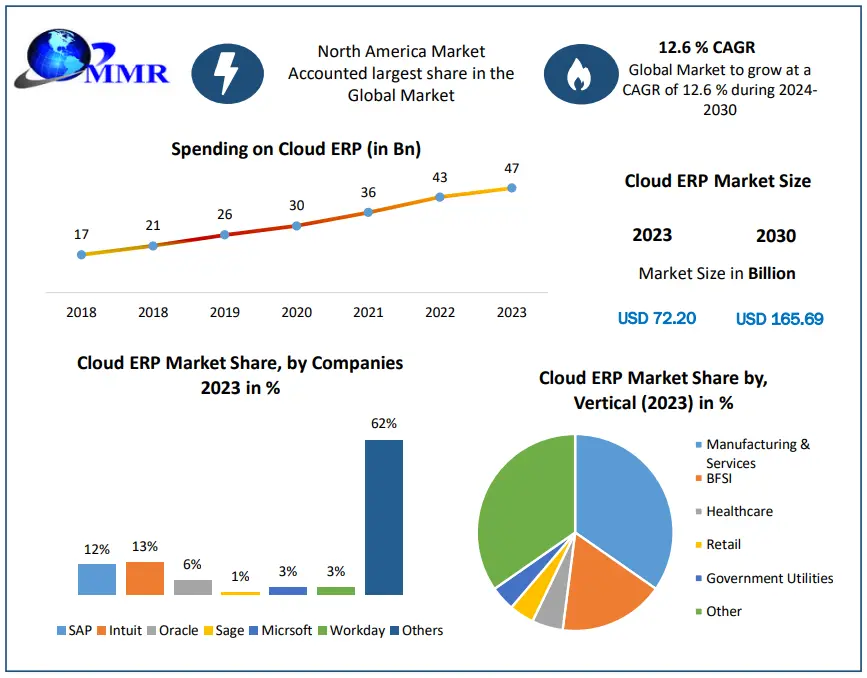
Cloud ERP Market was valued at USD 72.20 Bn in 2023 and is expected to reach USD 165.69 Bn by 2030, at a CAGR of 12.6 % during the forecast period.
Cloud ERP Market Overview
Cloud ERP (Enterprise Resource Planning) is an ERP software solution that are hosted on cloud computing infrastructure and accessed over the internet. Unlike traditional on-premises ERP systems, which require installation and maintenance of software on local servers, cloud ERP solutions are deployed and managed by third-party providers in remote data centers. Cloud ERP systems are hosted on cloud infrastructure provided by third-party vendors, such as Amazon Web Services (AWS), Microsoft Azure, or Google Cloud Platform. This allows businesses to access the ERP software and data remotely via the internet. Cloud ERP solutions typically operate on a subscription-based pricing model, where businesses pay a recurring fee for access to the software and services. This pricing model often includes maintenance, updates, and technical support, with costs based on usage and features.
 To know about the Research Methodology:- Request Free Sample Report
The Cloud ERP market has been experiencing significant growth in recent years, driven by increasing adoption of cloud computing technologies and the growing demand for modern, digital-first business solutions. According to various market research reports, the Cloud ERP market is expected to continue growing at a robust pace in the coming years. Cloud ERP solutions are being adopted across a wide range of industries, including manufacturing, retail, healthcare, finance, professional services, and more. Businesses of all sizes, from small and medium-sized enterprises (SMEs) to large multinational corporations, are leveraging Cloud ERP to streamline their operations, improve efficiency, and drive digital transformation.
Cloud ERP Market Dynamics
Digital Transformation to boost the Cloud ERP Market growth
Businesses are increasingly embracing digital transformation to modernize their operations, improve efficiency, and enhance customer experiences. Cloud ERP solutions play a central role in this transformation by providing the foundation for integrating and automating critical business processes, such as finance, supply chain management, human resources, and customer relationship management. By migrating to the cloud, businesses leverage the latest technologies and innovations to streamline their operations, drive innovation, and gain a competitive edge in the Cloud ERP Market. Cloud-based ERP systems are acquired through a subscription model, which encompasses not only the software but also hosting and technical assistance. This approach markedly diminishes capital expenditure on hardware, software licensing, and the associated implementation and IT support expenses, including system maintenance, updates, and patches. According to research conducted, the total cost of ownership for cloud ERP solutions is up to 50 to 60 % lower compared to on-premise solutions over a span of 10 years. Cloud ERP solutions offer significant cost advantages over traditional on-premises ERP systems. With cloud-based deployment models, businesses avoid hefty upfront investments in hardware, infrastructure, and software licenses, as well as ongoing maintenance and upgrade costs. Instead, Cloud ERP solutions operate on a subscription-based pricing model, where businesses pay only for the resources and services they use, making it more cost-effective and predictable for organizations of all sizes.
Cloud ERP solutions provide businesses with the scalability and flexibility needed to grow and adapt to changing business requirements. Cloud-based infrastructure allows businesses to scale their operations up or down dynamically, without the need for costly hardware upgrades or infrastructure investments. This scalability enables businesses to respond quickly to changing Cloud ERP market conditions, seasonal demand fluctuations, and business expansion opportunities, while remaining agile and cost-effective, which significantly boosts the Cloud ERP Market growth. Cloud ERP vendors continuously innovate and update their software to incorporate the latest technologies, features, and enhancements. This rapid pace of innovation enables businesses to stay ahead of the curve and leverage new capabilities to drive operational excellence, improve customer experiences, and capitalize on emerging opportunities. With cloud-based deployment models, businesses easily access and deploy these updates and innovations without the need for manual intervention or costly downtime, ensuring that they always have access to the latest and greatest features and functionalities.
Integration Complexity to restrain the Cloud ERP Market growth
Integrating cloud ERP systems with existing on-premises systems or other cloud-based applications is complex and challenging.
Compatibility issues, data migration concerns, and customization requirements may arise, requiring careful planning and coordination to ensure seamless integration and data interoperability. The primary concerns surrounding cloud ERP adoption is data security, which is expected to limit the Cloud ERP Market growth. Businesses hesitate to migrate sensitive or proprietary data to the cloud due to fears of data breaches, unauthorized access, or data loss. Ensuring robust security measures and compliance with data protection regulations is crucial for addressing these concerns. Cloud ERP solutions offer limited customization options compared to on-premises ERP systems. While cloud-based platforms provide flexibility and scalability, businesses may encounter constraints when it comes to tailoring the software to meet specific industry requirements or unique business processes. Balancing the need for customization with the benefits of cloud scalability and standardization is challenge for organizations.
Migrating to a cloud ERP solution often involves entering into long-term contracts with specific vendors. This lead to vendor lock-in, where businesses become dependent on a single provider for their ERP needs. Vendor lock-in limit flexibility, hinder innovation, and make it difficult for businesses to switch providers or adapt to changing technology trends and significantly restraints the Cloud ERP Market growth. Compliance with industry-specific regulations and data privacy laws pose challenges for cloud ERP adoption, especially in highly regulated industries such as healthcare, finance, and government. Businesses must ensure that their cloud ERP solutions comply with relevant regulations and standards, such as GDPR (General Data Protection Regulation) in the European Union or HIPAA (Health Insurance Portability and Accountability Act) in the United States.
Opportunities in Cloud ERP Market:
Industry-Specific Solutions: There is a growing demand for industry-specific Cloud ERP solutions tailored to the unique needs and requirements of different sectors such as manufacturing, healthcare, retail, and finance. ERP vendors have the opportunity to develop specialized solutions that address industry-specific challenges, compliance requirements, and best practices, providing businesses with tailored solutions that deliver maximum value and efficiency, which is expected to boost the Cloud ERP Market growth.
Integration and Interoperability: Integration with other cloud-based applications and platforms is becoming increasingly important as businesses adopt a multi-cloud strategy. Cloud ERP vendors have the opportunity to offer seamless integration capabilities that enable businesses to connect their ERP systems with other critical business applications such as CRM, HRMS, e-commerce, and supply chain management. By providing robust integration solutions, ERP vendors help businesses unlock greater value from their cloud investments and improve operational efficiency.
Artificial Intelligence and Analytics: The integration of artificial intelligence (AI) and advanced analytics capabilities into Cloud ERP solutions presents significant opportunities for businesses to gain deeper insights, improve decision-making, and drive innovation. ERP vendors leverage AI and analytics to offer predictive and prescriptive analytics, intelligent automation, and machine learning-driven insights that enable businesses to optimize processes, identify trends, and anticipate customer needs.
Cloud ERP Market Segment Analysis
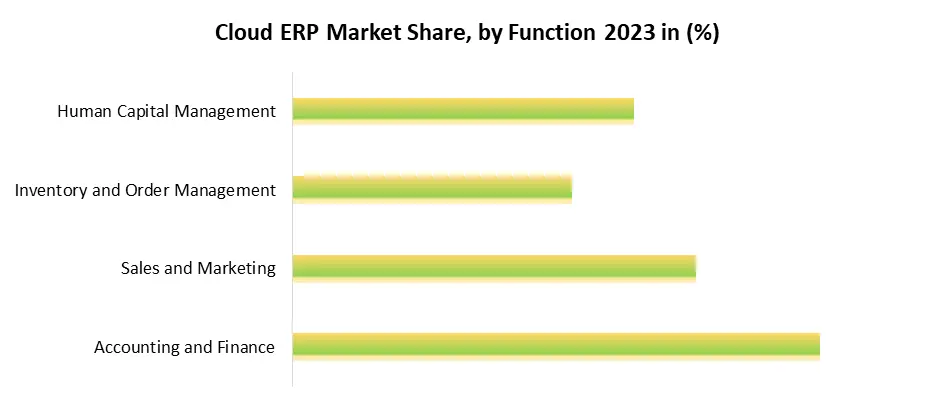
Based on Function, the market is segmented into Accounting and Finance, Sales and Marketing, Inventory and Order Management, and Human Capital Management. Accounting and Finance segment dominated the market in 2023 and is expected to hold the largest Cloud ERP Market share over the forecast period. This segment includes various core components such as general ledger, accounts payable, accounts receivable, budgeting and forecasting, and cash flow management, all essential for robust financial management. These tools enable businesses to streamline financial processes, enhance accuracy, and attain real-time visibility into their financial well-being. The general ledger serves as the central repository for an organization's financial data, meticulously recording all transactions.
Cloud ERP systems provide automation and real-time updates, ensuring the perpetual accuracy of financial records, which significantly boosts the Cloud ERP Market growth. This facilitates efficient maintenance of precise books, facilitates the generation of financial statements, and ensures compliance with regulatory standards. The accounts payable functionality within cloud ERP systems streamlines the management and payment of vendor invoices. Automation in accounts payable reduces manual data entry, expedites invoice approvals, and minimizes the occurrence of late payments, thereby enhancing vendor relationships and optimizing cash management. Effective cash flow management is paramount for the financial well-being of any organization. Cloud ERP solutions provide real-time visibility into cash positions, enabling companies to monitor incoming and outgoing funds. This fosters proactive decision-making, enabling organizations to seize investment opportunities or manage liquidity as needed.
Based on Vertical, the market is segmented into Manufacturing & Services, BFSI, Healthcare, Retail, Government Utilities, and Other. The manufacturing & Services segment dominated the market in 2023 and is expected to hold the largest Cloud ERP market share over the forecast period. The Manufacturing & Services segment in the Cloud ERP (Enterprise Resource Planning) market pertains to the specific subset of industries involved in manufacturing goods and providing various services. This segment encompasses businesses engaged in activities such as production, distribution, supply chain management, inventory control, and service delivery. This includes companies involved in the production of physical goods across various sectors such as automotive, aerospace, electronics, consumer goods, industrial equipment, and more. Cloud ERP solutions cater to the specific needs of manufacturing companies by offering modules for production planning, scheduling, inventory management, quality control, shop floor management, and procurement. These functionalities help streamline manufacturing processes, optimize resource utilization, reduce lead times, minimize waste, and enhance overall operational efficiency. Cloud ERP systems often include modules for asset management, which are crucial for both manufacturing and service industries. These modules facilitate the tracking, maintenance, and optimization of physical assets such as equipment, machinery, vehicles, and infrastructure. By providing real-time visibility into asset performance, maintenance schedules, and lifecycle costs, Cloud ERP helps businesses maximize asset utilization, minimize downtime, and prolong asset lifespan.
Cloud ERP Market Regional Insight
Digital Transformation Initiative to boost North America Cloud ERP Market growth
North America dominated the market in 2023 and is expected to hold the largest Cloud ERP Market share over the forecast period. Many organizations in North America are undergoing digital transformation to modernize their business processes and stay competitive. Cloud ERP solutions enable them to streamline operations, improve efficiency, and adapt to changing market dynamics more effectively. Cloud ERP eliminates the need for significant upfront investments in hardware, software licenses, and IT infrastructure. This makes it an attractive option for businesses looking to reduce capital expenditures and achieve cost savings over traditional on-premises ERP systems. Cloud ERP offers scalability, allowing businesses to easily adjust resources and capabilities according to their changing needs, which sis expected to boost the Cloud ERP Market growth. This flexibility is particularly beneficial for growing companies or those experiencing fluctuations in demand. The COVID-19 pandemic has accelerated the adoption of remote work arrangements across North America. Cloud ERP enables employees to access critical business data and applications from anywhere, facilitating collaboration and productivity regardless of location. Cloud ERP vendors invest heavily in robust security measures to protect sensitive business data. This reassures organizations, especially in highly regulated industries such as finance and healthcare, that their data is secure and compliant with relevant regulations. Cloud ERP platforms often integrate advanced analytics capabilities, providing businesses with valuable insights into their operations, customer behavior, and market trends. These insights empower decision-makers to make more informed strategic decisions and drive business growth.
The United States Cloud ERP Market is the largest in North America, driven by its vast economy, technological innovation, and a large base of enterprises across various industries. Major tech hubs such as Silicon Valley and Seattle are hotbeds for Cloud ERP adoption, with companies ranging from startups to multinational corporations embracing cloud-based solutions. Canada's Cloud ERP market is also experiencing significant growth, fueled by a strong economy, increasing digitalization efforts across industries, and a supportive regulatory environment. Canadian businesses are increasingly recognizing the benefits of cloud-based ERP in improving operational efficiency and driving innovation. Mexico's Cloud ERP market is poised for growth due to factors such as expanding internet penetration, rising adoption of digital technologies, and a growing number of small and medium-sized enterprises (SMEs) seeking to modernize their operations. Government initiatives aimed at promoting digital transformation are likely to further drive Cloud ERP adoption in the country.
Cloud ERP Market Scope: Inquire before buying
| Global Cloud ERP Market | |||
|---|---|---|---|
| Report Coverage | Details | ||
| Base Year: | 2023 | Forecast Period: | 2024-2030 |
| Historical Data: | 2018 to 2023 | Market Size in 2023: | US $ 72.20 Bn. |
| Forecast Period 2024 to 2030 CAGR: | 12.6% | Market Size in 2030: | US $ 165.69 Bn. |
| Segments Covered: | by Component | Solution Services |
|
| by Function | Accounting and Finance Sales and Marketing Inventory and Order Management Human Capital Management |
||
| by Vertical | Manufacturing & Services BFSI Healthcare Retail Government Utilities Other |
||
| by Organization Size | SMEs Large enterprises |
||
Cloud ERP Market, by Region
North America (United States, Canada and Mexico)
Europe (UK, France, Germany, Italy, Spain, Sweden, Austria and Rest of Europe)
Asia Pacific (China, South Korea, Japan, India, Australia, Indonesia, Malaysia, Vietnam, Taiwan, and Rest of APAC)
Middle East and Africa (South Africa, GCC, Egypt, Nigeria and Rest of ME&A)
South America (Brazil, Argentina Rest of South America)
Cloud ERP Solution providers include:
North America:
1. Oracle Corporation - Redwood City, California, USA
2. SAP SE - Walldorf, Germany (with a significant presence in North America)
3. Microsoft Corporation - Redmond, Washington, USA
4. Workday, Inc. - Pleasanton, California, USA
5. Infor - New York City, New York, USA
6. Salesforce - San Francisco, California, USA
7. Epicor Software Corporation - Austin, Texas, USA
8. NetSuite (Oracle NetSuite) - San Mateo, California, USA
9. Plex Systems, Inc. - Troy, Michigan, USA
10. Acumatica - Bellevue, Washington, USA
11. Cisco - San Jose, California
Europe:
12. Sage Group plc - Newcastle upon Tyne, United Kingdom
13. Unit4 - Utrecht, Netherlands
14. IFS - Linköping, Sweden
15. Exact Software - Delft, Netherlands
16. Visma - Oslo, Norway
Asia-Pacific:
17. Zoho Corporation - Chennai, India
18. Ramco Systems - Chennai, India
19. Deskera - Singapore
20. IFS (Asia-Pacific Division) - Singapore
21. Yonyou (Yonyou Software Co., Ltd.) - Beijing, China
Frequently Asked Questions:
1. What is Cloud ERP?
Ans: Cloud ERP (Enterprise Resource Planning) is a software solution hosted on cloud computing infrastructure and accessed over the internet. Unlike traditional on-premises ERP systems, cloud ERP solutions are managed by third-party providers in remote data centers.
2. What are the challenges associated with Cloud ERP adoption?
Ans: Challenges include integration complexity, data security concerns, limited customization options, vendor lock-in, and compliance with industry regulations and data privacy laws. However, these challenges is addressed through careful planning and implementation strategies.
3. What opportunities exist in the Cloud ERP market?
Ans: Opportunities include the development of industry-specific solutions tailored to different sectors, seamless integration capabilities, and the integration of artificial intelligence (AI) and advanced analytics. These innovations enable businesses to optimize processes, improve decision-making, and drive innovation.
4. How is the Cloud ERP market segmented?
Ans: The Cloud ERP market is segmented based on function (e.g., accounting and finance, sales and marketing) and vertical (e.g., manufacturing & services, BFSI, healthcare). These segments cater to the diverse needs of businesses across different industries and functional areas.
5. What is the regional outlook for the Cloud ERP market?
Ans: North America dominates the Cloud ERP market, driven by digital transformation initiatives, cost advantages, scalability, and technological innovation. The United States, Canada, and Mexico are key contributors to the region's growth, with diverse industries adopting cloud ERP solutions for operational excellence.