Gin Market Size by Segments, Region – Revenue Pool Analysis, Margin Structure Assessment, Capital Flow Trends, Competitive Benchmarking & Forecast to 2032

5.2%
CAGR (2026-2032)
18.41 USD Bn.
Market Size
328
Report Pages
147
Market Tables

Overview

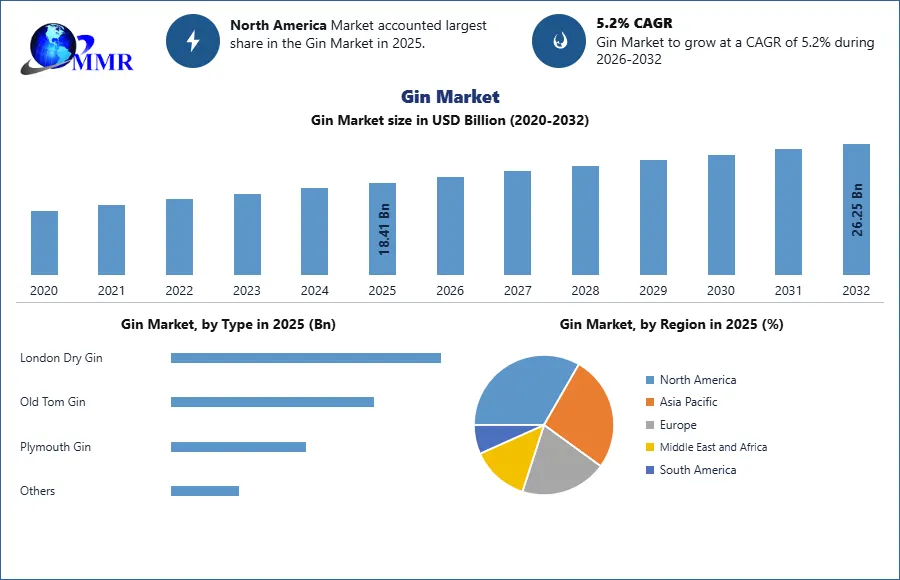
The Gin Market size was valued at USD 18.41 Billion in 2025 and the total Gin revenue is expected to grow at a CAGR of 5.2% from 2026 to 2032, reaching nearly USD 26.25 Billion by 2032.

Gin Market Overview:

Gin is a flavored, distilled, colorless to light yellow beverage prepared from pure spirits derived from a grain mash and includes juniper berries as its main flavoring ingredient. It comprises both the malty-flavored and full-bodied Netherlands kinds and the drier forms made in Britain and the United States, which are distinguished by different botanical flavoring. This distilled alcoholic beverage increases the range of alternatives available to meet the increasing demand for spirits. The alcoholic drinks market is developing as more distilleries arise in the global beverages sector, owing to the growth in alcohol use among the world's young and millennial populations.
Gin Market 2026-2032

To know about the Research Methodology :- Request Free Sample Report

The report explores the Gin market's segments (Type, Product Type, Price Point, Distribution Channel, and Region). Data has been provided by market participants, and regions (North America, Asia Pacific, Europe, Middle East & Africa, and South America). It provides a thorough analysis of the rapid advances that are currently taking place across all industry sectors. Facts and figures, illustrations, and presentations are used to provide key data analysis for the historical period from 2020 to 2025. The report investigates the Gin market's drivers, limitations, prospects, and barriers. This MMR report includes investor recommendations based on a thorough examination of the Gin market's contemporary competitive scenario.

Gin Market Dynamics:

Increasing demand for Alcoholic Beverages is a Major Driver of the Gin Market.

The growing demand for alcoholic beverages in developed and developing economies, increasing their large population bases, and growing use of alcohol by the millennial generation, as well as rising disposable income, help the industry's growth. Additionally, changing consumer preferences for premium liquor variations are anticipated to drive the demand for premium brands. Huge populations across the world are relocating to larger cities, where they are introduced to a broader choice of alcoholic beverage products, significantly contributing to market growth. However, rising social acceptance, extravagant consumption, and increasing urbanization are driving sector growth.

Consumer shift toward online shopping for alcohol is driving the market growth.

Because of the Covid 19 pandemic, the internet and technology are altering how customers locate and purchase items. Online alcohol buying was low in comparison to other retail categories, but it is a fast-growing channel that has expanded substantially under Covid-19. Consumers are increasingly using the internet to explore and learn about companies and goods that they would have discovered and learned about previously in venues and while out socializing.

Customers desire new experiences and higher-quality products.

Consumers are 'drinking better, not more when it comes to beverage alcohol, progressively preferring brands and categories that provide greater quality, authenticity, and flavor. This premiumization movement is being fueled by product innovation and rising levels of affluence and disposable cash, as well as a growing desire to explore new experiences, ingredients, and servings for social events.

The high Cost of Gin is a key Restraint for the Gin Market.

A standard bottle of gin's manufacturing expenses is likely to be greater, due to its manufacturing process, raw materials costs, etc. The cost of premium gin is not affordable to middle-level consumers and this factor restricts the market growth. Although excessive consumption contributes to various health concerns such as cancer, cirrhosis of the liver, violence, and accidents, among other issues, the gin market's expansion is restricted.

The alcoholic beverage industry is highly regulated.

Regulation differs widely around the world, frequently altering in reaction to societal changes. Some countries, for example, have imposed temporary limitations in reaction to Covid-19. Compliance with law and regulation is the very minimum wherever we operate, and we have long recognized that a responsible beverage company must go beyond ordinary compliance. In terms of starting new businesses and expanding, liquor licensing and sourcing emerged as a major growth restriction for the industry, as the requirement to obtain several mandatory licenses and regulations related to hours of operation and consumer minimum age, which varies by state, emerged as a major growth barrier for the industry. Each state in India has its regulatory limits on alcohol production, marketing and distribution, and even price, and we have long recognized that a responsible alcohol firm must go beyond mere compliance.

Gin Market Segment Analysis:

By Type, the London Dry Gin segment dominated the global gin market in terms of market share of xx% in 2025 and is expected to maintain its dominance at the end of the forecast period. London Dry Gin is a popular beverage all over the world due to its widespread availability and better flavor and refreshment provided to customers. The fruit utilized for its distinctive flavor, London Dry Gin, contains intense juniper tastes. It also has a lot of fresh citrus overtones. This is why a lemon twist enhances the citrus flavors of a Martini. Dry gins are distinguished by the absence of artificial tastes such as sweeteners. It's a pretty natural way to display gin.

By Product Type, the Flavored Gin segment is expected to dominate the market at the end of the forecast period. The citrus in quality lemonade pairs well with flavored gins, which are becoming increasingly popular, and Violet and new Apple & Lime flavors have become strong favorites among drinkers. Consumers place a high value on uniqueness. Violet gin stands out on the shelves and looks much better on social media. Due to this, flavored gin is popular among the drinkers and their popular flavors include rhubarb, strawberry, and orange.
By Distribution Channel, the Online Retail segment is expected to grow at the end of the forecast period. The increased use and penetration of the Internet have transformed the online marketplace into a significant distribution and communication medium through which consumers and businesses interact. Along with that, The Covid-19 outbreak has changed consumer preferences towards shopping. The growing importance of consumer engagement in online purchases has converted the Internet into a dominant force that impacts consumer behavior. Its features, such as the availability of vast volumes of information, cheaper search prices, and access to all rivals, have altered customers' research and purchasing habits. The Internet allows anybody to connect at any time and from any location, making it easier for customers to gather and compare rival offerings. Different merchants can be visited at the same time, as unknown retailers, and their products/services can be compared at the same time. Everyone has access to a massive quantity of information in terms of detail and several sources.

Gin Market Regional Insights:

North American Region is expected to dominate the global gin market at the end of the forecast period followed by the Asia Pacific region. The region's increasing millennial population is expected to drive the gin market. Furthermore, changing lifestyles, disposable income, and urbanization in this area are driving factors in the gin industry. The number of manufacturers in the United States has expanded rapidly as a result of secure approval processes implemented by regulatory agencies.

Gin Market

Gin production, distribution, and sale in the United States are heavily regulated. Consolidation has occurred at various levels in several industries as a result of the regulatory environment. While bigger corporations hold a sizable market share, the number of smaller brewers, vintners, and distillers, known as the craft sector, has increased rapidly but still accounts for a small portion of the industry. Small businesses have distribution issues due to rising concentration in many state distribution marketplaces and state restrictions controlling distribution. Responses to the call for information for this research claim that marketing arrangements involving major manufacturers, retailers, and distributors also restrict the growth of small businesses.

The Asia Pacific region is expected to grow at the end of the forecast period. The market is expected to develop at the fastest CAGR due to rising purchasing power and the substantial growth of the millennial population in emerging countries such as China, India, Malaysia, Thailand, and Indonesia. The enormous potential in these countries' undeveloped markets will almost certainly generate profitable possibilities in this region. Increasing demand for alcoholic beverages in emerging countries due to their large population, increased use of alcohol by the young generation, and rising disposable income encourage market growth in this region.

Gin Market Recent Developments:

Exact Date Company Development Impact
26 March 2026 Pernod Ricard S.A. Pernod Ricard officially confirmed it is in strategic discussions regarding a merger of equals with Brown-Forman. The potential combination would create a global spirits powerhouse, leveraging Pernod Ricard's massive distribution network for gin brands like Beefeater and Monkey 47.
18 March 2026 Bacardi Limited Bacardi USA was named "Best Large Spirits Supplier" for the sixth consecutive year at the 2026 Vibe Conference. The award highlights Bacardi's dominant on-premise presence and service excellence, critical for driving volume in the premium gin segment via brands like Bombay Sapphire.
17 February 2026 Diageo plc Diageo launched its Lunar New Year 2026 campaign, featuring limited-edition cultural collaborations and signature cocktails for its luxury spirits portfolio. By targeting the Year of the Horse festivities, Diageo is strengthening its luxury brand equity in high-growth Asian markets for priority gin brands Tanqueray and Gordon’s.
16 February 2026 Suntory Holdings Limited Suntory announced its 2026 outlook, aiming to become the "world’s most admired premium spirits company" despite a 0.4% stagnant alcohol revenue in 2025. The group plans to focus on global priority brands like Roku Gin through new food-pairing experiences and flavor launches to drive a projected 4.3% revenue increase.
03 December 2025 Diageo plc Diageo released its Global Inclusion and Diversity update, detailing progress on its "Spirit of Progress" 2030 sustainability and social impact goals. This corporate milestone improves ESG ratings and appeals to the growing demographic of socially conscious consumers, a key driver in the modern gin market.
02 April 2026 Ginebra San Miguel Inc. Ginebra San Miguel's market capitalization was reported at 78.34 billion, reflecting a steady 7.08% compound annual growth rate over the long term. Despite short-term market fluctuations, the company's valuation underscores its massive scale as a regional gin leader, supporting its aggressive sports marketing and local distribution strategy.


The objective of the report is to present a comprehensive analysis of the Gin market to the stakeholders in the industry. The past and current status of the industry with the forecasted market size and trends are presented in the report with the analysis of complicated data in simple language. The report covers all the aspects of the industry with a dedicated study of key players that include market leaders, followers, and new entrants.

PORTER, PESTEL analysis with the potential impact of micro-economic factors of the market has been presented in the report. External as well as internal factors that are supposed to affect the business positively or negatively have been analyzed, which will give a clear futuristic view of the industry to the decision-makers.

The report also helps in understanding the Gin market dynamics, and structure by analyzing the market segments and projecting the Gin market size. Clear representation of competitive analysis of key players by product, price, financial position, product portfolio, growth strategies, and regional presence in the Gin market make the report investor’s guide.

Gin Market Scope: Inquire before buying

Gin Market
Report Coverage Details
Base Year: 2025 Forecast Period: 2026-2032
Historical Data: 2020 to 2025 Market Size in 2025: 18.41 USD Billion
Forecast Period 2026-2032 CAGR: 5.2% Market Size in 2032: 26.25 USD Billion
Segments Covered: by Type London Dry Gin
Old Tom Gin
Plymouth Gin
Others
By Price Point Standard
Premium
Luxury
By Alcohol Content Low ABV (<37.5%)
Standard ABV (37.5%–40%)
High ABV (>40%)
By Production Method Pot Distilled Gin
Column Distilled Gin
Compound Gin
By Flavor Profile Unflavored
Flavored
    Citrus-Based
    Floral
    Spiced
    Fruit-Infused
    Herbal
    Others
By Packaging Type Glass Bottles
PET Bottles
Cans
Kegs
Others
By Distribution Channel On-trade
    Bars & Pubs
    Restaurants
    Hotels & Lounges
Off-trade
    Supermarkets/Hypermarkets
    Liquor Stores
    Online Stores
    Others
By End User Cocktail Mixing
Direct Consumption
Ready-to-Drink (RTD) Gin-Based Beverages
Culinary Use
Others


Gin Market, by Region

North America (United States, Canada and Mexico)
Europe (UK, France, Germany, Italy, Spain, Sweden, Austria and Rest of Europe)
Asia Pacific (China, South Korea, Japan, India, Australia, Indonesia, Malaysia, Vietnam, Taiwan, Bangladesh, Pakistan and Rest of APAC)
Middle East and Africa (South Africa, GCC, Egypt, Nigeria and Rest of ME&A)
South America (Brazil, Argentina Rest of South America)

Gin Market, Key Players

1. Diageo plc
2. William Grant & Sons Limited
3. Bacardi Limited
4. Pernod Ricard S.A.
5. San Miguel Corporation
6. Southwestern Distillery
7. Davide Campari-Milano N.V.
8. Remy Cointreau
9. Lucas Bols
10. Forest Spirits’ Gin.
11. The East India Company Ltd
12. Ginebra San Miguel Inc.
13. The Poshmakers Ltd
14. West End Drinks Ltd
15. Boudier Gabriel Ets SA
16. Suntory Holdings Limited
17. The Sustainable Spirit Co. (U.K.)
18. The Black Bottle Distillery
19. Langtons Gin Ltd

FAQs:

1. Which is the potential market for the Gin in terms of the region?
Ans. North American Region is expected to dominate the global gin market at the end of the forecast period.

2. What are the opportunities for new market entrants?
Ans. The key opportunity in the market is Customers desire new experiences and higher-quality products.

3. What is expected to drive the growth of the Gin market in the forecast period?
Ans. A major driver in the Gin market is the Increasing demand for Alcoholic Beverages.

4. What is the expected market size & growth rate of the Gin Market?
Ans. The Gin Market size was valued at USD 18.41 Billion in 2025 and the total Gin revenue is expected to grow at a CAGR of 5.2% from 2026 to 2032, reaching nearly USD 26.25 Billion by 2032.

5. What segments are covered in the Gin Market report?
Ans. The segments covered are Type, Product Type, Price Point, Distribution Channel and Region.

Table of Contents

1. Gin Market: Market Introduction 1.1. Executive Summary 1.2. Market Size (2025) & Forecast (2026-2032), 1.3. Market Size (Value in USD Million and Volume in Liters) and Market Share (%) - By Segments, Regions and Country 2. Competitive Landscape 2.1. MMR Competition Matrix 2.2. Competitive Analysis of key players 2.3. Key Players Benchmarking 2.3.1 Company Name 2.3.2 Headquarter 2.3.3 Product Portfolio 2.3.4 Production Capacity (Liters) 2.3.5 Pricing Strategy 2.3.6 Product Innovation 2.3.7 Brand Positioning & Marketing 2.3.8 Sustainability & ESG Initiatives 2.3.9 Quality control standards 2.3.10 Profit Margin (%) 2.3.11 Revenue(Billion), 2025 2.3.12 Revenue Growth Rate (%) 2.3.13 Market Share (%) 2025 2.3.14 R&D Investment 2.3.15 Global Reach 2.4. Market Structure 2.4.1 Market Leaders 2.4.2 Market Followers 2.4.3 Emerging Players 2.5. Mergers and Acquisitions Details 2.6. Market Share Analysis (2025) (%) 2.6.1 Global market share By manufacturer 2.6.2 Regional market share comparison 2.6.3 Market concentration and top player dominance 2.6.4 Market share trends over 2020–2025 2.7. Innovation & R&D Focus 2.7.1 Botanical innovation and flavor experimentation 2.7.2 Distillation technology advancements 2.7.3 Low & no-alcohol product innovation 2.7.4 Smart packaging and labelling technology 2.7.5 Digital marketing and AI-driven engagement 2.8. Marketing & Branding Strategies 2.8.1 Brand positioning and value proposition 2.8.2 Marketing campaigns and digital presence 2.8.3 Social media and influencer engagement 2.8.4 Experiential marketing: tastings and events 2.8.5 Loyalty programs and consumer retention strategies 2.9. Product Benchmarking 2.9.1 Product portfolio comparison (variants, ABV, flavors) 2.9.2 Craft vs industrial-scale production 2.9.3 Flavored, premium, and RTD offerings 2.9.4 Packaging and design differentiation 3. Gin Market Dynamics 3.1. Gin Market Trends 3.2. Gin Market Dynamics 3.2.1 Drivers 3.2.2 Restraints 3.2.3 Opportunities 3.2.4 Challenges 3.3. PORTER’s Five Forces Analysis 3.4. PESTLE Analysis 4. Regulatory & Compliance Landscape 4.1 Global alcohol and spirits regulations 4.2 Labeling, certification, and quality standards 4.3 Taxation and excise frameworks by region 4.4 Import-export compliance and licensing requirements 4.5 Regulatory impact on product innovation and distribution 4.6 Anticipated changes and policy-driven market risks 5. Consumer Insights & Behavior 5.1 Demographic profiling and consumption segmentation 5.2 Drinking occasions, usage patterns, and frequency 5.3 Flavor preference analysis and emerging trends 5.4 Impact of cocktails, mixology, and bar culture 5.5 Price sensitivity and willingness-to-pay in premium segments 5.6 Regional differences in adoption of craft and flavored gins 6. Pricing Analysis (2025) 6.1 Global gin pricing benchmarks by type (2020–2025) 6.2 Regional price variation and influencing factors 6.3 Pricing impact of taxes, duties, and excise 6.4 Price trends in premium, craft, and flavored segments 6.5 Price positioning strategies of leading players 6.6 Influence of raw material and packaging costs 7. Production & Manufacturing Analysis (2025) 7.1 Key production processes and distillation methods 7.2 Sourcing of botanicals, grains, and other ingredients 7.3 Craft vs industrial-scale production trends 7.4 Technology adoption in production and quality control 7.5 Regional production hubs and capacity analysis 8. Supply Chain Analysis 8.1 Supply chain efficiency and optimization 8.2 Raw material procurement and sourcing challenges 8.3 Distribution channel management and warehousing 8.4 Transportation, cold chain, and storage considerations 8.5 Bottleneck and risk analysis in supply chain 8.6 Regional logistics infrastructure and trade flow insights 9. Packaging Innovation & Shelf-Life Dynamics 9.1 Packaging design trends: glass, bottles, and closures 9.2 Sustainable and eco-friendly packaging initiatives 9.3 Labeling innovations: brand storytelling and compliance 9.4 Shelf-life and storage stability for different gin types 9.5 Impact of packaging on consumer purchase decisions 9.6 Innovation in ready-to-drink and premium formats 10. Comparative Analysis: Gin vs. Vodka vs. Tequila 10.1 Market size and growth comparison by segment and region 10.2 Consumer demographics, behavior, and consumption occasions 10.3 Pricing and premiumization trends across spirits 10.4 Flavor profiles, product innovation, and differentiation 10.5 Distribution channels and market reach comparison 10.6 Competitive positioning and brand strategies 11. Marketing & Consumer Engagement 11.1 Digital marketing and social media campaigns for gin brands 11.2 Experiential marketing: tastings, events, and brand activations 11.3 Influencer and bartender-led promotional initiatives 11.4 Loyalty programs and repeat consumer engagement strategies 11.5 Regional marketing approaches and cultural targeting 11.6 Impact of storytelling and brand heritage on consumer perception 12. Environmental, Social & Sustainability (ESG) Insights 12.1 Sustainable sourcing of botanicals, grains, and raw materials 12.2 Eco-friendly packaging and carbon footprint reduction initiatives 12.3 Energy-efficient production processes and waste management 12.4 Certification trends: organic, fair-trade, and sustainability labels 12.5 ESG compliance and regulatory reporting requirements 12.6 Influence of ESG factors on consumer purchase decisions 13. Trade, Import-Export & Tariff Analysis (2025) 13.1 Key exporting and importing countries by volume and value 13.2 Duty-free and travel retail performance trends 13.3 Regional trade regulations, tariffs, and compliance requirements 13.4 Cross-border distribution hubs and logistics efficiency 13.5 Impact of trade policies on global market expansion 13.6 Emerging markets with high export potential 14. Raw Material and Botanical Sourcing Analysis 14.1 Juniper berry global supply landscape 14.2 Citrus peels, spices, and botanical inputs 14.3 Price volatility and seasonality risks 14.4 Sustainability and traceability practices 14.5 Impact on product differentiation 15. Manufacturing, Distillation & Capacity Analysis 15.1 Distillation technologies and methods 15.2 Small-batch vs large-scale production 15.3 Capacity utilization and expansion plans 15.4 Contract distilling models 15.5 Production cost efficiency 16. Regional Production Analysis 16.1 Production capacity and key gin hubs by region/country 16.2 Major gin-producing countries and distilleries 16.3 Production trends: craft vs industrial-scale 16.4 Botanical sourcing and regional specialization 16.5 Technology adoption in regional production 16.6 Regulatory influence on regional production 17. Regional Consumption & Market Insights (2025) 17.1 Global consumption volume and value by region/country (2020–2025) 17.2 Regional flavor and style preferences 17.3 Price positioning and premiumization trends 17.4 Import-export flows and trade dependencies 17.5 Growth opportunities and emerging market hotspots 17.6 Regional consumer behavior and adoption patterns 17.7 Forecast consumption outlook by country (2026–2032) 18. Branding & Marketing Strategy 18.1 Brand positioning and value proposition analysis 18.2 Messaging, storytelling, and heritage-driven strategies 18.3 Premium and craft segment marketing approaches 18.4 Digital campaigns, social media, and influencer engagement 18.5 Experiential marketing: events, tastings, and mixology activations 18.6 Competitive branding benchmarking and differentiation strategies 19. Ready-to-Drink (RTD) & Innovation Segment Analysis 19.1 Market size and growth trends of RTD gin products 19.2 Popular flavors, formats, and packaging innovations 19.3 Regional adoption patterns and emerging markets 19.4 Impact on traditional gin sales and premium segments 19.5 Competitive landscape and key players in RTD category 19.6 Innovation strategies for new product launches 20. Technology & Product Innovation 20.1 Distillation and infusion technology advancements 20.2 Craft and small-batch production innovations 20.3 Low and no-alcohol gin product development 20.4 Smart packaging and labeling innovations 20.5 Flavor experimentation and botanical diversification 20.6 R&D investment and innovation benchmarking 21. Craft Gin and Micro-Distillery Ecosystem 21.1 Growth of craft distilleries 21.2 Regional botanical differentiation 21.3 Local branding and storytelling 21.4 Distribution challenges for craft brands 21.5 Scaling and commercialization issues 22. Distribution & Channel Economics 22.1 On-trade vs off-trade sales performance and trends 22.2 Online and e-commerce channel growth analysis 22.3 Retailer margin structures and pricing impact 22.4 Supply-demand alignment across channels 22.5 Distribution cost optimization and logistics efficiency 22.6 Strategic partnerships and channel expansion opportunities 23. Gin Share in Total Alcohol & Spirits Consumption (2025) 23.1 Gin share in total alcoholic beverage consumption – global overview 23.2 Gin share in total alcohol consumption by country 23.3 Gin share within total spirits category (vs vodka, whisky, rum, tequila) 23.4 Historical share movement and structural shifts (2020–2025) 24. Global Gin Market :Size and Forecast By Segmentation (By Value in USD Billion and Volume in Liters) (2025-2032) 24.1. Global Gin Market Size and Forecast, By Type 24.1.1 London Dry Gin 24.1.2 Old Tom Gin 24.1.3 Plymouth Gin 24.1.4 Others 24.2. Global Gin Market Size and Forecast, By Price Point 24.2.1 Standard 24.2.2 Premium 24.2.3 Luxury 24.3. Global Gin Market Size and Forecast, By Alcohol Content 24.3.1 Low ABV (<37.5%) 24.3.2 Standard ABV (37.5%–40%) 24.3.3 High ABV (>40%) 24.4. Global Gin Market Size and Forecast, By Production Method 24.4.1 Pot Distilled Gin 24.4.2 Column Distilled Gin 24.4.3 Compound Gin 24.5. Global Gin Market Size and Forecast, By Flavor Profile 24.5.1 Unflavored 24.5.2 Flavored 24.5.3 Citrus-Based 24.5.4 Floral 24.5.5 Spiced 24.5.6 Fruit-Infused 24.5.7 Herbal 24.5.8 Others 24.6. Global Gin Market Size and Forecast, By Packaging Type 24.6.1 Glass Bottles 24.6.2 PET Bottles 24.6.3 Cans 24.6.4 Kegs 24.6.5 Others 24.7. Global Gin Market Size and Forecast, By Distribution Channel 24.7.1 On-trade 24.7.2 Bars & Pubs 24.7.3 Restaurants 24.7.4 Hotels & Lounges 24.7.5 Off-trade 24.7.6 Supermarkets/Hypermarkets 24.7.7 Liquor Stores 24.7.8 Online Stores 24.7.9 Others 24.8. Global Gin Market Size and Forecast, By End-use 24.8.1 Cocktail Mixing 24.8.2 Direct Consumption 24.8.3 Ready-to-Drink (RTD) Gin-Based Beverages 24.8.4 Culinary Use 24.8.5 Others 24.9. Global Gin Market Size and Forecast, By Region 24.9.1 North America 24.9.2 United States 24.9.3 Canada 24.9.4 Mexico 24.9.5 Europe 24.9.6 United Kingdom 24.9.7 France 24.9.8 Germany 24.9.9 Italy 24.9.10 Spain 24.9.11 Sweden 24.9.12 Russia 24.9.13 Rest of Europe 24.9.14 Asia Pacific 24.9.15 China 24.9.16 S. Korea 24.9.17 India 24.9.18 Japan 24.9.19 Australia 24.9.20 Indonesia 24.9.21 Malaysia 24.9.22 Philippines 24.9.23 Thailand 24.9.24 Vietnam 24.9.25 Rest of Asia Pacific 24.9.26 Middle East and Africa 24.9.27 South Africa 24.9.28 GCC 24.9.29 Israel 24.9.30 Egypt 24.9.31 Nigeria 24.9.32 Rest of ME&A 24.9.33 South America 24.9.34 Brazil 24.9.35 Argentina 24.9.36 Colombia 24.9.37 Chile 24.9.38 Rest Of South America 22. Company Profile: Key Players 25.01. Diageo 25.01.1 Overview 25.01.2 Business Portfolio 25.01.3 Financial Overview 25.01.4 SWOT Analysis 25.01.5 Strategic Analysis 25.01.6 Recent Developments 25.02. Bacardi Limited 25.03. Pernod Ricard 25.04. William Grant & Sons 25.05. Brown-Forman Corporation 25.06. Suntory Holdings 25.07. Lucas Bols 25.08. Maison Ferrand 25.09. Sazerac Company 25.10. Kyrö Distillery Company 25.11. Bullards Spirits 25.12. The Cotswolds Distilling Company 25.13. The Boatyard Distillery 25.14. Bruichladdich Distillery (Rémy Cointreau) 25.15. Martin Miller's Gin 25.16. Hayman Distillers 25.17. New Amsterdam Spirits Company, 25.18. Hernö Gin 25.19. González Byass 25.20. Four Pillars Distillery 25.21. Renais Gin 25.22. Ian Macleod Distillers 25.23. Archie Rose Distilling Co. 25.24. James Gin Australia 25.24.1 Others 26. Key Findings 27. Strategic Outlook & Future Opportunities 28. Global Gin Market : Research Methodology

Custom Market Research Services

We Will Customise The Research For You, In Case The Report Listed Above Does Not Meet With Your Requirements