
Gin Market Size by Type, Product Type, Price Point, Distribution Channel, Region – Revenue Pool Analysis, Margin Structure Assessment, Capital Flow Trends, Competitive Benchmarking & Forecast to 2032
Overview
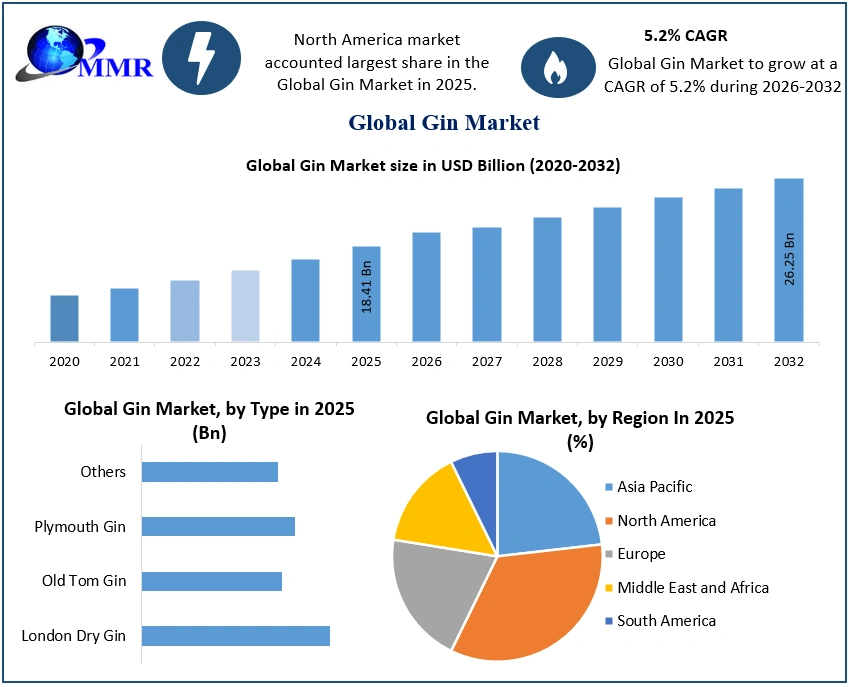
The Gin Market size was valued at USD 18.41 Billion in 2025 and the total Gin revenue is expected to grow at a CAGR of 5.2% from 2026 to 2032, reaching nearly USD 26.25 Billion by 2032.
Gin Market Overview:
Gin is a flavored, distilled, colorless to light yellow beverage prepared from pure spirits derived from a grain mash and includes juniper berries as its main flavoring ingredient. It comprises both the malty-flavored and full-bodied Netherlands kinds and the drier forms made in Britain and the United States, which are distinguished by different botanical flavoring. This distilled alcoholic beverage increases the range of alternatives available to meet the increasing demand for spirits. The alcoholic drinks market is developing as more distilleries arise in the global beverages sector, owing to the growth in alcohol use among the world's young and millennial populations.
To know about the Research Methodology :- Request Free Sample Report
The report explores the Gin market's segments (Type, Product Type, Price Point, Distribution Channel, and Region). Data has been provided by market participants, and regions (North America, Asia Pacific, Europe, Middle East & Africa, and South America). It provides a thorough analysis of the rapid advances that are currently taking place across all industry sectors. Facts and figures, illustrations, and presentations are used to provide key data analysis for the historical period from 2020 to 2025. The report investigates the Gin market's drivers, limitations, prospects, and barriers. This MMR report includes investor recommendations based on a thorough examination of the Gin market's contemporary competitive scenario.
Gin Market Dynamics:
Increasing demand for Alcoholic Beverages is a Major Driver of the Gin Market.
The growing demand for alcoholic beverages in developed and developing economies, increasing their large population bases, and growing use of alcohol by the millennial generation, as well as rising disposable income, help the industry's growth. Additionally, changing consumer preferences for premium liquor variations are anticipated to drive the demand for premium brands. Huge populations across the world are relocating to larger cities, where they are introduced to a broader choice of alcoholic beverage products, significantly contributing to market growth. However, rising social acceptance, extravagant consumption, and increasing urbanization are driving sector growth.
Consumer shift toward online shopping for alcohol is driving the market growth.
Because of the Covid 19 pandemic, the internet and technology are altering how customers locate and purchase items. Online alcohol buying was low in comparison to other retail categories, but it is a fast-growing channel that has expanded substantially under Covid-19. Consumers are increasingly using the internet to explore and learn about companies and goods that they would have discovered and learned about previously in venues and while out socializing.
Customers desire new experiences and higher-quality products.
Consumers are 'drinking better, not more when it comes to beverage alcohol, progressively preferring brands and categories that provide greater quality, authenticity, and flavor. This premiumization movement is being fueled by product innovation and rising levels of affluence and disposable cash, as well as a growing desire to explore new experiences, ingredients, and servings for social events.
The high Cost of Gin is a key Restraint for the Gin Market.
A standard bottle of gin's manufacturing expenses is likely to be greater, due to its manufacturing process, raw materials costs, etc. The cost of premium gin is not affordable to middle-level consumers and this factor restricts the market growth. Although excessive consumption contributes to various health concerns such as cancer, cirrhosis of the liver, violence, and accidents, among other issues, the gin market's expansion is restricted.
The alcoholic beverage industry is highly regulated.
Regulation differs widely around the world, frequently altering in reaction to societal changes. Some countries, for example, have imposed temporary limitations in reaction to Covid-19. Compliance with law and regulation is the very minimum wherever we operate, and we have long recognized that a responsible beverage company must go beyond ordinary compliance. In terms of starting new businesses and expanding, liquor licensing and sourcing emerged as a major growth restriction for the industry, as the requirement to obtain several mandatory licenses and regulations related to hours of operation and consumer minimum age, which varies by state, emerged as a major growth barrier for the industry. Each state in India has its regulatory limits on alcohol production, marketing and distribution, and even price, and we have long recognized that a responsible alcohol firm must go beyond mere compliance.
Gin Market Segment Analysis:
By Type, the London Dry Gin segment dominated the global gin market in terms of market share of xx% in 2025 and is expected to maintain its dominance at the end of the forecast period. London Dry Gin is a popular beverage all over the world due to its widespread availability and better flavor and refreshment provided to customers. The fruit utilized for its distinctive flavor, London Dry Gin, contains intense juniper tastes. It also has a lot of fresh citrus overtones. This is why a lemon twist enhances the citrus flavors of a Martini. Dry gins are distinguished by the absence of artificial tastes such as sweeteners. It's a pretty natural way to display gin.
By Product Type, the Flavored Gin segment is expected to dominate the market at the end of the forecast period. The citrus in quality lemonade pairs well with flavored gins, which are becoming increasingly popular, and Violet and new Apple & Lime flavors have become strong favorites among drinkers. Consumers place a high value on uniqueness. Violet gin stands out on the shelves and looks much better on social media. Due to this, flavored gin is popular among the drinkers and their popular flavors include rhubarb, strawberry, and orange.
By Distribution Channel, the Online Retail segment is expected to grow at the end of the forecast period. The increased use and penetration of the Internet have transformed the online marketplace into a significant distribution and communication medium through which consumers and businesses interact. Along with that, The Covid-19 outbreak has changed consumer preferences towards shopping. The growing importance of consumer engagement in online purchases has converted the Internet into a dominant force that impacts consumer behavior. Its features, such as the availability of vast volumes of information, cheaper search prices, and access to all rivals, have altered customers' research and purchasing habits. The Internet allows anybody to connect at any time and from any location, making it easier for customers to gather and compare rival offerings. Different merchants can be visited at the same time, as unknown retailers, and their products/services can be compared at the same time. Everyone has access to a massive quantity of information in terms of detail and several sources.
Gin Market Regional Insights:
North American Region is expected to dominate the global gin market at the end of the forecast period followed by the Asia Pacific region. The region's increasing millennial population is expected to drive the gin market. Furthermore, changing lifestyles, disposable income, and urbanization in this area are driving factors in the gin industry. The number of manufacturers in the United States has expanded rapidly as a result of secure approval processes implemented by regulatory agencies.
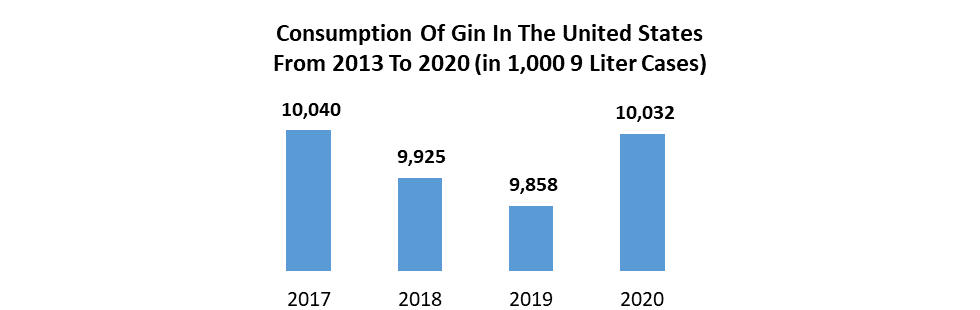
Gin production, distribution, and sale in the United States are heavily regulated. Consolidation has occurred at various levels in several industries as a result of the regulatory environment. While bigger corporations hold a sizable market share, the number of smaller brewers, vintners, and distillers, known as the craft sector, has increased rapidly but still accounts for a small portion of the industry. Small businesses have distribution issues due to rising concentration in many state distribution marketplaces and state restrictions controlling distribution. Responses to the call for information for this research claim that marketing arrangements involving major manufacturers, retailers, and distributors also restrict the growth of small businesses.
The Asia Pacific region is expected to grow at the end of the forecast period. The market is expected to develop at the fastest CAGR due to rising purchasing power and the substantial growth of the millennial population in emerging countries such as China, India, Malaysia, Thailand, and Indonesia. The enormous potential in these countries' undeveloped markets will almost certainly generate profitable possibilities in this region. Increasing demand for alcoholic beverages in emerging countries due to their large population, increased use of alcohol by the young generation, and rising disposable income encourage market growth in this region.
The objective of the report is to present a comprehensive analysis of the Gin market to the stakeholders in the industry. The past and current status of the industry with the forecasted market size and trends are presented in the report with the analysis of complicated data in simple language. The report covers all the aspects of the industry with a dedicated study of key players that include market leaders, followers, and new entrants.
PORTER, PESTEL analysis with the potential impact of micro-economic factors of the market has been presented in the report. External as well as internal factors that are supposed to affect the business positively or negatively have been analyzed, which will give a clear futuristic view of the industry to the decision-makers.
The report also helps in understanding the Gin market dynamics, and structure by analyzing the market segments and projecting the Gin market size. Clear representation of competitive analysis of key players by product, price, financial position, product portfolio, growth strategies, and regional presence in the Gin market make the report investor’s guide.
Gin Market Scope: Inquire before buying
| Gin Market | |||
|---|---|---|---|
| Report Coverage | Details | ||
| Base Year: | 2025 | Forecast Period: | 2026-2032 |
| Historical Data: | 2020 to 2025 | Market Size in 2025: | USD 18.41 Bn. |
| Forecast Period 2026 to 2032 CAGR: | 5.2 % | Market Size in 2032: | USD 26.25 Bn. |
| Segments Covered: | by Type | London Dry Gin Old Tom Gin Plymouth Gin Others |
|
| by Product Type | Flavored Plain |
||
| by Price Point | Standard Premium Luxury |
||
| by Distribution Channel | Supermarkets Hypermarkets Specialty Stores Online Retail Others |
||
Gin Market, by Region
North America (United States, Canada and Mexico)
Europe (UK, France, Germany, Italy, Spain, Sweden, Austria and Rest of Europe)
Asia Pacific (China, South Korea, Japan, India, Australia, Indonesia, Malaysia, Vietnam, Taiwan, Bangladesh, Pakistan and Rest of APAC)
Middle East and Africa (South Africa, GCC, Egypt, Nigeria and Rest of ME&A)
South America (Brazil, Argentina Rest of South America)
Gin Market, Key Players
1. Diageo plc
2. William Grant & Sons Limited
3. Bacardi Limited
4. Pernod Ricard S.A.
5. San Miguel Corporation
6. Southwestern Distillery
7. Davide Campari-Milano N.V.
8. Remy Cointreau
9. Lucas Bols
10. Forest Spirits’ Gin.
11. The East India Company Ltd
12. Ginebra San Miguel Inc.
13. The Poshmakers Ltd
14. West End Drinks Ltd
15. Boudier Gabriel Ets SA
16. Suntory Holdings Limited
17. The Sustainable Spirit Co. (U.K.)
18. The Black Bottle Distillery
19. Langtons Gin Ltd
FAQs:
1. Which is the potential market for the Gin in terms of the region?
Ans. North American Region is expected to dominate the global gin market at the end of the forecast period.
2. What are the opportunities for new market entrants?
Ans. The key opportunity in the market is Customers desire new experiences and higher-quality products.
3. What is expected to drive the growth of the Gin market in the forecast period?
Ans. A major driver in the Gin market is the Increasing demand for Alcoholic Beverages.
4. What is the expected market size & growth rate of the Gin Market?
Ans. The Gin Market size was valued at USD 18.41 Billion in 2025 and the total Gin revenue is expected to grow at a CAGR of 5.2% from 2026 to 2032, reaching nearly USD 26.25 Billion by 2032.
5. What segments are covered in the Gin Market report?
Ans. The segments covered are Type, Product Type, Price Point, Distribution Channel and Region.