Edible Oils Market - Industry Structure Evaluation, Demand Drivers Analysis, Regional Growth Analysis and Identification, Competitive Positioning Review & Global Market Size Forecast to 2032

4.7%
CAGR (2026-2032)
233 USD Bn.
Market Size
313
Report Pages
140
Market Tables

Overview

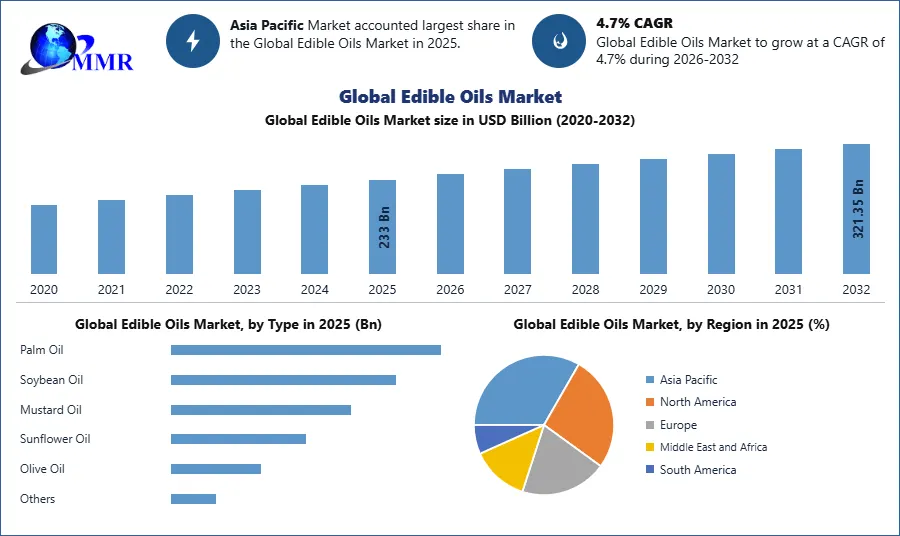
The Edible Oils Market size was valued at USD 233 Billion in 2025 and the total Edible Oils revenue is expected to grow at a CAGR of 4.7% from 2026 to 2032, reaching nearly USD 321.35 Billion.

Edible Oils Market Overview:

The edible oils market is highly competitive globally, showing a mix of large players and small-scale manufacturers that provides a diverse array of edible oil products. The Edible vegetable oils consist of nearly 96% triglycerides of plant origin comprising olive, palm, soybean, canola, and sunflower oil, and are composed of different fatty acids. Other compounds or group of compounds identified include free fatty acids, phospholipids, phytosterols, tocopherols, and other antioxidants or waxes. The study provided detailed information about edible oil parameters such as consumer preferences, safety regulations across the countries, etc.

The MMR report covers the edible oils market's segments by Type, Packaging Type, Distribution Channel, and Region. The data provides a thorough analysis of the rapid advances that are currently taking place across all industry sectors. Facts and figures, illustrations, and presentations are used to provide key data analysis for the historical period from 2019 to 2025 and forecast period 2026-2032. This MMR report includes investor recommendations based on a thorough examination of the Edible Oils market's contemporary competitive scenario.

Global Edible Oils Market: Competitive Dashboard

Manufacturers of edible oils are growing their marketing approaches to align with ongoing market trends. Prominent suppliers are increasingly focusing on the nutritional enhancement of their products, offering various edible oils that boast specific health benefits. High quality remains a top priority for these manufacturers. Notable developments in the industry include Cargill's launch of the Gemini Pureit sunflower oil brand in Karnataka, India, in February.

Alfa Laval acquired Desmet, a world leader in edible oil and biofuel processing in . Furthermore, in November , Cargill announced a USD 35 million investment to acquire and upgrade an edible oil refinery in Nellore, Andhra Pradesh. In August , the Government of India launched the National Mission for Edible Oils - Oil Palm (NMEO-OP), further highlighting the importance of this sector.
Edible Oils MarketTo know about the Research Methodology :- Request Free Sample Report

Edible Oils Market Dynamics:

Global Fast-Food Boom Drives Edible Oils Market Demand:

The growing demand for fast food globally is driving an increased demand for edible oils. Factors such as changing lifestyles, evolving food tastes, and a rising number of working women are contributing to the surge in fast food consumption. Fast food aims to satisfy consumers by providing quick service and rapid turnover at competitive prices. These foods are easily prepared using energy-efficient cooking methods and are highly palatable owing to fat absorption, crust formation, and appealing flavors and aromas. Frying, a popular method for preparing meals and fast foods worldwide, relies on oil for its chemical composition that facilitates the right reactions, resulting in delicious food. Consequently, this trend is boosting the demand for edible oils market.

Increasing Awareness About the Health Benefits Associated with Edible Oils Consumption

An equilibrated diet and regular exercise are crucial for preventing and improving the quality of life for patients suffering from chronic diseases such as cancer, neurological disorders, and cardiovascular diseases. Fats, a significant component of the diet, are predominantly consumed through edible oils market. While many people worldwide consume excessive calories from fats, contributing to a global pandemic of obesity and overweight individuals, it is important to note that not all fats impact health negatively. Edible oils, which are a major source of dietary fats, offer various health benefits. One of the primary advantages of edible oil is its lightness and ease of digestion. Rich in Vitamin E and antioxidants, edible oils also contain unsaturated fats that help lower cholesterol levels, making them beneficial for heart health. Furthermore, organic oils are often unrefined, unbleached, and unscented, preserving their natural qualities and enhancing their health benefits. As awareness of these health benefits grows, the demand for edible oils is increasing, driving significant growth in the edible oils market. This awareness, coupled with the recognized need for healthier dietary fats, positions edible oils as a key component in promoting better health and preventing chronic diseases.

Adverse Health Effects Associated with Oil Rancidity Restrain Edible Oils Market Growth

When oils meet oxygen and moisture, they undergo a process called autooxidation, or rancidity. This results in unpleasant odors, changes in taste, strange hues, the formation of potentially harmful chemicals, and a decline in the product's effectiveness. Edible vegetable oils are particularly prone to quality decline due to oxidation and microbial degradation, leading to nutritional loss and off-flavors. Quality degradation of oils can result in the creation of reactive and hazardous oxidation products, posing health risks such as cancer and inflammation. In the body, rancid oil produces toxic free radicals, which are known to cause cellular damage and have been linked to diabetes, Alzheimer's disease, and other disorders. Furthermore, rancid oils can upset the stomach and deplete the body of vitamins B and E. The chemical composition of edible oils includes saturated and unsaturated fatty acids and glycerides, which are susceptible to these adverse changes. These health risks associated with oil rancidity are a significant restraint on the growth of the edible oils market.

Edible Oils Market Segment Analysis:

By Type, the Palm Oils segment held the highest market share of about 45% in 2025 and is expected to dominate the edible oils market at the end of the forecast period. Palm oil, the most widely consumed edible oil, has been a key driver of a tremendous rise in global vegetable oil markets. The oil palm tree, which grows mainly in the tropics, generates high-quality oil that is mostly used for cooking in developing countries. Thanks to its unique applications such as great cooking properties, smooth and creamy texture, absence of smell, and the natural preservative effect that extend the shelf life of food products, the demand for palm oil is increasing rapidly during the forecast period. It is also utilized in a variety of items ranging from margarine, ice cream, detergents, cosmetics, and fuel for automobiles and power plants, among others.

Palm oil is predominantly consumed in India, China, Indonesia, and Europe. The demand for palm oils is increasing because an individual needs to consume 2kg of palm oil per year, accounting for 6% of total fat consumption for a healthy adult between the ages of 18 and 72. Replacing palm oil with other types of edible oil, such as sunflower, soybean, or rapeseed oil, would require significantly more land because palm trees produce 4-10 times more oil per unit of farmed area than other crops. This substitution would have a considerable environmental impact, potentially leading to more forests being converted into agricultural land, thus affecting the Edible Oils Market.

The soybean oils segment is expected to grow significantly during the forecast period. Soybean oil is considered healthier than many other edible oils due to its range of important fatty acids and high Omega-3 and Omega-6 content. These fatty acids help control lipid and cholesterol metabolism and maintain healthy arterial veins. Additionally, its high vitamin B concentration aids digestion, preventing chronic digestive problems and constipation. Refined soybean oil is widely utilized worldwide for these health benefits. Soybean oil also contains vitamin E, an anti-inflammatory ingredient that benefits skin health, making it popular in serums, gels, lotions, and other beauty products.

Its moderate, neutral flavor suits various recipes, further increasing its demand in the Edible Oils Market.
Soybean oil is generally safe for most people when consumed in food proportions and applied to the skin in approved amounts as an insect repellent. Pharmaceutical-grade soybean oil is also acceptable when used as a nutritional supplement in intravenous feedings. However, soybean oil can cause negative effects, including allergies in individuals hypersensitive to soybeans and soy products, gynecomastia, mood disorders, and obesity due to increased estrogen levels, especially in males. Growing awareness about these side effects may restrict segment growth in the Edible Oils Market.


Based on Packaging Type, in 2025, the pouches segment is projected to hold a significant 60% share of the global edible oils market, driven by its increasing popularity among consumers. Pouches offer numerous advantages over traditional packaging formats such as bottles and cans. They occupy less physical space, which appeals particularly to urban consumers living in smaller spaces. Furthermore, pouches are lightweight and easy to handle, making them highly portable for today's on-the-go lifestyles. Moreover, the pouch format allows for innovative bag-in-box packaging solutions that minimize oil wastage and mess during filling. Enhanced barrier technologies employed in pouches help maintain oil freshness better than other packaging types. Some self-standing pouch designs facilitate easier dispensing and pouring of oil directly from the pouch without requiring an additional container, adding to their convenience. These user-friendly features are driving increased consumer preference, especially among young professionals and families, towards oils packaged in pouches. Overall, these factors have positioned pouches as the preferred format driving growth in the edible oils market globally.

Edible Oils Market Regional Insights:

In 2025, The Asia-Pacific edible oils market had a revenue share of about 53% of the global edible oils market and is expected to maintain its dominance at the end of the forecast period. The APAC region has a dense concentration of global and local edible oil manufacturers, as well as a massive population, increasing disposable income, and increased awareness among individuals about the health benefits of edible oil usage, rapidly growing food processing industries in Asia and other developing countries which are the factors driving the region's edible oils market growth. Furthermore, the increasing usage of edible oil in cosmetics and personal care products is driving growth in the Asia-Pacific edible oils market.


India has the world's fourth biggest vegetable oil economy, harvesting over 25 million tonnes of oilseeds annually. China is the world's largest consumer of edible oil, followed by Europe. But China's COVID-19 regulations, decreasing economic development, and increased global commodity costs have decreased China's demand for oilseed processing, protein meal, and vegetable oil consumption.

North American edible oils market is expected to account for the significant growth in the global edible oils market during the forecast period owing to the increasing adoption of edible oil in the cosmetic and beauty product industry and the presence of major players in the US and Canada, etc. Global soybean production increased in past years, with bumper crops in the United States and Brazil adding to inventory buildups. Demand for protein meals has slowed because of China's new tariffs on US soybean exports and consequent steps to reduce the proportion of protein meal in feed rations.

The objective of the report is to present a comprehensive analysis of the market to the stakeholders in the industry. The past and status of the industry with the forecasted edible oils market size and trends are presented in the report with the analysis of complicated data in simple language. The report covers all the aspects of the industry with a dedicated study of key players that include market leaders, followers, and new entrants. The report also helps in understanding the Edible Oils market dynamics, and structure by analyzing the edible oils market segments and projecting the edible oils market size. Clear representation of competitive analysis of key players by product, price, financial position, product portfolio, growth strategies, and regional presence in the edible oils market make the report investor’s guide.

Recent Industry Developments

Exact Date Company Development Impact
03 March 2026 Whitworths Food Group The company completed the acquisition of KTC Edibles from the private equity firm Endless LLP to consolidate its position in the UK oil market. This move expands their distribution network and strengthens their portfolio in the specialty and ethnic edible oil segments.
15 September 2025 Clean Food Group (CFG) Acquired the assets of Algal Omega 3, including a 1 million-liter fermentation facility, to scale production of sustainable oils. The acquisition makes CFG the world's largest producer of yeast-derived oils, providing a viable alternative to traditional tropical oils.
01 July 2025 India Gate Foods Launched the Uplife Gut Pro Oil, billed as India's first cooking oil fortified with Pro Digest and anti-inflammatory properties. The launch targets the premium wellness segment, differentiating the brand through functional health benefits for digestion.
01 February 2025 FDA (U.S.) A revised "healthy" definition took effect, allowing oils like olive and avocado oil to carry official healthy labels. This regulatory shift is expected to boost marketing efficacy and consumer demand for heart-healthy mono-unsaturated oils.
15 January 2025 Indonesian Ministry of Agriculture Officially implemented the B40 biodiesel program, increasing the mandatory palm oil blend rate from 35% to 40%. The mandate led to a 24% drop in palm oil exports, tightening global edible oil supplies and increasing price volatility.

Edible Oils Market Scope: Inquire before buying

Edible Oils Market
Report Coverage Details
Base Year: 2025 Forecast Period: 2026-2032
Historical Data: 2020 to 2025 Market Size in 2025: 233 USD Billion
Forecast Period 2026-2032 CAGR: 4.7% Market Size in 2032: 321.35 USD Billion
Segments Covered: by Type Palm Oil
Soybean Oil
Mustard Oil
Sunflower Oil
Olive Oil
Others
by Packaging Type Pouches
Jars
Cans
Bottles
by Distribution Channel Direct/Institutional Sales
Supermarkets and Hypermarkets
Convenience Stores
Online

Edible Oils Market, by Region

North America (United States, Canada and Mexico)
Europe (UK, France, Germany, Italy, Spain, Sweden, Austria, Turkey, Russia and Rest of Europe)
Asia Pacific (China, India, Japan, South Korea, Australia, ASEAN and Rest of APAC)
Middle East and Africa (South Africa, GCC, Egypt, Nigeria and Rest of ME&A)
South America (Brazil, Argentina, Columbia and Rest of South America)

Key Players / Competitors Profiles Covered in Brief in Global Edible Oils Market Report in Strategic Perspective:

  1. Cargill Inc.
  2. Aceitera General Deheza
  3. Bunge Limited
  4. Wilmar International Limited
  5. Adani Wilmar Limited
  6. Louis Dreyfus Company
  7. AAK AB
  8. Fuji Oil Holdings Inc.
  9. Olam International
  10. Conagra Brands, Inc.
  11. Associated British Foods plc
  12. Mewah Group
  13. IOI Corporation Berhad
  14. Sime Darby Plantation Berhad
  15. Golden Agri-Resources Ltd.
  16. Musim Mas Group
  17. Avril Group
  18. Marico Limited
  19. Richardson International Limited
  20. Patanjali Foods Limited
  21. Gokul Agro Resources Ltd.
  22. Viterra Inc.
  23. Nisshin OilliO Group, Ltd.
  24. United Plantations Berhad
  25. Kuala Lumpur Kepong Berhad

Table of Contents

1. Edible Oils Market Introduction
1.1. Study Assumption and Market Definition
1.2. Scope of the Study
1.3. Executive Summary
2. Global Edible Oils Market: Competitive Landscape
2.1. MMR Competition Matrix
2.2. Competitive Landscape
2.3. Key Players Benchmarking
2.3.1. Company Name
2.3.2. Business Segment
2.3.3. End-user Segment
2.3.4. Revenue (2025)
2.3.5. Company Locations
2.4. Leading Edible Oils Market Companies, by market capitalization
2.5. Market Structure
2.5.1. Market Leaders
2.5.2. Market Followers
2.5.3. Emerging Players
2.6. Mergers and Acquisitions Details
3. Edible Oils Market: Dynamics
3.1. Edible Oils Market Trends by Region
3.1.1. North America Edible Oils Market Trends
3.1.2. Europe Edible Oils Market Trends
3.1.3. Asia Pacific Edible Oils Market Trends
3.1.4. Middle East and Africa Edible Oils Market Trends
3.1.5. South America Edible Oils Market Trends
3.2. Edible Oils Market Dynamics by Region
3.2.1. North America
3.2.1.1. North America Edible Oils Market Drivers
3.2.1.2. North America Edible Oils Market Restraints
3.2.1.3. North America Edible Oils Market Opportunities
3.2.1.4. North America Edible Oils Market Challenges
3.2.2. Europe
3.2.2.1. Europe Edible Oils Market Drivers
3.2.2.2. Europe Edible Oils Market Restraints
3.2.2.3. Europe Edible Oils Market Opportunities
3.2.2.4. Europe Edible Oils Market Challenges
3.2.3. Asia Pacific
3.2.3.1. Asia Pacific Edible Oils Market Drivers
3.2.3.2. Asia Pacific Edible Oils Market Restraints
3.2.3.3. Asia Pacific Edible Oils Market Opportunities
3.2.3.4. Asia Pacific Edible Oils Market Challenges
3.2.4. Middle East and Africa
3.2.4.1. Middle East and Africa Edible Oils Market Drivers
3.2.4.2. Middle East and Africa Edible Oils Market Restraints
3.2.4.3. Middle East and Africa Edible Oils Market Opportunities
3.2.4.4. Middle East and Africa Edible Oils Market Challenges
3.2.5. South America
3.2.5.1. South America Edible Oils Market Drivers
3.2.5.2. South America Edible Oils Market Restraints
3.2.5.3. South America Edible Oils Market Opportunities
3.2.5.4. South America Edible Oils Market Challenges
3.3. PORTER's Five Forces Analysis
3.4. PESTLE Analysis
3.5. Technology Roadmap
3.6. Regulatory Landscape by Region
3.6.1. North America
3.6.2. Europe
3.6.3. Asia Pacific
3.6.4. Middle East and Africa
3.6.5. South America
3.7. Key Opinion Leader Analysis For Edible Oils Industry
3.8. Analysis of Government Schemes and Initiatives For Edible Oils Industry
3.9. Edible Oils Market Trade Analysis
3.10. The Global Pandemic Impact on Edible Oils Market
4. Edible Oils Market: Global Market Size and Forecast by Segmentation (in USD Billion) 2025-2032
4.1. Edible Oils Market Size and Forecast, by Type (2025-2032)
4.1.1. Palm Oil
4.1.2. Soybean Oil
4.1.3. Mustard Oil
4.1.4. Sunflower Oil
4.1.5. Olive Oil
4.1.6. Others
4.2. Edible Oils Market Size and Forecast, by Packaging Type (2025-2032)
4.2.1. Pouches
4.2.2. Jars
4.2.3. Cans
4.2.4. Bottles
4.3. Edible Oils Market Size and Forecast, by Distribution Channel (2025-2032)
4.3.1. Direct/Institutional Sales
4.3.2. Supermarkets and Hypermarkets
4.3.3. Convenience Stores
4.3.4. Online
4.4. Edible Oils Market Size and Forecast, by Region (2025-2032)
4.4.1. North America
4.4.2. Europe
4.4.3. Asia Pacific
4.4.4. Middle East and Africa
4.4.5. South America
5. North America Edible Oils Market Size and Forecast by Segmentation (in USD Billion) 2025-2032
5.1. North America Edible Oils Market Size and Forecast, by Type (2025-2032)
5.1.1. Palm Oil
5.1.2. Soybean Oil
5.1.3. Mustard Oil
5.1.4. Sunflower Oil
5.1.5. Olive Oil
5.1.6. Others
5.2. North America Edible Oils Market Size and Forecast, by Packaging Type (2025-2032)
5.2.1. Pouches
5.2.2. Jars
5.2.3. Cans
5.2.4. Bottles
5.3. North America Edible Oils Market Size and Forecast, by Distribution Channel (2025-2032)
5.3.1. Direct/Institutional Sales
5.3.2. Supermarkets and Hypermarkets
5.3.3. Convenience Stores
5.3.4. Online
5.4. North America Edible Oils Market Size and Forecast, by Country (2025-2032)
5.4.1. United States
5.4.1.1. United States Edible Oils Market Size and Forecast, by Type (2025-2032)
5.4.1.1.1. Palm Oil
5.4.1.1.2. Soybean Oil
5.4.1.1.3. Mustard Oil
5.4.1.1.4. Sunflower Oil
5.4.1.1.5. Olive Oil
5.4.1.1.6. Others
5.4.1.2. United States Edible Oils Market Size and Forecast, by Packaging Type (2025-2032)
5.4.1.2.1. Pouches
5.4.1.2.2. Jars
5.4.1.2.3. Cans
5.4.1.2.4. Bottles
5.4.1.3. United States Edible Oils Market Size and Forecast, by Distribution Channel (2025-2032)
5.4.1.3.1. Direct/Institutional Sales
5.4.1.3.2. Supermarkets and Hypermarkets
5.4.1.3.3. Convenience Stores
5.4.1.3.4. Online
5.4.2. Canada
5.4.2.1. Canada Edible Oils Market Size and Forecast, by Type (2025-2032)
5.4.2.1.1. Palm Oil
5.4.2.1.2. Soybean Oil
5.4.2.1.3. Mustard Oil
5.4.2.1.4. Sunflower Oil
5.4.2.1.5. Olive Oil
5.4.2.1.6. Others
5.4.2.2. Canada Edible Oils Market Size and Forecast, by Packaging Type (2025-2032)
5.4.2.2.1. Pouches
5.4.2.2.2. Jars
5.4.2.2.3. Cans
5.4.2.2.4. Bottles
5.4.2.3. Canada Edible Oils Market Size and Forecast, by Distribution Channel (2025-2032)
5.4.2.3.1. Direct/Institutional Sales
5.4.2.3.2. Supermarkets and Hypermarkets
5.4.2.3.3. Convenience Stores
5.4.2.3.4. Online
5.4.3. Mexico
5.4.3.1. Mexico Edible Oils Market Size and Forecast, by Type (2025-2032)
5.4.3.1.1. Palm Oil
5.4.3.1.2. Soybean Oil
5.4.3.1.3. Mustard Oil
5.4.3.1.4. Sunflower Oil
5.4.3.1.5. Olive Oil
5.4.3.1.6. Others
5.4.3.2. Mexico Edible Oils Market Size and Forecast, by Packaging Type (2025-2032)
5.4.3.2.1. Pouches
5.4.3.2.2. Jars
5.4.3.2.3. Cans
5.4.3.2.4. Bottles
5.4.3.3. Mexico Edible Oils Market Size and Forecast, by Distribution Channel (2025-2032)
5.4.3.3.1. Direct/Institutional Sales
5.4.3.3.2. Supermarkets and Hypermarkets
5.4.3.3.3. Convenience Stores
5.4.3.3.4. Online
6. Europe Edible Oils Market Size and Forecast by Segmentation (in USD Billion) 2025-2032
6.1. Europe Edible Oils Market Size and Forecast, by Type (2025-2032)
6.2. Europe Edible Oils Market Size and Forecast, by Packaging Type (2025-2032)
6.3. Europe Edible Oils Market Size and Forecast, by Distribution Channel (2025-2032)
6.4. Europe Edible Oils Market Size and Forecast, by Country (2025-2032)
6.4.1. United Kingdom
6.4.1.1. United Kingdom Edible Oils Market Size and Forecast, by Type (2025-2032)
6.4.1.2. United Kingdom Edible Oils Market Size and Forecast, by Packaging Type (2025-2032)
6.4.1.3. United Kingdom Edible Oils Market Size and Forecast, by Distribution Channel (2025-2032)
6.4.2. France
6.4.2.1. France Edible Oils Market Size and Forecast, by Type (2025-2032)
6.4.2.2. France Edible Oils Market Size and Forecast, by Packaging Type (2025-2032)
6.4.2.3. France Edible Oils Market Size and Forecast, by Distribution Channel (2025-2032)
6.4.3. Germany
6.4.3.1. Germany Edible Oils Market Size and Forecast, by Type (2025-2032)
6.4.3.2. Germany Edible Oils Market Size and Forecast, by Packaging Type (2025-2032)
6.4.3.3. Germany Edible Oils Market Size and Forecast, by Distribution Channel (2025-2032)
6.4.4. Italy
6.4.4.1. Italy Edible Oils Market Size and Forecast, by Type (2025-2032)
6.4.4.2. Italy Edible Oils Market Size and Forecast, by Packaging Type (2025-2032)
6.4.4.3. Italy Edible Oils Market Size and Forecast, by Distribution Channel (2025-2032)
6.4.5. Spain
6.4.5.1. Spain Edible Oils Market Size and Forecast, by Type (2025-2032)
6.4.5.2. Spain Edible Oils Market Size and Forecast, by Packaging Type (2025-2032)
6.4.5.3. Spain Edible Oils Market Size and Forecast, by Distribution Channel (2025-2032)
6.4.6. Sweden
6.4.6.1. Sweden Edible Oils Market Size and Forecast, by Type (2025-2032)
6.4.6.2. Sweden Edible Oils Market Size and Forecast, by Packaging Type (2025-2032)
6.4.6.3. Sweden Edible Oils Market Size and Forecast, by Distribution Channel (2025-2032)
6.4.7. Austria
6.4.7.1. Austria Edible Oils Market Size and Forecast, by Type (2025-2032)
6.4.7.2. Austria Edible Oils Market Size and Forecast, by Packaging Type (2025-2032)
6.4.7.3. Austria Edible Oils Market Size and Forecast, by Distribution Channel (2025-2032)
6.4.8. Rest of Europe
6.4.8.1. Rest of Europe Edible Oils Market Size and Forecast, by Type (2025-2032)
6.4.8.2. Rest of Europe Edible Oils Market Size and Forecast, by Packaging Type (2025-2032)
6.4.8.3. Rest of Europe Edible Oils Market Size and Forecast, by Distribution Channel (2025-2032)
7. Asia Pacific Edible Oils Market Size and Forecast by Segmentation (in USD Billion) 2025-2032
7.1. Asia Pacific Edible Oils Market Size and Forecast, by Type (2025-2032)
7.2. Asia Pacific Edible Oils Market Size and Forecast, by Packaging Type (2025-2032)
7.3. Asia Pacific Edible Oils Market Size and Forecast, by Distribution Channel (2025-2032)
7.4. Asia Pacific Edible Oils Market Size and Forecast, by Country (2025-2032)
7.4.1. China
7.4.1.1. China Edible Oils Market Size and Forecast, by Type (2025-2032)
7.4.1.2. China Edible Oils Market Size and Forecast, by Packaging Type (2025-2032)
7.4.1.3. China Edible Oils Market Size and Forecast, by Distribution Channel (2025-2032)
7.4.2. S Korea
7.4.2.1. S Korea Edible Oils Market Size and Forecast, by Type (2025-2032)
7.4.2.2. S Korea Edible Oils Market Size and Forecast, by Packaging Type (2025-2032)
7.4.2.3. S Korea Edible Oils Market Size and Forecast, by Distribution Channel (2025-2032)
7.4.3. Japan
7.4.3.1. Japan Edible Oils Market Size and Forecast, by Type (2025-2032)
7.4.3.2. Japan Edible Oils Market Size and Forecast, by Packaging Type (2025-2032)
7.4.3.3. Japan Edible Oils Market Size and Forecast, by Distribution Channel (2025-2032)
7.4.4. India
7.4.4.1. India Edible Oils Market Size and Forecast, by Type (2025-2032)
7.4.4.2. India Edible Oils Market Size and Forecast, by Packaging Type (2025-2032)
7.4.4.3. India Edible Oils Market Size and Forecast, by Distribution Channel (2025-2032)
7.4.5. Australia
7.4.5.1. Australia Edible Oils Market Size and Forecast, by Type (2025-2032)
7.4.5.2. Australia Edible Oils Market Size and Forecast, by Packaging Type (2025-2032)
7.4.5.3. Australia Edible Oils Market Size and Forecast, by Distribution Channel (2025-2032)
7.4.6. Indonesia
7.4.6.1. Indonesia Edible Oils Market Size and Forecast, by Type (2025-2032)
7.4.6.2. Indonesia Edible Oils Market Size and Forecast, by Packaging Type (2025-2032)
7.4.6.3. Indonesia Edible Oils Market Size and Forecast, by Distribution Channel (2025-2032)
7.4.7. Malaysia
7.4.7.1. Malaysia Edible Oils Market Size and Forecast, by Type (2025-2032)
7.4.7.2. Malaysia Edible Oils Market Size and Forecast, by Packaging Type (2025-2032)
7.4.7.3. Malaysia Edible Oils Market Size and Forecast, by Distribution Channel (2025-2032)
7.4.8. Vietnam
7.4.8.1. Vietnam Edible Oils Market Size and Forecast, by Type (2025-2032)
7.4.8.2. Vietnam Edible Oils Market Size and Forecast, by Packaging Type (2025-2032)
7.4.8.3. Vietnam Edible Oils Market Size and Forecast, by Distribution Channel (2025-2032)
7.4.9. Taiwan
7.4.9.1. Taiwan Edible Oils Market Size and Forecast, by Type (2025-2032)
7.4.9.2. Taiwan Edible Oils Market Size and Forecast, by Packaging Type (2025-2032)
7.4.9.3. Taiwan Edible Oils Market Size and Forecast, by Distribution Channel (2025-2032)
7.4.10. Rest of Asia Pacific
7.4.10.1. Rest of Asia Pacific Edible Oils Market Size and Forecast, by Type (2025-2032)
7.4.10.2. Rest of Asia Pacific Edible Oils Market Size and Forecast, by Packaging Type (2025-2032)
7.4.10.3. Rest of Asia Pacific Edible Oils Market Size and Forecast, by Distribution Channel (2025-2032)
8. Middle East and Africa Edible Oils Market Size and Forecast by Segmentation (in USD Billion) 2025-2032
8.1. Middle East and Africa Edible Oils Market Size and Forecast, by Type (2025-2032)
8.2. Middle East and Africa Edible Oils Market Size and Forecast, by Packaging Type (2025-2032)
8.3. Middle East and Africa Edible Oils Market Size and Forecast, by Distribution Channel (2025-2032)
8.4. Middle East and Africa Edible Oils Market Size and Forecast, by Country (2025-2032)
8.4.1. South Africa
8.4.1.1. South Africa Edible Oils Market Size and Forecast, by Type (2025-2032)
8.4.1.2. South Africa Edible Oils Market Size and Forecast, by Packaging Type (2025-2032)
8.4.1.3. South Africa Edible Oils Market Size and Forecast, by Distribution Channel (2025-2032)
8.4.2. GCC
8.4.2.1. GCC Edible Oils Market Size and Forecast, by Type (2025-2032)
8.4.2.2. GCC Edible Oils Market Size and Forecast, by Packaging Type (2025-2032)
8.4.2.3. GCC Edible Oils Market Size and Forecast, by Distribution Channel (2025-2032)
8.4.3. Nigeria
8.4.3.1. Nigeria Edible Oils Market Size and Forecast, by Type (2025-2032)
8.4.3.2. Nigeria Edible Oils Market Size and Forecast, by Packaging Type (2025-2032)
8.4.3.3. Nigeria Edible Oils Market Size and Forecast, by Distribution Channel (2025-2032)
8.4.4. Rest of ME&A
8.4.4.1. Rest of ME&A Edible Oils Market Size and Forecast, by Type (2025-2032)
8.4.4.2. Rest of ME&A Edible Oils Market Size and Forecast, by Packaging Type (2025-2032)
8.4.4.3. Rest of ME&A Edible Oils Market Size and Forecast, by Distribution Channel (2025-2032)
9. South America Edible Oils Market Size and Forecast by Segmentation (in USD Billion) 2025-2032
9.1. South America Edible Oils Market Size and Forecast, by Type (2025-2032)
9.2. South America Edible Oils Market Size and Forecast, by Packaging Type (2025-2032)
9.3. South America Edible Oils Market Size and Forecast, by Distribution Channel (2025-2032)
9.4. South America Edible Oils Market Size and Forecast, by Country (2025-2032)
9.4.1. Brazil
9.4.1.1. Brazil Edible Oils Market Size and Forecast, by Type (2025-2032)
9.4.1.2. Brazil Edible Oils Market Size and Forecast, by Packaging Type (2025-2032)
9.4.1.3. Brazil Edible Oils Market Size and Forecast, by Distribution Channel (2025-2032)
9.4.2. Argentina
9.4.2.1. Argentina Edible Oils Market Size and Forecast, by Type (2025-2032)
9.4.2.2. Argentina Edible Oils Market Size and Forecast, by Packaging Type (2025-2032)
9.4.2.3. Argentina Edible Oils Market Size and Forecast, by Distribution Channel (2025-2032)
9.4.3. Rest Of South America
9.4.3.1. Rest Of South America Edible Oils Market Size and Forecast, by Type (2025-2032)
9.4.3.2. Rest Of South America Edible Oils Market Size and Forecast, by Packaging Type (2025-2032)
9.4.3.3. Rest Of South America Edible Oils Market Size and Forecast, by Distribution Channel (2025-2032)
10. Company Profile: Key Players
10.1. Cargill Inc.
10.1.1. Company Overview
10.1.2. Business Portfolio
10.1.3. Financial Overview
10.1.4. SWOT Analysis
10.1.5. Strategic Analysis
10.1.6. Scale of Operation (small, medium, and large)
10.1.7. Details on Partnership
10.1.8. Regulatory Accreditations and Certifications Received by Them
10.1.9. Awards Received by the Firm
10.1.10. Recent Developments
10.2. Aceitera General Deheza
10.3. Bunge Limited
10.4. Wilmar International Limited
10.5. Adani Wilmar Limited
10.6. Louis Dreyfus Company
10.7. AAK AB
10.8. Fuji Oil Holdings Inc.
10.9. Olam International
10.10. Conagra Brands Inc.
10.11. Associated British Foods plc
10.12. Mewah Group
10.13. IOI Corporation Berhad
10.14. Sime Darby Plantation Berhad
10.15. Golden Agri-Resources Ltd.
10.16. Musim Mas Group
10.17. Avril Group
10.18. Marico Limited
10.19. Richardson International Limited
10.20. Patanjali Foods Limited
10.21. Gokul Agro Resources Ltd.
10.22. Viterra Inc.
10.23. Nisshin OilliO Group Ltd.
10.24. United Plantations Berhad
10.25. Kuala Lumpur Kepong Berhad
11. Key Findings
12. Industry Recommendations
13. Edible Oils Market: Research Methodology
14. Terms and Glossary

Custom Market Research Services

We Will Customise The Research For You, In Case The Report Listed Above Does Not Meet With Your Requirements