
Flavor Systems Market by Type, Source, Form, Application, End User, and Region – Global Market Size Estimation, Industry-Wide Analysis, Competitive Landscape Assessment & Forecast to 2034
Overview
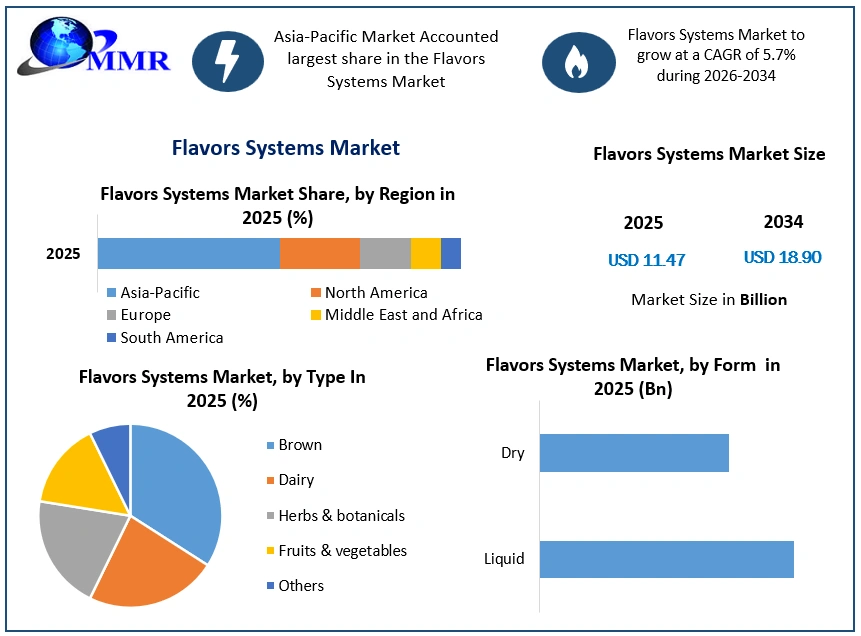
The Global Flavors Systems Market size was valued at USD 11.47 Bn. in 2025, and the total Global Flavors Systems Market revenue is expected to grow by 5.7% from 2026 to 2034, reaching nearly USD 18.90 Bn.
Flavors Systems Market Overview
The Flavors Systems Market has kept pace with the evolving tastes of consumers who are starting to prefer a wider variety of flavours with natural, better-quality experiences within food, beverages, and pharmaceutical products. Many products use flavour systems to flavour, stabilize, and modify the flavour proteins to aroma, which are required in many products such as processed food, dairy, beverages, confectionery, and nutraceuticals.
Flavors Systems Market Size, Growth & Share Analysis
To know about the Research Methodology:- Request Free Sample Report
The trend towards clean-label ingredients and demand for more natural ingredients is also a driving force behind the expansion. Other trends influencing the Flavors Systems Industry include various encapsulating technologies to improve shelf stability of flavour systems and an increase in ethnic and exotic flavours that continue to gain popularity due to globalisation.
The growing plant-based and alternative protein sector is a significant consumer of flavour systems, which are essential for enhancing palatability and masking undesirable tastes. These systems are transforming the food and beverage industry by delivering authentic, consistent, and appealing taste experiences that align with evolving consumer preferences.
The North American and European markets are the largest suppliers and spearheads of flavour systems, as both operate in Research and Development-oriented industries with consumers who value the highest quality products. The Asia-Pacific Region is expected to be the fastest growing region for flavour systems, with urbanisation, an increasing middle-class of consumers, and 'Western' food imports leading the way for increased consumption of flavour systems. Rising demand for customized, health-focused, and sustainably produced foods is expected to drive the need for flavour systems.
Flavors Systems Market Dynamics
Increasing Demand for Natural and Clean-Label Flavors to Boost Market Growth
Growing consumer demand for natural, clean-label, and organic products is fueling the expansion of the flavor systems market. Shoppers are increasingly seeking transparency in ingredients, prompting manufacturers to replace synthetic options with natural flavor solutions. Advances in extraction and fermentation technologies are enabling the production of authentic, high-quality flavors that meet both regulatory requirements and evolving consumer preferences. The surge in health-conscious eating, along with rising interest in plant-based and functional foods, is further accelerating the adoption of innovative flavor systems across the food, beverage, and nutraceutical sectors.
Technological Advancements in Flavors Encapsulation and Delivery to Drive the Global Flavors Systems Market
Innovative new processes such as microencapsulation, nanoemulsions, and controlled releases have significantly improved flavour systems beyond previous standards. These technologies are giving enhanced shelf life and stability in flavour, as well as higher overall flavour strength; thus, performance across applications will be improved. In addition to these technical developments, there have also been major advancements in AI flavour profiling and biotechnology to produce new, unique, and customized taste experiences, allowing for a wide range of potential market opportunities.
Rising Popularity of Ethnic and Exotic Flavors to Boost the Flavors Systems Market
Globalization and the growing influence of international cuisines are fueling consumer demand for ethnic and exotic flavors, including Asian, Middle Eastern, and Latin American profiles. Food manufacturers are increasingly incorporating these distinctive tastes into snacks, sauces, beverages, and ready-to-eat meals to cater to adventurous palates seeking diverse culinary experiences. This trend is particularly strong in North America and Europe, where multicultural dining is reshaping product innovation, encouraging companies to expand flavor portfolios and boosting the adoption of advanced flavor systems to deliver authentic taste experiences.
AI-Driven Flavor Personalization Unlocks New Opportunities in the Flavors Systems Market
Advancements in AI and machine learning are enabling food and beverage manufacturers to create personalized flavor profiles tailored to individual preferences. For example, sweetness or acidity levels in beverages can be fine-tuned before production to match consumer tastes. At the same time, the market is witnessing a surge in functional flavors enriched with health-promoting ingredients such as vitamins, probiotics, and adaptogens. As demand for health-oriented food and beverage products continues to rise, functional flavors are positioned for significant expansion. Additionally, emerging markets in Asia-Pacific and Latin America offer strong growth potential, driven by urbanization, higher disposable incomes, and evolving consumer palates.
Flavors Systems Market Segment Analysis
Based on the Source, the Natural Flavors Segment is expected to dominate the Flavors Systems Market during the forecast period. Derived from plant, animal, or microbial sources, natural flavors are in high demand as consumers increasingly prefer clean-label, organic, and minimally processed products. They are widely used in premium food and beverage offerings, where authenticity, freshness, and brand positioning are crucial.
Nature-identical flavors serve as a cost-effective alternative, created from lab-synthesized molecules that are chemically identical to natural flavors. These meet strict regulatory standards while providing consistent taste profiles, making them popular in processed foods, beverages, and pharmaceuticals. Artificial flavors, produced entirely through synthetic processes, offer manufacturers greater control over flavor intensity, stability, and cost, supporting large-scale production across a variety of mass-market applications. The combined use of these flavor types enables manufacturers to balance cost, authenticity, and product performance to meet evolving consumer preferences and market demands.
Based on Type, the Fruits & Vegetables segment dominates the Flavors Systems Market in 2025 and is expected to hold the largest Flavors Systems Market share over the forecast period. It is known for its natural, refreshing, and vibrant taste profiles, such as citrus, berry, and tropical notes. These flavors are widely used in beverages, snacks, and products targeting health-conscious consumers.
Their appeal is strongly tied to the clean-label movement, with demand driven by the perception of naturalness, nutritional value, and versatility in both sweet and savory applications. Brown flavors, such as chocolate, coffee, and caramel, continue to hold strong appeal in indulgent and comfort-oriented product categories, offering familiarity and depth. Dairy flavors remain key in bakery, confectionery, and dairy-based beverages, providing richness and mouthfeel.
Herbs & botanicals, with their aromatic and functional benefits, are increasingly integrated into teas, functional beverages, and savory formulations. The “other flavors” category, including floral, spicy, and fusion flavor profiles, caters to niche trends and experimental product launches, enabling brands to differentiate in competitive markets. This diversified flavor portfolio allows manufacturers to address varied consumer demands for health, indulgence, and novelty in the global food and beverage industry.
Flavors Systems Market Regional Insights
In 2025, the Asia-Pacific region dominated the global flavor systems market and is expected to contribute to the Market Growth over the coming years. This trend in Asia's growth is supported by rapid urbanization, the increase in disposable incomes for a growing population, and the influx of processed and convenience foods that are appealing to consumers, all of which are positioning this region as a key contributor to the global Flavors market.
Countries like China, India, Japan, and South Korea are major markets in the Asia Pacific, driven by industries that present a healthy food & beverage manufacturing sector, and an increasing interest in Flavors from varying backgrounds & diversity looking to experience more international Flavors. the introduction of quick-service restaurants (QSR), packaged snacks, and ready-to-drink beverages is driving demand for Flavors systems in this region.
North America held the second-largest Flavors Systems Market Share, led by strong demand from the U.S. and Canada. Consumers' interests in natural and clean-label, as well as new and innovative Flavors, will likely spur growth in this market. Further contributing to a growing market space is the already established food processing industry in North America, coupled with trends toward an increase in plant-based foods and functional beverages that continue to grow consumer interest.
There are also strict food regulation practices in conjunction with North America taking the lead in terms of R&D and developing advanced Flavors technologies to bring and offer premium Flavors solutions. Europe follows in line, and leads the market opportunity driven by food Flavors with Germany, France, and the U.K. identifying and contributing to the EU demand for organic and natural flavourings.
Given the food regulations in Europe, preference for authentic and high-quality Flavors is growing interest for producers and manufacturers to be seen in the market as having the complete and unique difference in the experience offered to compete in premium or distinct overall categories, thus spurring and supporting the incremental growth for Flavors foods in European countries.
Latin America and the Middle East & Africa are becoming key high-growth markets today, with rapid urbanization, Western dietary influences, and the expansion of the food processing industry leading to these new markets. Brazil, Mexico, and South Africa are the three most important markets, with growing demand for flavoured snacks, drinks, and convenience food.
| Government/Region | Initiative | Funding | Focus Area |
| U.S. (FDA & USDA) | Clean Label Flavors Innovation Grant | USD 120 Mn. | Natural Flavors R&D for processed foods and plant-based alternatives |
| EU (Horizon Europe) | Sustainable Flavors Production Fund | EUR 180 Mn. | Eco-friendly extraction tech & fermentation-derived Flavors |
| Japan (MAFF) | Premium Flavors Development Program | USD 80 Mn. | Umami enhancement, fermented Flavors for F&B exports |
| India (MoFPI) | Traditional Flavors Modernization Scheme | USD 50 Mn. | Commercializing regional spice/herb extracts for global markets |
| China (CNFA & MIIT) | Flavors Tech Industrialization Plan | USD 250 Mn. | AI-driven Flavors synthesis, lab-grown aromas for snacks & beverages |
Flavors Systems Market Competitive Landscape
The MMR Competitive Matrix for the flavour system market provides an in-depth benchmarking analysis of leading companies, categorizing them into market leaders, market followers, and emerging players. It evaluates each player based on parameters such as company name, headquarters, product portfolio, target end-use industries, revenue, market share, and global presence, offering a clear perspective on competitive positioning.
The market is highly competitive and dominated by a few multinational giants such as Givaudan, IFF, Firmenich (acquired by DSM), Symrise, and Kerry Group, holding a significant share of the global market. Givaudan, the Swiss flavours and fragrance leader, commands the largest market share due to its strong technological capabilities, strategic acquisitions, and consistent R&D investment, allocating nearly 10% of its annual turnover toward innovation. Its vertical integration, proprietary extraction methods, fermentation-derived natural flavour solutions, and advanced delivery systems like microencapsulation and taste modulation set it apart from competitors.
Acquisitions such as Amyris’ flavour business have strengthened its clean-label and biotech-based offerings, while programs like TasteEssentials and TasteSolutions enable it to deliver complete flavour systems covering taste, nutrition, and texture—crucial for growth in the plant-based, functional, and health-focused food sectors. This competitive framework highlights the importance of strategic partnerships, innovation, and R&D investment in driving growth and differentiation within the global flavour system industry.
June 2023 - Kerry Group (Ireland)
Launch: "TasteSense Sweet" sugar reduction technology for sugar reduction that offers next next-generation system
Features: Sugar reduction with 50% less sugar and with no aftertaste
Pilot: Two major soft drink manufacturers in the EU and U.S.
Flavors Systems Market Recent Development
| Date | Company | Development | Impact |
|---|---|---|---|
| 15 October 2025 | Symrise AG | Symrise completed a strategic investment in Cellibre, a biotech firm specializing in precision fermentation. | Accelerates the commercialization of high-value natural flavor ingredients while strengthening supply-chain resilience. |
| Givaudan | The company launched an AI-powered sensory mapping platform to optimize flavor profiling for plant-based proteins. | Reduces the "sensory gap" in meat alternatives, leading to higher consumer acceptance and product consistency. | |
| International Flavors & Fragrances (IFF) | IFF introduced a new line of clean-label botanical flavor systems developed using its proprietary PANOPTIC foresight framework. | Supports the growing consumer demand for transparent, earth-forward ingredient sourcing in functional food and beverage segments. | |
| Sensient Technologies | Sensient expanded its sustainable design program to apply carbon-reduction metrics to 100% of its new flavor system developments. | Significantly lowers the carbon footprint of flavor production while meeting stringent ESG targets for global food partners. |
Flavor Systems Market Scope: Inquire before buying
| Global Flavor Systems Market | |||
|---|---|---|---|
| Report Coverage | Details | ||
| Base Year: | 2025 | Forecast Period: | 2026-2034 |
| Historical Data: | 2020 to 2025 | Market Size in 2026: | USD 11.47 Bn. |
| Forecast Period 2026 to 2034 CAGR: | 5.7% | Market Size in 2034: | USD 18.90 Bn. |
| Segments Covered: | by Type | Brown Dairy Herbs & botanicals Fruits & vegetables Others |
|
| by Source | Nature-identical Flavors Artificial Flavors Natural Flavors |
||
| by Form | Liquid Dry |
||
| by Application | Beverages Dairy & frozen desserts Bakery & confectionery products Savouries and snacks Others |
||
| by End User | Food & Beverage Industry Pharmaceuticals Personal Care Others |
||
Global Flavors Systems Market, by Region
North America (United States, Canada, Mexico)
Europe (United Kingdom, France, Germany, Italy, Spain, Sweden, Russia, Rest of Europe)
Asia Pacific(China, South Korea, Japan, India, Australia, Indonesia, Malaysia, Philippines,
Thailand, Vietnam, Rest of Asia Pacific)
Middle East and Africa (MEA) (South Africa, GCC, Nigeria, Rest of MEA)
South America (Brazil, Argentina, Colombia, Chile, Rest of South America)
Global Flavors Systems Market, Key Players
North America:
1. Cargill
2. Archer Daniels Midland Company (ADM)
3. Request Free Sample Report
4. Kerry
5. International Flavors and Fragrances (IFF)
6. Flavorchem Corporation
Europe:
7. Givaudan
8. Firmenich
9. Symrise
10. Mane SA
11. Robertet
12. Tate & Lyle
13. Döhler
Asia-Pacific:
14. Takasago
15. T. Hasegawa
16. Huabao International Holdings Limited
17. Jiangsu Zhongmei Flavor & Fragrance Co., Ltd.
18. Mane KANCOR
19. Takasago International Corporation
20. Sensient Technologies India Pvt. Ltd.
Frequently Asked Questions:
1. What is the market size of the Global Flavour Systems Market in 2025?
Ans. The market size Global Flavors Systems Market in 2025 was 11.47 billion USD.
2. What are the different segments of the Global Flavor Systems Market?
Ans. The Global Flavor Systems Market is divided into Type, Source, Application, Form, and End User.
3. What is the study period of this market?
Ans. The Global Flavor Systems Market will be studied from 2020 to 2034.
4. Which region is expected to hold the highest Global Flavor Systems Market share?
Ans. The Asia Pacific is expected to hold the highest Global Flavor Systems Market share.
5. What is the Forecast Period of the Global Flavor Systems Market?
Ans. The Forecast Period of the market is 2026-2034 in the market.