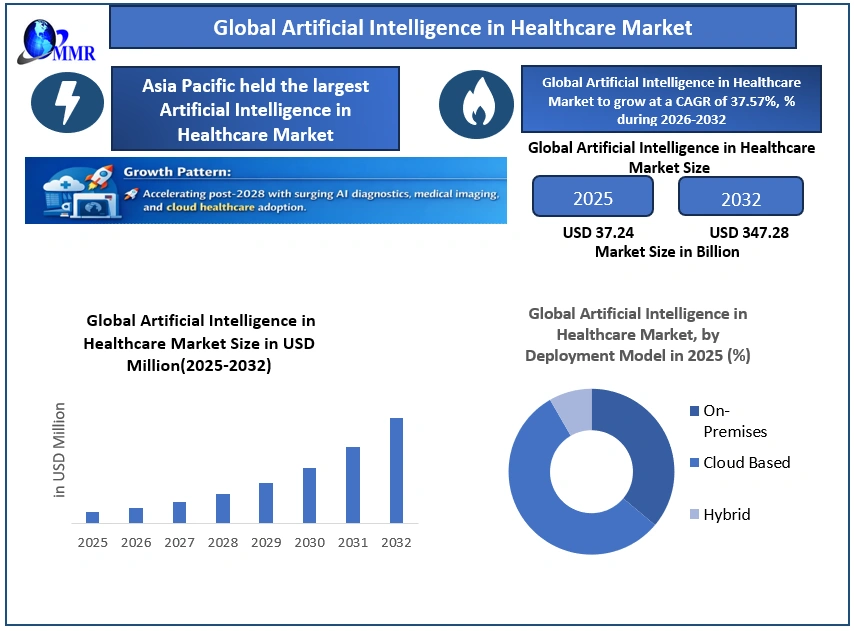
The Global Artificial Intelligence in Healthcare Market is projected to grow from USD 37.24 billion in 2025 to USD 347.28 billion by 2032, registering a CAGR of 37.57% during 2026–2032. This high-growth trajectory reflects the rapid expansion of AI applications beyond diagnostics into enterprise clinical workflows, population health analytics, administrative automation, and cloud-based healthcare intelligence platforms.Global Artificial Intelligence in Healthcare Market Overview
The Global Artificial Intelligence in Healthcare Market encompasses AI-powered software platforms, clinical decision-support tools, medical imaging analytics, predictive and prescriptive analytics solutions, and cloud-based AI services deployed across healthcare delivery, diagnostics, payer systems, and life sciences workflows. The market excludes standalone medical hardware but includes AI-enabled software integrated with imaging equipment, electronic health records (EHRs), and clinical information systems.To know about the Research Methodology :- Request Free Sample Report Artificial Intelligence in Healthcare is transforming care delivery by enabling faster diagnostics, precision medicine, workflow automation, and population-scale analytics. Market growth is supported by rising chronic disease burden, regulatory validation of AI medical devices, expanding digital health infrastructure, and increasing healthcare data availability. Large-scale adoption across hospitals, diagnostic centers, and public health programs is accelerating the transition from pilot deployments to enterprise-scale AI implementation.
Key Highlights :
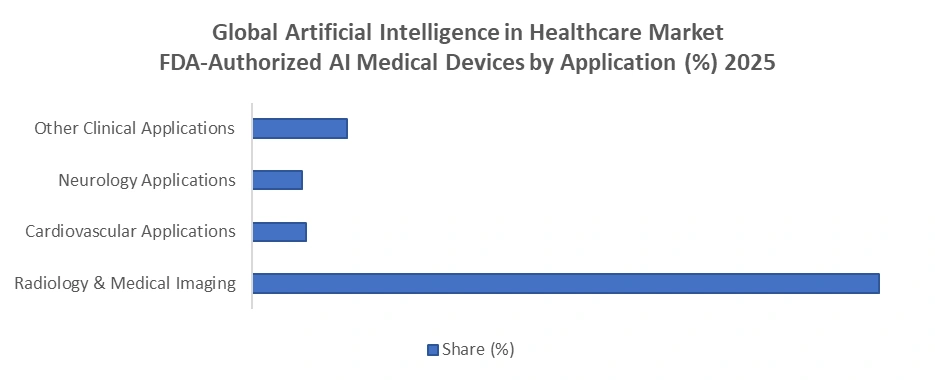
• Over 1,000 AI/ML-enabled medical devices have received U.S. FDA authorization, with approximately 76% concentrated in radiology and medical imaging, indicating strong regulatory acceptance and clinical maturity. • AI-powered diagnostics and imaging represent the largest and fastest-growing application segment, accounting for over 74% of AI device approvals in 2024, driven by expanding use in CT, MRI, X-ray, and mammography. • Noncommunicable diseases account for nearly 75% of global deaths, significantly increasing demand for AI-enabled early detection, screening optimization, and predictive risk analytics. • Asia Pacific is the fastest-growing region, led by India, where large-scale digital health infrastructure enables population-level AI deployment across diagnostics and public health programs. • Cloud-based deployment models dominate, accounting for over 60% of new AI healthcare implementations, driven by scalability, faster integration, and lower total cost of owners.
Global Artificial Intelligence in Healthcare Market Dynamics:
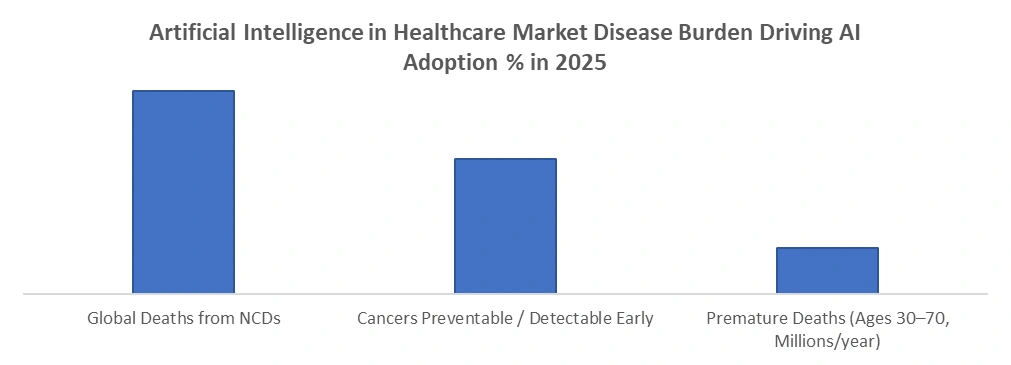
AI-Powered Diagnostics and Medical Imaging as the Primary Growth Engine AI-powered diagnostics and medical imaging are emerging as the primary growth engine of the Global Artificial Intelligence in Healthcare Market, driven by strong regulatory acceptance and accelerating clinical adoption. From a consulting standpoint, extensive regulatory validation has substantially lowered market entry risks, with over 1,000 AI/ML-enabled medical devices authorized in the United States, indicating increasing maturity of AI across clinical workflows. Medical imaging remains the dominant segment within the AI in Healthcare Market, accounting for nearly 76% of authorized AI devices across radiology applications such as X-ray, CT, MRI, ultrasound, and mammography. In 2024, 168 AI-enabled devices received authorization, with 74.4% focused on radiology, while cardiovascular and neurology applications, each representing around 6–7%, signal emerging secondary growth areas.Global Artificial Intelligence in Healthcare Market: Early Disease Detection Growth Early disease detection remains a critical demand driver as healthcare systems shift toward preventive and predictive care models. Noncommunicable diseases contribute to nearly 75% of global mortality, while 30–50% of cancers are preventable or detectable at early stages through systematic screening. AI-enabled screening tools improve diagnostic accuracy, throughput, and clinician productivity, particularly in high-volume imaging and pathology environments. Following a temporary decline during the COVID-19 pandemic, screening utilization rebounded strongly, reaching approximately 79–80% by 2023, reinforcing the role of AI in managing higher screening volumes and addressing workforce shortages.
Global AI in Healthcare Market: Asia Pacific Growth Driven by Scalable Digital Health Infrastructure Asia Pacific represents the fastest-growing regional market, with India emerging as a strategic deployment hub. Under the Ayushman Bharat Digital Mission (ABDM), India has created a large-scale, AI-ready healthcare data ecosystem, with over 799 million digital health IDs, 670 million linked health records, and extensive provider digitization. This government-backed digital infrastructure enables scalable deployment of AI diagnostics, population health analytics, and predictive care models, positioning India as a reference market for large-scale AI healthcare implementation in emerging economies. Data Privacy hamper Global AI in Healthcare Market:
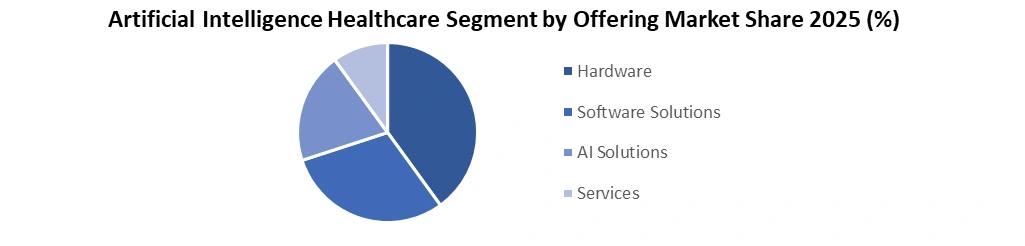
Artificial Intelligence Healthcare Segment Market Analysis: Cloud Deployment and AI Applications Driving Adoption AI in Healthcare Market shows software and AI platforms leading adoption, supported by machine learning frameworks, APIs, and clinical applications integrated with EHRs and imaging systems. GPUs and ASICs dominate hardware demand for imaging and deep learning workloads. Cloud-based deployment holds the largest AI in Healthcare Market share, with hybrid models rising for compliance-sensitive use cases. Diagnosis and early detection remain the leading application. Key players shaping the AI in Healthcare competitive landscape include Microsoft, NVIDIA, GE HealthCare, Siemens Healthiness, Philips, Oracle, Google Health, AWS, Medtronic, Qure.ai, and others.
Key Constraint Analyst Interpretation Market-Level Impact Health Data Classified as Highly Sensitive stringent classification of health data significantly raises compliance thresholds, making large-scale data aggregation for AI model training structurally complex and time-intensive. Slows innovation cycles and limits scalability of AI diagnostics across regions. Restrictions on Secondary Use of Health Records limited secondary use of electronic health records reduces dataset diversity, directly affecting the accuracy, generalizability, and clinical validation of AI healthcare models. Constrains advancement of predictive analytics and population-level AI applications. Fragmented Regulatory Implementation Across Regions Regulatory inconsistency across jurisdictions introduces legal uncertainty for multinational deployments, increasing operational risk for AI vendors and healthcare providers. Delays cross-border expansion and discourages uniform AI platform investments. Global AI in Healthcare Market: Recent Developments by Ethical and Regulatory Compliance . Stringent classification of health data as highly sensitive significantly increases compliance requirements, making large-scale data aggregation for AI model training complex and time-intensive. Restrictions on secondary use of health records reduce dataset diversity, impacting model generalizability and clinical validation. Additionally, fragmented regulatory implementation across regions introduces legal uncertainty, slowing multinational deployment and increasing operational risk for AI vendors.
Artificial Intelligence in Healthcare Market Scope: Inquiry Before Buying
Global Artificial Intelligence in Healthcare Market Report Coverage Details Base Year: 2025 Forecast Period: 2026-2032 Historical Data: 2020 to 2025 Market Size in 2025: USD 37.24 Bn. Forecast Period 2026 to 2032 CAGR: 37.57% Market Size in 2032: USD 347.28 Bn. Segments Covered: by Offering Hardware Processor MPU FPGA GPU ASIC Memory Network Adapter Interconnect Switch Software Solutions AI platform Application Programming Interfaces(API) Machine Learning Framework AI Solutions Clinical AI Solutions Operational & Administrative AI Solutions Research & Drug Development AI Solutions Services Deployment & Integration Support & Maintenance Others by Function Diagnosis & Early Disease Detection Treatment Planning &Personalization Post-Treatment Surveillance& Survivorship Care Pharmacy Management Data Management &Analytics by Deployment Model On-Premises Cloud Based Hybrid by Application Robot Assisted Surgery Virtual Assistants Administrative Workflow Assistants Connected Medical devices Medical Imaging & Diagnostics Clinical Trials Fraud Detection Others by Technology Machine Learning Deep learning Supervised Unsupervised Others Natural Language Processing Smart Assistance OCR (Optical Character Recognition) Medical Coding & Auto-Coding Text analytics Speech analytics Classification and categorization Context-Aware Computing Computer Vision by End User Healthcare providers Hospitals Clinics Diagnostic Centres Healthcare payers Healthcare companies Patients Others Artificial Intelligence in Healthcare Market, by Region
North America (United States, Canada, and Mexico) Europe (UK, France, Germany, Italy, Spain, Sweden, Austria, and the Rest of Europe) Asia Pacific (China, South Korea, Japan, India, Australia, ASEAN, Indonesia, Philippines, Malaysia, Vietnam, Thailand, ASEAN, Rest of Asia Pacific) Middle East & Africa (South Africa, GCC, Nigeria, Rest of ME&A) South America (Brazil, Argentina, Rest of South America)Global Artificial Intelligence in Healthcare Market, Key Players
1) Microsoft 2) Koninklijke Philips N.V. 3) Siemens Healthineers AG 4) Intel Corporation 5) NVIDIA Corporation 6) GE HealthCare Technologies Inc. 7) Medtronic 8) Micron Technology, Inc. 9) Oracle 10) Merative 11) General Vision, Inc. 12) CloudMedx 13) Oncora Medical 14) Lunit Inc. 15) Qure.ai 16) Tempus 17) Babylon Health 18) Stryker 19) Qventus 20) Google Health 21) Amazon Web Services (AWS) 22) BioSymetrics 23) Corti AI 24) Enlitic 25) OthersFAQs – Artificial Intelligence in Healthcare Market
1. What is driving the growth of Artificial Intelligence in Healthcare? The market is driven by rapid adoption of AI-powered diagnostics, medical imaging, predictive analytics, and cloud-based platforms, supported by regulatory approvals and the rising global burden of chronic diseases. 2. Which application dominates the AI in Healthcare Market? AI-powered diagnostics and medical imaging dominate the market, accounting for nearly 76% of FDA-authorized AI medical devices, particularly across radiology applications such as CT, MRI, and X-ray imaging. 3. Why is early disease detection a key driver for AI adoption? Early disease detection is critical as noncommunicable diseases cause nearly 75% of global deaths, and AI enables faster screening, predictive risk modeling, and improved clinical decision-making. 4. Which region is witnessing the fastest growth in AI healthcare adoption? Asia Pacific is the fastest-growing region, led by India, supported by over 799 million digital health IDs and more than 670 million linked health records enabling large-scale AI deployment. 5. What challenges limit AI adoption in healthcare? Stringent data privacy regulations such as GDPR and restricted cross-border health data sharing limit large-scale AI model training and slow adoption despite strong technological and clinical demand.
1. Global Artificial Intelligence in Healthcare Market Introduction 1.1. Study Assumption and Market Definition 1.2. Scope of the Study 1.3. Executive Summary 2. Global Artificial Intelligence in Healthcare Market: Competitive Landscape 2.1. MMR Competition Matrix 2.2. Key Players Benchmarking 2.2.1. Company Name 2.2.2. Headquarter 2.2.3. Product Segment 2.2.4. End-User Segment 2.2.5. Revenue Details in 2025 2.2.6. Market Share (%) 2.2.7. Growth Rate (%) 2.2.8. Return on Investment (%) 2.2.9. Technological Capabilities 2.2.10. Geographical Presence 2.3. Market Structure 2.3.1. Market Leaders 2.3.2. Market Followers 2.3.3. Emerging Players 2.4. Mergers and Acquisitions Details 3. Global Artificial Intelligence in Healthcare Market: Dynamics 3.1. Global Artificial Intelligence in Healthcare Market Trends 3.2. Global Artificial Intelligence in Healthcare Market Dynamics 3.2.1. Drivers 3.2.2. Restraints 3.2.3. Opportunities 3.2.4. Challenges 3.3. PORTER’s Five Forces Analysis 3.4. PESTLE Analysis 3.5. Regulatory Landscape by Region 3.6. Key Opinion Leader Analysis for the Global Industry 3.7. Analysis of Government Schemes and Initiatives for Industry 4. Regulatory, Ethical & Data Governance Landscape 4.1. Global Overview of AI-Related Healthcare Regulations 4.2. Patient Data Privacy, Security, and Consent Frameworks 4.3. Algorithm Transparency, Bias, and Explainable AI (XAI) 4.4. Regulatory Approval Pathways for AI-Based Medical Solutions 4.5. Future Regulatory Outlook and Compliance Risks 5. Investment & Funding Trends in AI in Healthcare 5.1. Global Investment Landscape and Funding Momentum 5.2. Venture Capital, Private Equity, and Strategic Investments 5.3. Funding Trends by Technology and Application 5.4. Regional Investment Hotspots and Deal Activity 5.5. Mergers, Acquisitions, and Strategic Partnerships 5.6. Investment Risks, Valuation Trends, and Exit Scenarios 6. Pricing, Commercial Models & ROI Analysis (2025) 6.1. AI Solution Pricing Models (Subscription, License, Usage-Based) 6.2. Cost of Implementation and Total Cost of Ownership (TCO) 6.3. ROI Assessment for Key AI Healthcare Use Cases 6.4. Reimbursement Impact and Monetization Challenges 6.5. Cost-Benefit Analysis Across End Users 7. Clinical Validation & Evidence Assessment 7.1. Clinical Accuracy, Sensitivity, and Specificity Benchmarks 7.2. Validation Methodologies for AI Models in Healthcare 7.3. Comparison of AI Performance vs. Conventional Clinical Practices 7.4. Real-World Evidence (RWE) and Post-Deployment Outcomes 7.5. Bias, Generalizability, and Clinical Limitations of AI Models 8. Healthcare Data Readiness & Interoperability Assessment 8.1. Healthcare Data Availability and Quality Assessment 8.2. Structured vs. Unstructured Data Readiness for AI 8.3. Interoperability Standards (HL7, FHIR, DICOM) 8.4. Data Integration Challenges Across Healthcare Systems 8.5. Data Readiness Gaps Impacting AI Performance 9. Organizational & Infrastructure Readiness for AI 9.1. Enterprise Architecture for AI-Enabled Healthcare 9.2. Cloud vs. On-Premises Infrastructure Readiness 9.3. Scalability, Latency, and Performance Requirements 9.4. Cybersecurity and Infrastructure Risk Considerations 10. Technology & Innovation Analysis 10.1. Evolution of AI Technologies in Healthcare 10.2. Machine Learning and Deep Learning Advancements 10.3. Role of NLP and Computer Vision in Clinical Workflows 10.4. Edge AI and Real-Time Decision-Making 10.5. Technology Readiness Levels and Innovation Maturity 11. Workforce Impact & Change Management 11.1. Impact of AI Adoption on Clinical and Administrative Roles 11.2. Physician Trust, Acceptance, and Human-in-the-Loop Models 11.3. Training, Upskilling, and Talent Requirements 11.4. Change Management Strategies for AI Implementation 11.5. Workforce Resistance and Adoption Challenges 12. Adoption & Maturity Analysis 12.1. AI Adoption Levels Across Healthcare Stakeholders 12.2. Maturity Curve from Pilot to Enterprise-Scale Deployment 12.3. Adoption Barriers and Readiness Gaps by End User 12.4. Regional and Country-Level Adoption Maturity 12.5. Buying Behaviour and Vendor Selection Criteria 13. Global Artificial Intelligence in Healthcare Market: Global Market Size and Forecast by Segmentation (by Value in USD Million) (2025-2032) 13.1. Global Artificial Intelligence in Healthcare Market Size and Forecast, By Offering (2025-2032) 13.1.1. Hardware 13.1.1.1. Processor 13.1.1.1.1. MPU (memory protection unit) 13.1.1.1.2. FPGA (Field-programmable gate array) 13.1.1.1.3. GPU (Graphics processing unit) 13.1.1.1.4. ASIC (Application-specific integrated circuit) 13.1.2. Memory 13.1.3. Network 13.1.3.1. Adapter 13.1.3.2. Interconnect 13.1.3.3. Switch 13.1.4. Software Solutions 13.1.4.1. AI platform 13.1.4.1.1. Application Programming Interfaces (API) 13.1.4.1.2. Machine Learning Framework 13.1.4.2. AI Solutions 13.1.4.2.1. Clinical AI Solutions 13.1.4.2.2. Operational & Administrative AI Solutions 13.1.4.2.3. Research & Drug Development AI Solutions 13.1.5. Services 13.1.5.1. Deployment & Integration 13.1.5.2. Support & Maintenance 13.1.5.3. Others 13.2. Global Artificial Intelligence in Healthcare Market Size and Forecast, By Deployment Model (2025-2032) 13.2.1. On-Premises 13.2.2. Cloud Based 13.2.3. Hybrid 13.3. Global Artificial Intelligence in Healthcare Market Size and Forecast, By Function (2025-2032) 13.3.1. Diagnosis & Early Disease Detection 13.3.2. Treatment Planning & Personalization 13.3.3. Post-Treatment Surveillance & Survivorship Care 13.3.4. Pharmacy Management 13.3.5. Data Management & Analytics 13.4. Global Artificial Intelligence in Healthcare Market Size and Forecast, By Technology (2025-2032) 13.4.1. Machine Learning 13.4.1.1. Deep learning 13.4.1.2. Supervised 13.4.1.3. Unsupervised 13.4.1.4. Others 13.4.2. Natural Language Processing 13.4.2.1. Smart Assistance 13.4.2.2. OCR (Optical Character Recognition) 13.4.2.3. Medical Coding & Auto-Coding 13.4.2.4. Text analytics 13.4.2.5. Speech analytics 13.4.2.6. Classification and categorization 13.4.3. Context-Aware Computing 13.4.4. Computer Vision 13.5. Global Artificial Intelligence in Healthcare Market Size and Forecast, By Application (2025-2032) 13.5.1. Robot Assisted Surgery 13.5.2. Virtual Assistants 13.5.3. Administrative Workflow Assistants 13.5.4. Connected Medical devices 13.5.5. Medical Imaging & Diagnostics 13.5.6. Clinical Trials 13.5.7. Fraud Detection 13.5.8. Others 13.6. Global Artificial Intelligence in Healthcare Market Size and Forecast, By End-User (2025-2032) 13.6.1. Healthcare providers 13.6.1.1. Hospitals 13.6.1.2. Clinics 13.6.1.3. Diagnostic Centres 13.6.2. Healthcare payers 13.6.3. Healthcare companies 13.6.4. Patients 13.6.5. Others 13.7. Global Artificial Intelligence in Healthcare Market Size and Forecast, By Region (2025-2032) 13.7.1. North America 13.7.2. Europe 13.7.3. Asia Pacific 13.7.4. Middle East and Africa 13.7.5. South America 14. North America Artificial Intelligence in Healthcare Market Size and Forecast by Segmentation (by Value in USD Million) (2025-2032) 14.1. Global Artificial Intelligence in Healthcare Market Size and Forecast, By Offering (2025-2032) 14.1.1. Hardware 14.1.1.1. Processor 14.1.1.1.1. MPU (memory protection unit) 14.1.1.1.2. FPGA (Field-programmable gate array) 14.1.1.1.3. GPU (Graphics processing unit) 14.1.1.1.4. ASIC (Application-specific integrated circuit) 14.1.1.2. Memory 14.1.1.3. Network 14.1.1.3.1. Adapter 14.1.1.3.2. Interconnect 14.1.1.3.3. Switch 14.1.2. Software Solutions 14.1.2.1. AI platform 14.1.2.1.1. Application Programming Interfaces (API) 14.1.2.1.2. Machine Learning Framework 14.1.2.2. AI Solutions 14.1.2.2.1. Clinical AI Solutions 14.1.2.2.2. Operational & Administrative AI Solutions 14.1.2.2.3. Research & Drug Development AI Solutions 14.1.3. Services 14.1.3.1. Deployment & Integration 14.1.3.2. Support & Maintenance 14.1.3.3. Others 14.2. Global Artificial Intelligence in Healthcare Market Size and Forecast, By Deployment Model (2025-2032) 14.2.1. On-Premises 14.2.2. Cloud Based 14.2.3. Hybrid 14.3. Global Artificial Intelligence in Healthcare Market Size and Forecast, By Function (2025-2032) 14.3.1. Diagnosis & Early Disease Detection 14.3.2. Treatment Planning & Personalization 14.3.3. Post-Treatment Surveillance & Survivorship Care 14.3.4. Pharmacy Management 14.3.5. Data Management & Analytics 14.4. Global Artificial Intelligence in Healthcare Market Size and Forecast, By Technology (2025-2032) 14.4.1. Machine Learning 14.4.1.1. Deep learning 14.4.1.2. Supervised 14.4.1.3. Unsupervised 14.4.1.4. Others 14.4.2. Natural Language Processing 14.4.2.1. Smart Assistance 14.4.2.2. OCR (Optical Character Recognition) 14.4.2.3. Medical Coding & Auto-Coding 14.4.2.4. Text analytics 14.4.2.5. Speech analytics 14.4.2.6. Classification and categorization 14.4.3. Context-Aware Computing 14.4.4. Computer Vision 14.5. Global Artificial Intelligence in Healthcare Market Size and Forecast, By Application (2025-2032) 14.5.1. Robot Assisted Surgery 14.5.2. Virtual Assistants 14.5.3. Administrative Workflow Assistants 14.5.4. Connected Medical devices 14.5.5. Medical Imaging & Diagnostics 14.5.6. Clinical Trials 14.5.7. Fraud Detection 14.5.8. Others 14.6. Global Artificial Intelligence in Healthcare Market Size and Forecast, By End-User (2025-2032) 14.6.1. Healthcare providers 14.6.1.1. Hospitals 14.6.1.2. Clinics 14.6.1.3. Diagnostic Centres 14.6.2. Healthcare payers 14.6.3. Healthcare companies 14.6.4. Patients 14.6.5. Others 14.7. Global Artificial Intelligence in Healthcare Market Size and Forecast, By Region (2025-2032) 14.7.1. North America 14.7.2. Europe 14.7.3. Asia Pacific 14.7.4. Middle East and Africa 14.7.5. South America 15. North America Artificial Intelligence in Healthcare Market Size and Forecast by Segmentation (by Value in USD Million) (2025-2032) 15.1. North America Artificial Intelligence in Healthcare Market Size and Forecast, By Offering (2025-2032) 15.2. North America Artificial Intelligence in Healthcare Market Size and Forecast, By Deployment Model (2025-2032) 15.3. North America Artificial Intelligence in Healthcare Market Size and Forecast, By Function (2025-2032) 15.4. North America Artificial Intelligence in Healthcare Market Size and Forecast, By Technology (2025-2032) 15.5. North America Artificial Intelligence in Healthcare Market Size and Forecast, By Application (2025-2032) 15.6. North America Artificial Intelligence in Healthcare Market Size and Forecast, By End-User (2025-2032) 16. Europe Artificial Intelligence in Healthcare Market Size and Forecast by Segmentation (by Value in USD Million) (2025-2032) 16.1. Europe Artificial Intelligence in Healthcare Market Size and Forecast, By Offering (2025-2032) 16.2. Europe Artificial Intelligence in Healthcare Market Size and Forecast, By Deployment Model (2025-2032) 16.3. Europe Artificial Intelligence in Healthcare Market Size and Forecast, By Function (2025-2032) 16.4. Europe Artificial Intelligence in Healthcare Market Size and Forecast, By Technology (2025-2032) 16.5. Europe Artificial Intelligence in Healthcare Market Size and Forecast, By Application (2025-2032) 16.6. Europe Artificial Intelligence in Healthcare Market Size and Forecast, By End-User (2025-2032) 16.7. Europe Artificial Intelligence in Healthcare Market Size and Forecast, by Country (2025-2032) 16.7.1. United Kingdom 16.7.2. France 16.7.3. Germany 16.7.4. Italy 16.7.5. Spain 16.7.6. Sweden 16.7.7. Russia 16.7.8. Rest of Europe 17. Asia Pacific Artificial Intelligence in Healthcare Market Size and Forecast by Segmentation (by Value in USD Million) (2025-2032) 17.1. Asia Pacific Artificial Intelligence in Healthcare Market Size and Forecast, By Offering (2025-2032) 17.2. Asia Pacific Artificial Intelligence in Healthcare Market Size and Forecast, By Deployment Model (2025-2032) 17.3. Asia Pacific Artificial Intelligence in Healthcare Market Size and Forecast, By Function (2025-2032) 17.4. Asia Pacific Artificial Intelligence in Healthcare Market Size and Forecast, By Technology (2025-2032) 17.5. Asia Pacific Artificial Intelligence in Healthcare Market Size and Forecast, By Application (2025-2032) 17.6. Asia Pacific Artificial Intelligence in Healthcare Market Size and Forecast, By End-User (2025-2032) 17.7. Asia Pacific Artificial Intelligence in Healthcare Market Size and Forecast, by Country (2025-2032) 17.7.1. China 17.7.2. S Korea 17.7.3. Japan 17.7.4. India 17.7.5. Australia 17.7.6. Indonesia 17.7.7. Malaysia 17.7.8. Philippines 17.7.9. Thailand 17.7.10. Vietnam 17.7.11. Rest of Asia Pacific 18. Middle East and Africa Global Artificial Intelligence in Healthcare Market Size and Forecast (by Value in USD Million) (2025-2032) 18.1. Middle East and Africa Artificial Intelligence in Healthcare Market Size and Forecast, By Offering (2025-2032) 18.2. Middle East and Africa Artificial Intelligence in Healthcare Market Size and Forecast, By Deployment Model (2025-2032) 18.3. Middle East and Africa Artificial Intelligence in Healthcare Market Size and Forecast, By Function (2025-2032) 18.4. Middle East and Africa Artificial Intelligence in Healthcare Market Size and Forecast, By Technology (2025-2032) 18.5. Middle East and Africa Artificial Intelligence in Healthcare Market Size and Forecast, By Application (2025-2032) 18.6. Middle East and Africa Artificial Intelligence in Healthcare Market Size and Forecast, By End-User (2025-2032) 18.7. Middle East and Africa Artificial Intelligence in Healthcare Market Size and Forecast, by Country (2025-2032) 18.7.1. South Africa 18.7.2. GCC 18.7.3. Egypt 18.7.4. Nigeria 18.7.5. Rest of ME&A 19. South America Artificial Intelligence in Healthcare Market Size and Forecast by Segmentation (by Value in USD Million) (2025-2032) 19.1. South America Artificial Intelligence in Healthcare Market Size and Forecast, By Offering (2025-2032) 19.2. South America Artificial Intelligence in Healthcare Market Size and Forecast, By Deployment Model (2025-2032) 19.3. South America Artificial Intelligence in Healthcare Market Size and Forecast, By Function (2025-2032) 19.4. South America Artificial Intelligence in Healthcare Market Size and Forecast, By Technology (2025-2032) 19.5. South America Artificial Intelligence in Healthcare Market Size and Forecast, By Application (2025-2032) 19.6. South America Artificial Intelligence in Healthcare Market Size and Forecast, By End-User (2025-2032) 19.7. South America Artificial Intelligence in Healthcare Market Size and Forecast, by Country (2025-2032) 19.7.1. Brazil 19.7.2. Argentina 19.7.3. Colombia 19.7.4. Chile 19.7.5. Rest Of South America 20. Company Profile: Key Players 20.1. Microsoft 20.1.1. Company Overview 20.1.2. Business Portfolio 20.1.3. Financial Overview 20.1.4. SWOT Analysis 20.1.5. Strategic Analysis 20.1.6. Recent Development 20.2. Koninklijke Philips N.V. 20.3. Siemens Healthineers AG 20.4. Intel Corporation 20.5. NVIDIA Corporation 20.6. GE HealthCare Technologies Inc. 20.7. Medtronic 20.8. Micron Technology, Inc. 20.9. Oracle 20.10. Merative 20.11. General Vision, Inc. 20.12. CloudMedx 20.13. Oncora Medical 20.14. Lunit Inc. 20.15. Qure.ai 20.16. Tempus 20.17. Babylon Health 20.18. Stryker 20.19. Qventus 20.20. Google Health 20.21. Amazon Web Services (AWS) 20.22. BioSymetrics 20.23. Corti AI 20.24. Enlitic 21. Key Findings 22. Analyst Recommendations 23. Global Artificial Intelligence in Healthcare Market: Research Methodology