
Global Data Center Networking Market Size by Deployment Type, by Solution Type, by Product, by Service Type, by Organization Size, by Region and Forecast 2034
Overview
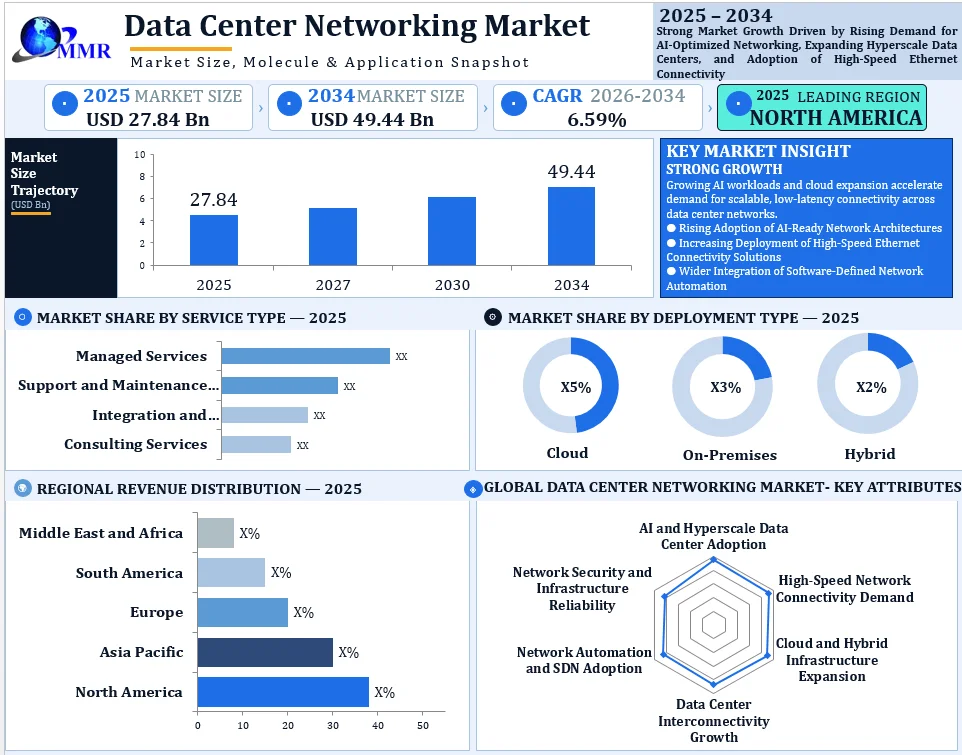
Global Data Center Networking Market is valued at USD 27.84 Bn in 2025 and is expected to reach USD 49.44 Bn by 2034, growing at a CAGR of 6.59% during the forecast period.
Global Data Center Networking Market Overview
The Global Data Center Networking Market comprises hardware, software, and services that enable high-speed, secure, and reliable communication between servers, storage systems, and computing resources within and across data centers. The infrastructure includes Ethernet switches, routers, network interface cards (NICs), firewalls, gateways, and network management software, which support efficient data transmission, traffic management, and network connectivity.
The growing adoption of cloud computing, artificial intelligence (AI), machine learning (ML), big data analytics, and virtualization increases the demand for advanced data center networking solutions. The expansion of hyperscale data centers, public and private cloud infrastructure, and edge computing increases the need for high-bandwidth, low-latency, and scalable network infrastructure. Additionally, technologies such as software-defined networking (SDN), network function virtualization (NFV), network automation, and leaf-spine architecture improve network flexibility, performance, and resource utilization.
Global Data Center Networking Market Growth and Share Analysis
To know about the Research Methodology :- Request Free Sample Report
Key Highlights – Global Data Center Networking Market
• The Global Data Center Networking Market is valued at USD 27.84 billion in 2025 and is projected to reach USD 49.44 billion by 2034, registering a CAGR of 6.59% during 2026–2034.
• North America dominates the market, supported by hyperscale data center expansion, advanced IT infrastructure, and investments in AI and cloud computing.
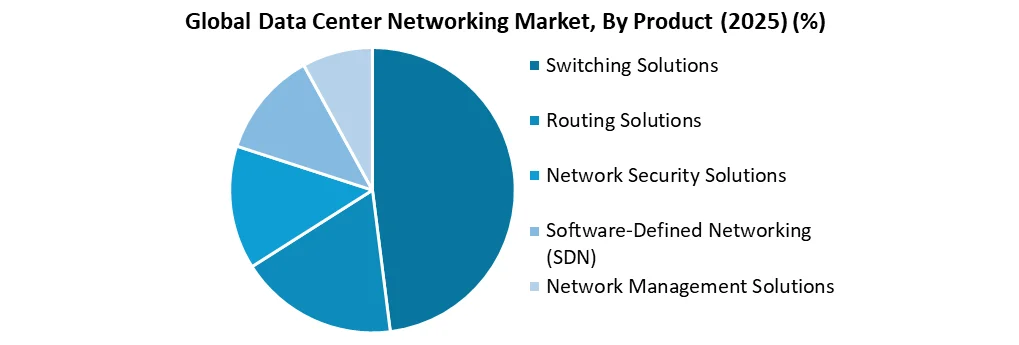
• Switching Solutions represent a significant product segment as demand for high-speed Ethernet connectivity, 400G and 800G networking, and efficient data center traffic management increases.
• The growing adoption of AI, cloud computing, machine learning, and high-performance computing drives demand for low-latency, high-bandwidth, and scalable networking infrastructure.
• AI-optimized data center interconnectivity, software-defined networking (SDN), and network automation create significant opportunities for market participants, while infrastructure costs and cybersecurity risks remain key challenges.
Data Center Networking Market Scope and Research Methodology
The report covers market trends, major segments, significant investment pockets, value chains, regional landscape and competitive environment in depth. The study is a useful source of information for major market players, new entrants, investors, and stakeholders in developing future plans and actions taken to consolidate their market position. The report majorly focuses on the key drivers and challenges, which guide investors about future market trends. The report provides an in-depth analysis of the data center networking companies including detailed profiles and financial performance in the industry. The analysis of the market dynamics provided in the report is based on local, regional and global levels. SWOT analysis was conducted to present strengths, weaknesses, opportunities and threats of Data Center Networking competitors in the industry. A bottom-up approach was used to estimate the market Data Center Networking Market size.
Data Center Networking Market Dynamics
Global Data Center Networking Market Drivers
Growing Adoption of Artificial Intelligence and Hyperscale Data Centers
The increasing adoption of artificial intelligence (AI), machine learning (ML), cloud computing, and high-performance computing (HPC) drives demand for advanced data center networking infrastructure. AI workloads require high-bandwidth, low-latency connectivity to facilitate communication between GPUs, servers, and storage systems. According to the International Energy Agency (IEA), global data center electricity consumption increases by 17% in 2025, while consumption from AI-focused data centers grows by 50%. This expansion in computing infrastructure increases the requirement for high-speed Ethernet switches, network interface cards, routers, and advanced interconnect solutions.
Increasing Demand for High-Speed Network Connectivity
The growing volume of enterprise data, cloud applications, and distributed workloads increases the need for high-speed network connectivity and efficient traffic management. Organizations increasingly adopt 400G and 800G Ethernet, InfiniBand, and leaf-spine network architectures to improve bandwidth capacity and reduce network congestion. According to IDC, data center Ethernet switch revenue grows by 43.4% year-over-year in Q2 2026, while 800G ports account for 41.2% of data center Ethernet switch revenue. This increasing adoption of high-speed networking technologies strengthens demand for advanced data center networking solutions.
Global Data Center Networking Market Restraints
High Infrastructure Deployment and Operational Costs
The deployment of advanced data center networking infrastructure requires substantial investments in high-performance switches, routers, optical transceivers, network controllers, and supporting infrastructure. The integration of 400G and 800G Ethernet, AI networking fabrics, and advanced optical connectivity further increases equipment and implementation expenses. Smaller enterprises and organizations with limited IT budgets face financial constraints when upgrading existing network infrastructure. Additionally, ongoing expenses related to maintenance, energy consumption, software licensing, and network administration restrict adoption, particularly among cost-sensitive businesses.
Complexity of Network Integration and Infrastructure Modernization
Integrating modern networking technologies into existing data center environments creates operational and technical difficulties. Enterprises often operate legacy networking equipment alongside newer cloud-native and software-defined infrastructure, which increases configuration and compatibility requirements. Integrating software-defined networking (SDN), network function virtualization (NFV), and automated network management systems requires specialized expertise and infrastructure modifications. These complexities increase migration costs, create operational disruptions, and slow the adoption of advanced networking solutions.
Global Data Center Networking Market Opportunities
Expansion of AI-Optimized Data Center Interconnectivity
The rapid expansion of AI infrastructure creates significant opportunities for high-speed data center interconnect (DCI), optical networking, and low-latency Ethernet solutions. AI model training and distributed computing require continuous data exchange between geographically distributed data centers and interconnected GPU clusters. According to a Ciena-commissioned global survey of more than 1,300 data center decision-makers across 13 countries, respondents anticipate at least a sixfold increase in data center interconnect bandwidth demand over five years, while 43% of new data center facilities are expected to support AI workloads. This trend creates opportunities for advanced optical transport, high-capacity switching, and scalable connectivity solutions.
Growing Adoption of Software-Defined Networking and Network Automation
The increasing need for flexible, scalable, and centrally managed infrastructure creates opportunities for software-defined networking (SDN), network automation, and AI-driven network management. These technologies enable enterprises to automate network configuration, optimize traffic distribution, improve resource utilization, and monitor network performance in real time. The expansion of hybrid cloud, multi-cloud environments, and edge computing further increases the requirement for programmable networking solutions that support seamless connectivity across distributed IT infrastructure.
Global Data Center Networking Market Challenges
Increasing Cybersecurity Threats and Network Vulnerabilities
The growing interconnection of servers, cloud platforms, applications, and external networks increases the exposure of data center infrastructure to cyberattacks. Threats such as distributed denial-of-service (DDoS) attacks, ransomware, unauthorized access, and lateral network movement create security risks for enterprise data and critical applications. Maintaining network segmentation, zero-trust security, encryption, firewalls, and continuous threat monitoring across complex networking environments remains a major challenge for data center operators.
Managing Network Performance and Scalability for Complex Workloads
Managing network traffic across large-scale data centers becomes increasingly challenging as AI training, real-time analytics, and distributed computing workloads generate intensive east-west data flows between interconnected servers. Network congestion, latency, packet loss, and bandwidth limitations affect application performance and resource utilization. Maintaining consistent network performance while expanding infrastructure requires continuous capacity planning, efficient traffic management, and advanced monitoring solutions. The challenge becomes more significant as organizations deploy larger GPU clusters and increasingly distributed computing environments.
Data Center Networking Market Segment
By Deployment Type
The market is segmented into On-Premises, Cloud, and Hybrid. On-Premises deployment holds a significant position as enterprises maintain direct control over their networking infrastructure, data security, network configurations, and internal IT resources. This deployment model supports organizations with strict data governance, regulatory, and performance requirements. Cloud deployment gains traction as businesses increasingly adopt cloud computing, hyperscale infrastructure, and virtualized networking solutions to achieve scalability, flexibility, and reduced infrastructure management requirements. Hybrid deployment supports organizations that combine on-premises infrastructure with public and private cloud environments, enabling flexible workload distribution, centralized management, and seamless connectivity across different IT environments.
By Product
The market includes Switching Solutions, Routing Solutions, Network Security Solutions, Software-Defined Networking (SDN), and Network Management Solutions. Switching Solutions account for a significant share of demand as data centers require high-speed communication between servers, storage systems, and computing resources. Increasing adoption of high-bandwidth Ethernet switches and leaf-spine architectures supports efficient east-west traffic management. Routing Solutions enable communication between different networks and data center environments while supporting traffic optimization and external connectivity. Network Security Solutions gain importance as organizations prioritize firewall protection, network segmentation, intrusion detection, and secure data transmission. Software-Defined Networking (SDN) improves network programmability, centralized control, and automation, allowing enterprises to manage complex networking environments efficiently. Network Management Solutions support real-time monitoring, performance optimization, configuration management, and troubleshooting across interconnected data center infrastructure.
By Service Type
The market is segmented into Consulting Services, Integration and Deployment Services, Support and Maintenance Services, and Managed Services. Consulting Services support organizations in network architecture planning, infrastructure assessment, technology selection, and capacity optimization. Integration and Deployment Services address the installation, configuration, and integration of networking hardware and software with existing data center infrastructure, including cloud and virtualization environments. Support and Maintenance Services ensure network reliability through equipment upgrades, software updates, troubleshooting, and preventive maintenance. Managed Services gain adoption as enterprises outsource network monitoring, administration, security management, and performance optimization to specialized service providers, allowing internal IT teams to focus on core business operations.
Global Data Center Networking Market: Regional Insights
North America dominates the global data center networking market, supported by the strong presence of hyperscale cloud providers, advanced IT infrastructure, and substantial investments in artificial intelligence (AI) and cloud computing. The United States drives regional demand through the expansion of hyperscale data centers, enterprise cloud infrastructure, and high-performance computing facilities. According to CBRE, North America records a 43% year-over-year increase in data center inventory in Q1 2025, reflecting strong infrastructure expansion. The growing deployment of 400G and 800G Ethernet switches, high-speed routers, software-defined networking (SDN), and data center interconnect (DCI) strengthens regional demand. Canada also contributes through investments in colocation facilities, cloud infrastructure, and enterprise digital transformation.
Asia Pacific represents a rapidly expanding regional market, driven by increasing digitalization, cloud adoption, AI infrastructure investments, and growing demand for hyperscale data centers. China, Japan, India, Singapore, and Australia contribute to regional development through investments in cloud computing, telecommunications infrastructure, and enterprise networking. According to McKinsey, China accounts for 20 GW of installed hyperscaler and colocation data center capacity in 2025, while Singapore accounts for 1.4 GW. The expansion of AI-ready data centers, high-speed Ethernet connectivity, optical networking, and hybrid cloud infrastructure increases demand for scalable networking solutions. India also supports regional growth through expanding digital infrastructure, data localization requirements, and increasing enterprise adoption of cloud services.
Europe maintains a significant position in the global data center networking market, supported by increasing cloud adoption, enterprise digitalization, and investments in secure data infrastructure. The United Kingdom, Germany, France, and the Netherlands represent important data center hubs, with demand driven by financial services, telecommunications, manufacturing, and technology enterprises. According to CBRE, data center inventory across London's, Frankfurt's, Paris's, and Amsterdam's four major markets increases by 7.2% year-over-year in 2025. Growing emphasis on data sovereignty, cybersecurity, energy-efficient networking, and hybrid cloud connectivity encourages enterprises to modernize their networking infrastructure. Additionally, investments in AI computing and high-capacity optical networks strengthen demand for advanced data center networking solutions.
South America experiences increasing demand for data center networking solutions as cloud computing adoption, digital transformation, and telecommunications investments expand across the region. Brazil, Mexico, Chile, and Colombia contribute to market development through colocation facilities, enterprise IT modernization, and growing digital service requirements. Brazil represents a major regional hub, supported by expanding cloud infrastructure and investments in hyperscale data centers. According to CBRE, data center inventory across the four largest Latin American markets increases by 13.7% year-over-year in Q1 2025, with Santiago recording 23% growth. Increasing demand for network switches, routing solutions, data center interconnectivity, and network security infrastructure supports regional market expansion.
The Middle East and Africa market develops through increasing investments in digital infrastructure, cloud computing, smart city projects, and enterprise connectivity. The United Arab Emirates, Saudi Arabia, and South Africa represent important markets as governments and private enterprises expand hyperscale data centers, telecommunications networks, and digital services. Investments in AI infrastructure and national digital transformation initiatives increase demand for high-speed networking equipment, network security solutions, cloud connectivity, and data center management platforms. Additionally, the expansion of colocation facilities and regional cloud availability zones supports the adoption of scalable networking infrastructure. Growing requirements for data localization, cybersecurity, and reliable interconnectivity further strengthen regional demand.
Global Data Center Networking Market: Competitive Landscape
The Global Data Center Networking Market exhibits strong competition, with established networking equipment manufacturers, cloud infrastructure providers, and semiconductor companies competing through product innovation, technological advancements, strategic partnerships, and portfolio expansion. Key players focus on developing high-performance Ethernet switches, advanced routing solutions, network security platforms, and software-defined networking technologies to address the growing requirements of hyperscale data centers and AI-driven workloads.
Cisco Systems, Inc. maintains a strong competitive position through its Nexus 9000 series switches, data center routing solutions, network security technologies, and software-based network management platforms. The company focuses on AI-ready networking infrastructure and strengthens its ecosystem through collaboration with NVIDIA. Arista Networks, Inc. differentiates its portfolio through high-performance Ethernet switching, cloud networking, and its Extensible Operating System (EOS), targeting hyperscale cloud providers and large enterprise data centers. NVIDIA Corporation strengthens its position through Spectrum-X Ethernet networking, InfiniBand solutions, BlueField data processing units (DPUs), and high-speed interconnect technologies designed for AI and GPU-intensive workloads.
Hewlett Packard Enterprise (HPE) competes through its data center networking portfolio, combining switching, routing, automation, and cloud-native network management capabilities. Its acquisition of Juniper Networks in July 2025 strengthens its networking portfolio through Juniper's switching, routing, and Mist AI-driven networking technologies. Huawei Technologies Co., Ltd. maintains a strong presence through its CloudEngine switching platforms, data center routers, and intelligent network management solutions, particularly across Asian markets. Dell Technologies, Inc. focuses on integrated data center infrastructure through its PowerSwitch networking portfolio, supporting enterprise servers, storage systems, and cloud environments.
Other significant participants include Broadcom Inc., Extreme Networks, Inc., Fortinet, Inc., Intel Corporation, Nokia Corporation, and ZTE Corporation. Broadcom strengthens the networking ecosystem through switching silicon and Ethernet ASIC technologies, while Extreme Networks focuses on enterprise switching and network management. Fortinet emphasizes network security and integrated protection solutions, whereas Intel supports networking infrastructure through Ethernet controllers and connectivity technologies. These companies compete through performance optimization, security capabilities, interoperability, automation, and scalable infrastructure solutions.
Overall, competitive positioning increasingly depends on AI-optimized networking, 400G and 800G Ethernet adoption, low-latency connectivity, software-defined networking, network automation, and integrated security solutions. Strategic collaborations, acquisitions, product development, and investments in next-generation networking technologies remain important competitive strategies as vendors address the evolving requirements of hyperscale, enterprise, and cloud data center operators.
Recent Developments in the Global Data Center Networking Market
| Date | Company | Development | Impact |
|---|---|---|---|
| October 12, 2026 | Cisco Systems, Inc. and NVIDIA Corporation | Cisco and NVIDIA introduce the Ultra-Dense Small Form Factor Pluggable (USFP), a next-generation optical module designed to support 400 Gb/s-per-lane signals and up to 12.8 Tb/s capacity. |
The development supports higher bandwidth density and improved power efficiency for large-scale AI data center networks. |
| October 8, 2026 | Broadcom Inc. | Broadcom announces its latest AI networking technologies for OCP 2026, including Tomahawk 6, Tomahawk Ultra, Jericho 4 Ethernet switches, and advanced optical interconnect solutions. |
The expanded portfolio strengthens high-bandwidth Ethernet connectivity and supports scalable networking architectures for large AI clusters. |
| October 7, 2026 | Arista Networks, Inc. | Arista announces open Ethernet rack-scale architectures for scale-up and scale-out AI fabrics, developed with AMD, Arm, Broadcom, Meta, Microsoft, and Qualcomm. |
The initiative advances open, standards-based networking and supports high-density AI infrastructure with improved flexibility and scalability. |
| September 2, 2026 | Hewlett Packard Enterprise (HPE) | HPE expands its collaboration with Oracle to deploy HPE Juniper Networking routing and switching platforms across Oracle's global AI data centers. |
The collaboration strengthens AI data center connectivity through high-performance switching, routing, congestion management, and network monitoring capabilities. |
| August 25, 2026 | Cisco Systems, Inc. | Cisco expands its Secure AI Factory architecture with NVIDIA and Supermicro, combining AI networking systems with high-density computing infrastructure. |
The integrated architecture supports large AI workloads across enterprise, neocloud, and sovereign cloud environments while improving deployment efficiency and network security. |
| July 21, 2026 | NVIDIA Corporation | NVIDIA introduces Spectrum-6, a 102.4 Tb/s Ethernet switch system designed for its next-generation Spectrum-X networking platform and gigascale AI factories. |
The technology increases network capacity and supports high-performance, low-latency connectivity for data centers operating large GPU clusters. |
Global Data Center Networking Market Scope: Inquiry Before Buying
| Data Center Networking Market | |||
|---|---|---|---|
| Report Coverage | Details | ||
| Base Year: | 2025 | Forecast Period: | 2026-2034 |
| Historical Data: | 2020 to 2025 | Market Size in 2025: | 27.84 USD Bn |
| Forecast Period 2026-2034 CAGR: | 6.59% | Market Size in 2034: | 49.44 USD Bn |
| Segments Covered: | By Deployment Type | On-Premises Cloud Hybrid |
|
| By Solution Type | Active Fire Protection System Passive Fire Protection System |
||
| by Product | Switching Solutions Routing Solutions Network Security Solutions Software-Defined Networking (SDN) Network Management Solutions |
||
| By Service Type | Consulting Services Integration and Deployment Services Support and Maintenance Services Managed Services |
||
| By Organization Size | Large Enterprises Small and Medium Enterprises (SMEs) |
||
Data Center Networking Market, by Region
North America (United States, Canada and Mexico)
Europe (UK, France, Germany, Italy, Spain, Sweden, Austria and Rest of Europe)
Asia Pacific (China, South Korea, Japan, India, Australia, Indonesia, Malaysia, Vietnam, Taiwan, Bangladesh, Pakistan and Rest of APAC)
Middle East and Africa (South Africa, GCC, Egypt, Nigeria and Rest of ME&A)
South America (Brazil, Argentina Rest of South America)
Global Data Center Networking Market Key Players
1. Broadcom Inc.
2. Cisco Systems, Inc.
3. Dell Technologies Inc.
4. Hewlett Packard Enterprise (HPE)
5. Lenovo Group Limited
6. International Business Machines Corporation (IBM)
7. Intel Corporation
8. Microsoft Corporation
9. Oracle Corporation
10. Huawei Technologies Co., Ltd.
11. Fujitsu Limited
12. Alcatel-Lucent Enterprise
13. Console Connect
14. Arista Networks, Inc.
15. Ciena Corporation
16. Extreme Networks, Inc.
17. Nokia Corporation
18. NetApp, Inc.
19. Palo Alto Networks, Inc.
20. Cloudflare, Inc.
21. Fortinet, Inc.
22. NVIDIA Corporation
23. Super Micro Computer, Inc.
24. ZTE Corporation
25. NEC Corporation
26. F5, Inc.
27. Check Point Software Technologies Ltd.
28. Edgecore Networks Corporation
29. Celestica Inc.
30. Accton Technology Corporation
31. Micas Networks, Inc.
32. Ruijie Networks Co., Ltd.
33. New H3C Technologies Co., Ltd.
34. Adtran Holdings, Inc.
35. Ribbon Communications Inc.
36. Telefonaktiebolaget LM Ericsson
37. Samsung Electronics Co., Ltd.
38. Tejas Networks Limited
39. MRO-TEK Realty Limited
40. Ubiquiti Inc.
41. MikroTik
42. TP-Link Corporation Limited
43. D-Link Corporation
44. Calix, Inc.
45. NETGEAR, Inc.
46. A10 Networks, Inc.
47. Radware Ltd.
48. Marvell Technology, Inc.
49. DriveNets Ltd.
50. Versa Networks, Inc.
Frequently Asked Questions
1. What is the global data center networking market size in 2025?
The global data center networking market is valued at USD 27.84 billion in 2025.
2. What is the expected CAGR of the data center networking market during 2026–2034?
The market is projected to grow at a CAGR of 6.59% during the forecast period.
3. What is the projected market size of the data center networking market by 2034?
The global data center networking market is expected to reach USD 49.44 billion by 2034.
4. Which region dominates the global data center networking market?
North America dominates the market due to hyperscale data center expansion and increasing investments in AI and cloud infrastructure.
5. What are the key factors driving the data center networking market?
The key growth drivers include increasing adoption of AI, cloud computing, high-performance computing, 400G and 800G Ethernet, and hyperscale data centers.